What Was Meant to Last | The Solstice Crest
The Solstice Crest is made of parts that were never meant to grow old together. Its carved oak frame was made to survive generations of use. Its upholstery was built for a different span of time. Restoration begins by recognizing that difference rather than treating every surface as equally historical.
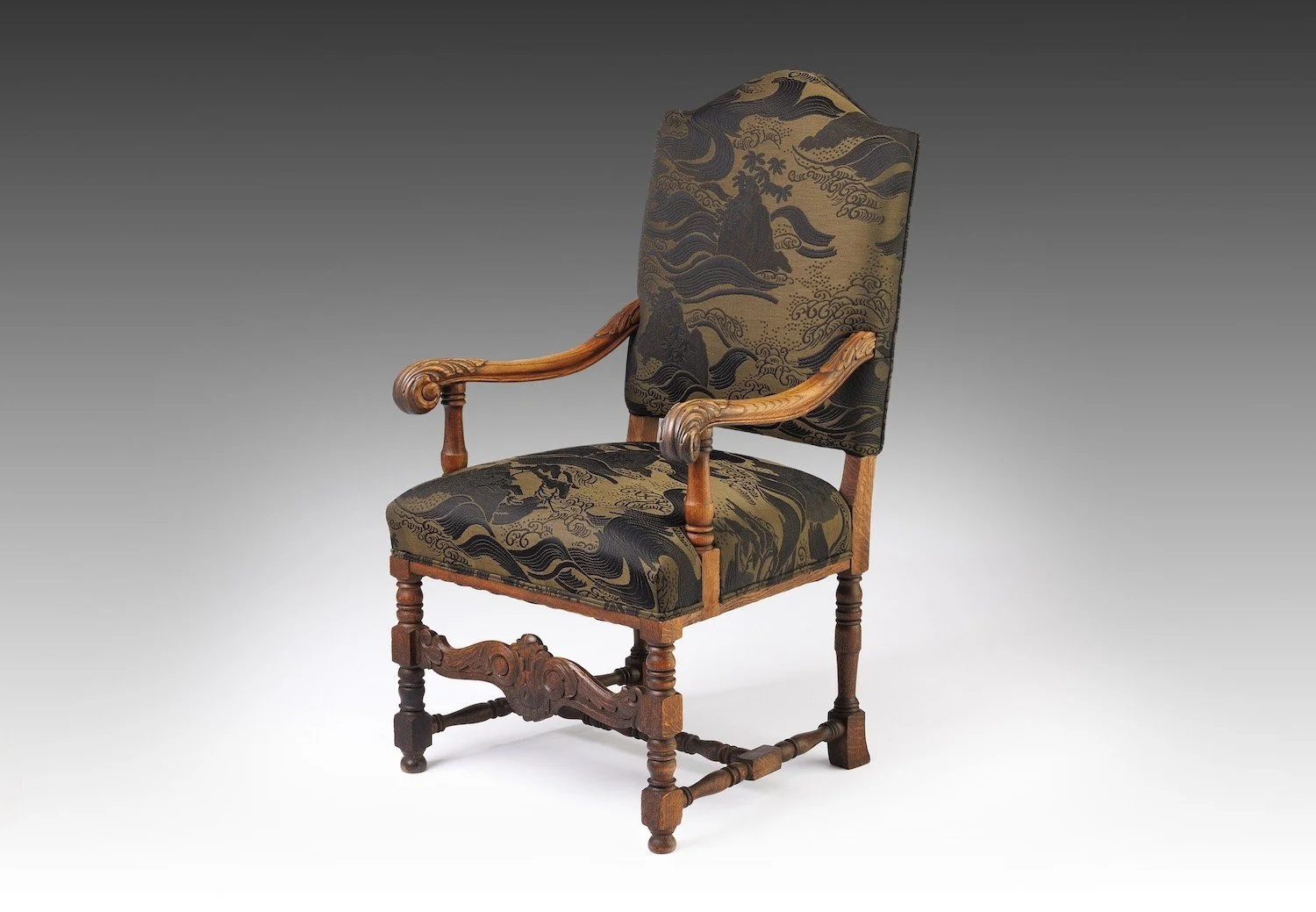
The Solstice Crest, an antique carved oak armchair, after restoration. The oak frame and its cleaned finish were kept; the seat and back were reupholstered in a Jim Thompson woven textile.
Built to Endure
The Solstice Crest is a high-back open armchair, described by the auction as Baroque and more specifically in the Louis XIII taste. Its legs are baluster-turned and joined at the front by a shaped stretcher carved with scrolling foliage. Its arms reach forward in a restrained curve and end in carved volutes. The carving follows the structure rather than disguising it, so the chair reads as a single carved form. The wood was identified as oak at the time of sale and has not been independently tested; what can be said is that the grain is consistent with oak throughout.
The oak frame was never built to be preserved. It was built to be used, and to go on being used after the things attached to it had worn out. That is a different intention from preservation, and it is the one restoration inherits.
A stretcher carved on its face is still a stretcher. It braces the legs, and it was expected to do so for as long as the chair stood. It still braces the chair every time someone sits.
The frame was left as it stood because it was still doing the work it had been built to do. The original joinery still holds, so nothing structural needed to be rebuilt.
Built to Wear
Upholstery is not a survival. It is the layer that spends itself so the structure beneath it does not have to.
A well-made chair was built around a frame intended to outlast its covering. Fabrics wore through, stuffing compressed, and coverings were replaced as part of ordinary household maintenance. The wooden structure was not remade each time the surface wore out. Replacing a covering that has stopped doing its work is not undoing history. It is continuing a cycle the makers expected.
That expectation is not only a matter of record. It is fixed into the chair.
A close-nailed chair keeps its own account of this. The show cover is fixed to the rails with a line of nails, and every recovering leaves its holes behind, so the rails hold a record of how many times the work has been done. On this chair that count has not yet been made. It is one of the few questions the object can still answer on its own.
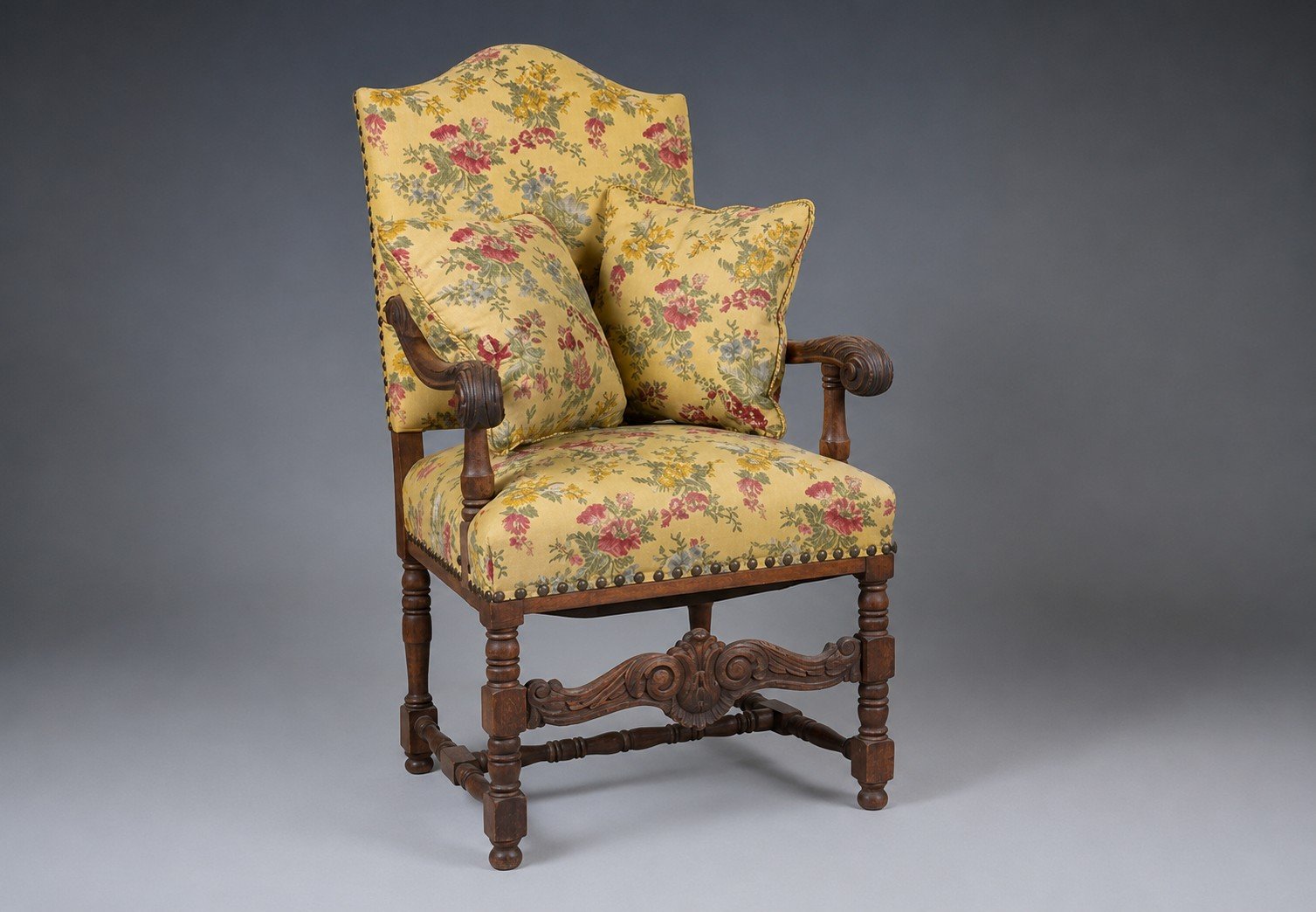
The Solstice Crest before restoration, in the covering it arrived in and with the two cushions that came with it. The brass nails along the seat rail hold the show cover to the frame.
The covering removed here had relaxed beyond the tension needed to define the frame beneath it. Its replacement is a Jim Thompson woven textile in a restrained bronze field, a cotton-polyester blend suited to light domestic use. Drawn to its proper tension, it restores the crisp profile of the back and seat, and because the weave is flat rather than piled the carved show wood keeps its edge against it. The two cushions that came with the chair were recovered in the same weave. A cushion has no frame and no finish; it is the wearing layer and nothing else.
What Hands Leave Behind
The finish belongs to neither category. It was not built to endure the way the frame was, and it was not built to be spent the way the covering was. It was built to record. A cleaned finish preserves what happened to it. A stripped finish cannot preserve that record.
The arms carry the clearest record. Along the outer curve the tone deepens where hands repeatedly rested and pressed. The surface has become smoother through handling, and the carved terminals have softened at their edges.
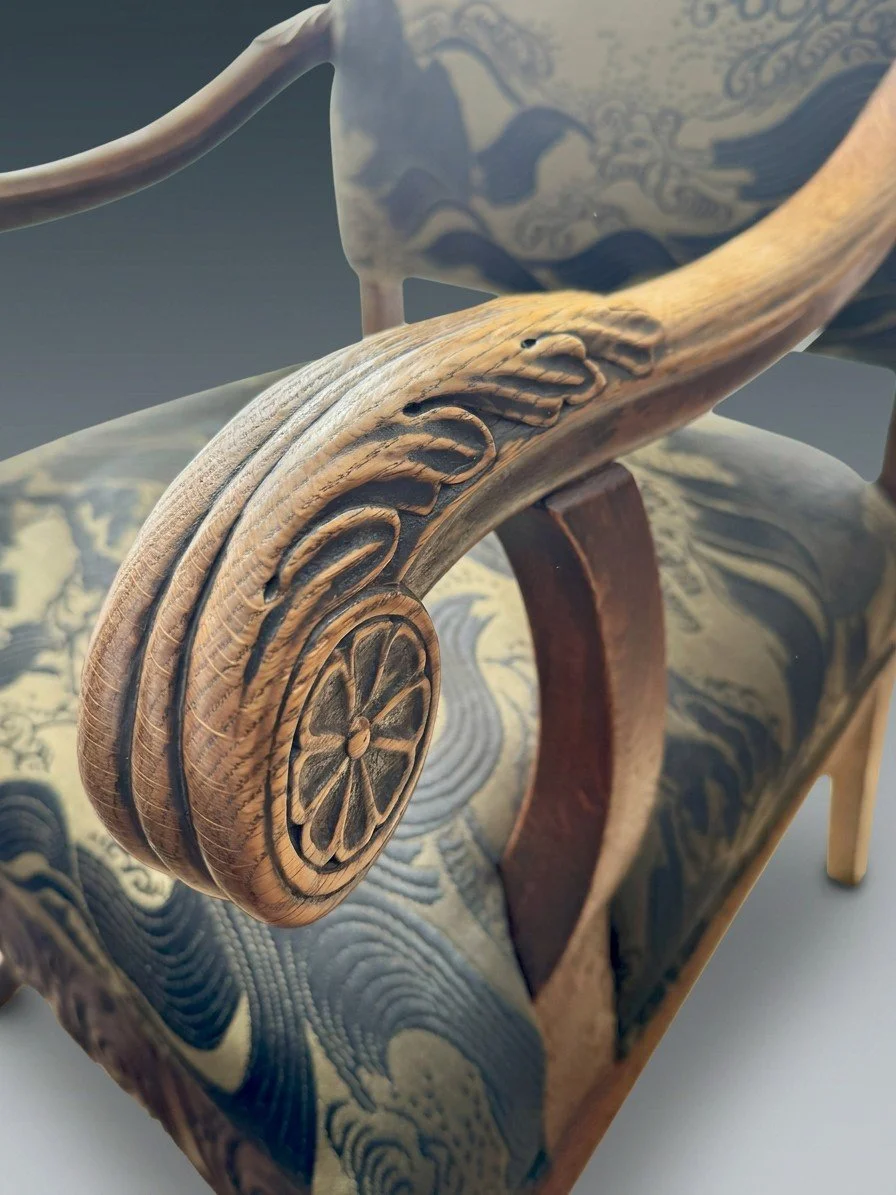
The carved arm of the Solstice Crest. Along the outer curve the tone deepens through repeated contact; the finish was cleaned rather than refinished, so this record remains legible.
The arms end in volutes at hand height, and a volute is a shape the hand closes around rather than rests on, so the change sits exactly where the form invites it. None of it weakens the chair.
The finish was cleaned rather than stripped. The wood was neither sanded nor stained, and the tonal variation across the oak remains legible. Refinishing would have removed the evidence that use created. The new textile lets the eye return to that evidence instead of competing with it.
The frame remains. The joinery remains. The finish remains, carrying the marks of handling that no workshop can reproduce. The layer built to wear has begun another cycle of use.
Object in This Journal
The Solstice Crest. A high-back open armchair in carved oak, described by the auction as Baroque and more specifically in the Louis XIII taste, one half of the Cliffs of Gold pair. The frame, its joinery, and the cleaned original finish were kept; only the upholstery was replaced, in a Jim Thompson woven textile. Acquire The Solstice Crest
See more of the collection's restored antique seating.
Related Reading
Beyond the Label | How Antique Furniture Is Identified
Reading Furniture Like a Text | Wear and Patina
The Language of Threads | Reupholstering Antique Chairs
Thoughtfully Collected. Quietly Shared.
