 Image 1 of 4
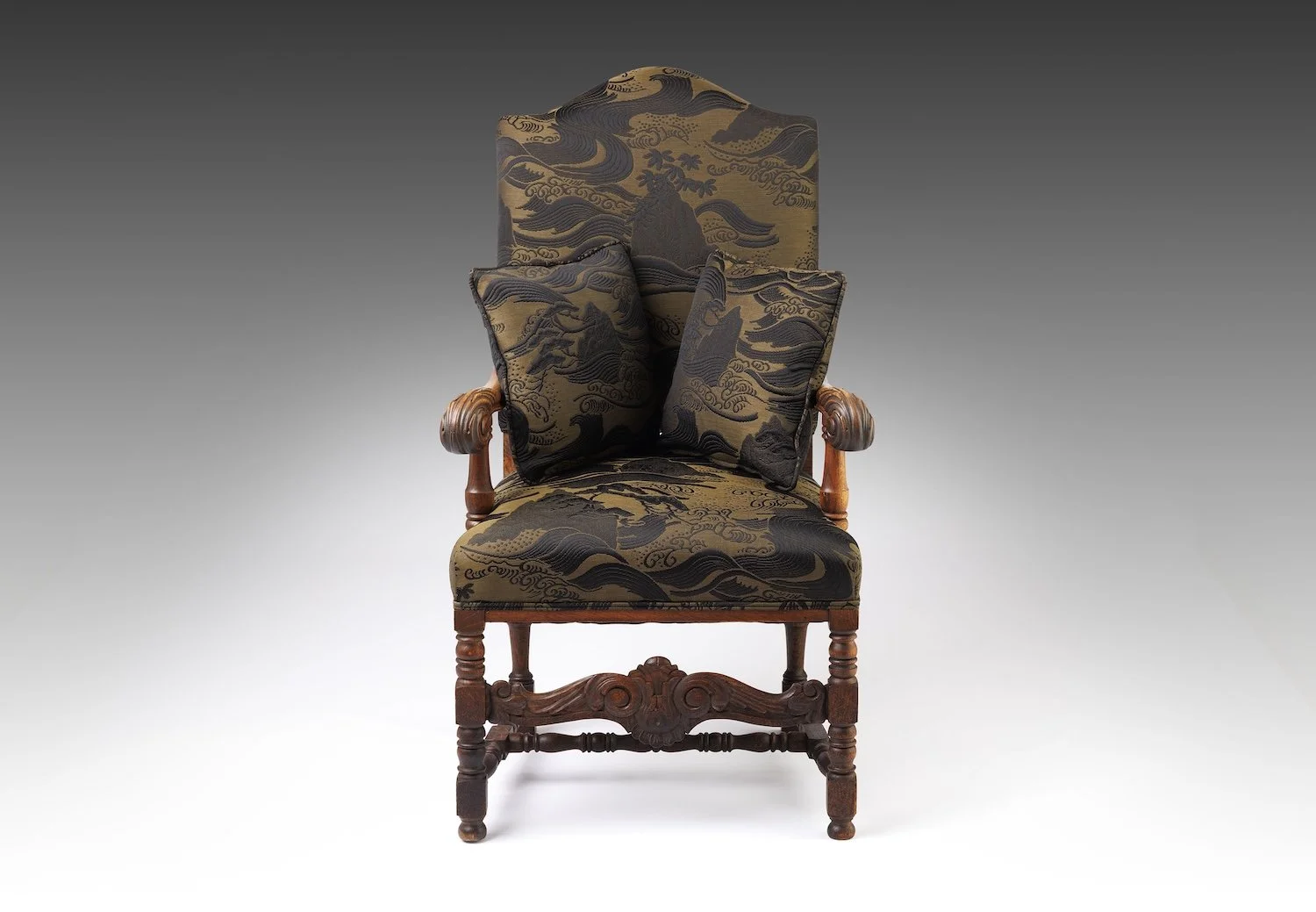 Image 2 of 4
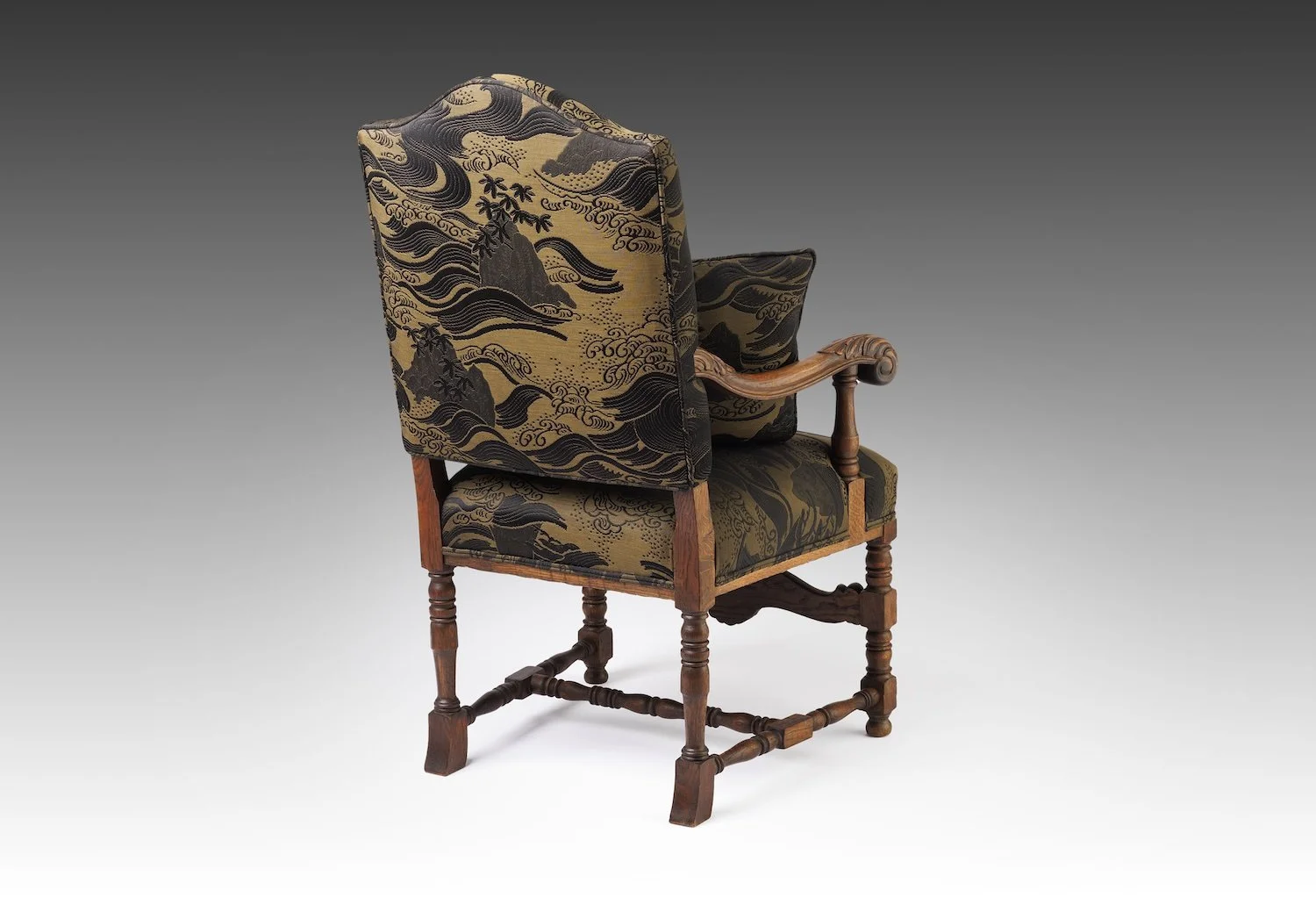 Image 3 of 4
 Image 4 of 4
Living With This Object
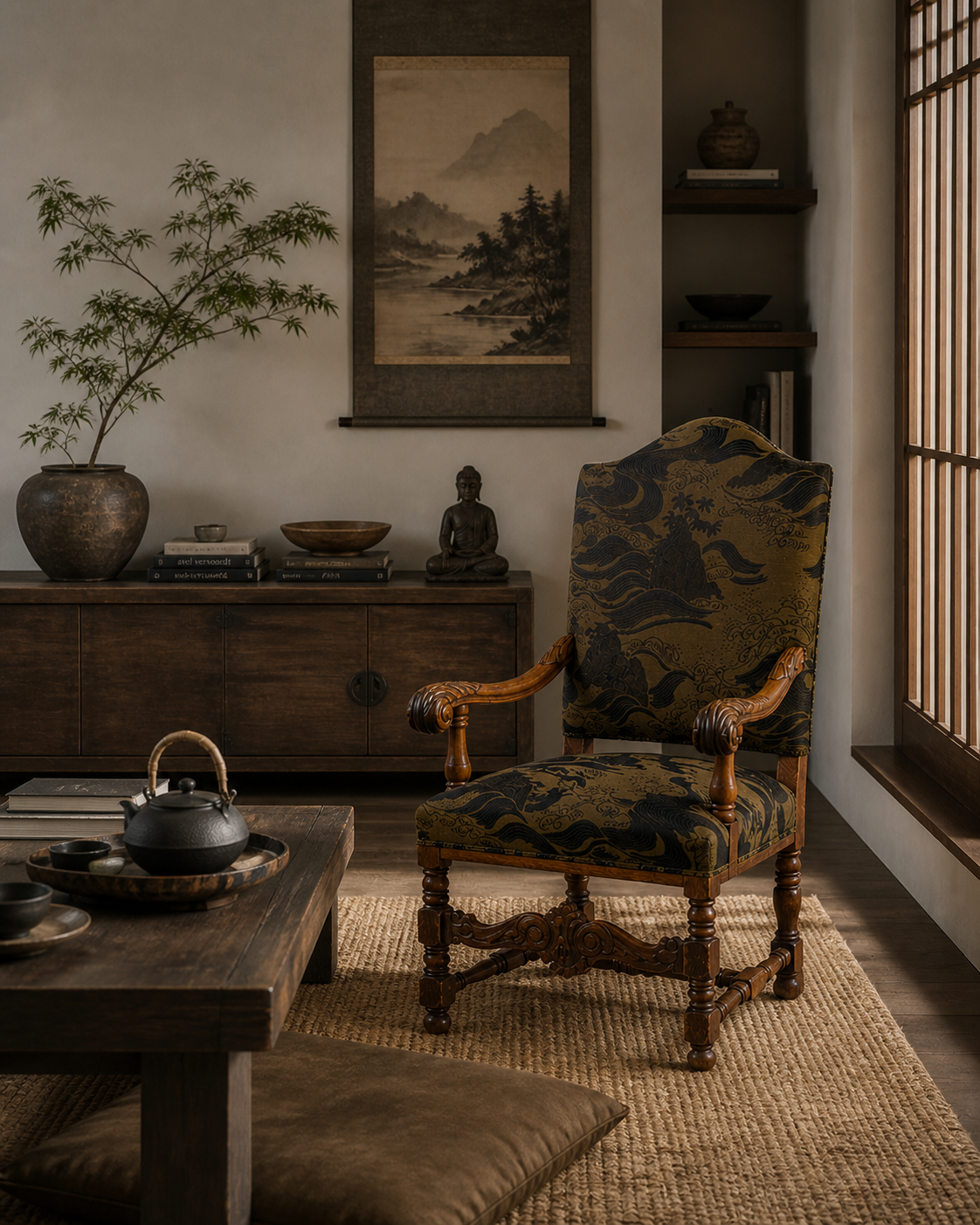
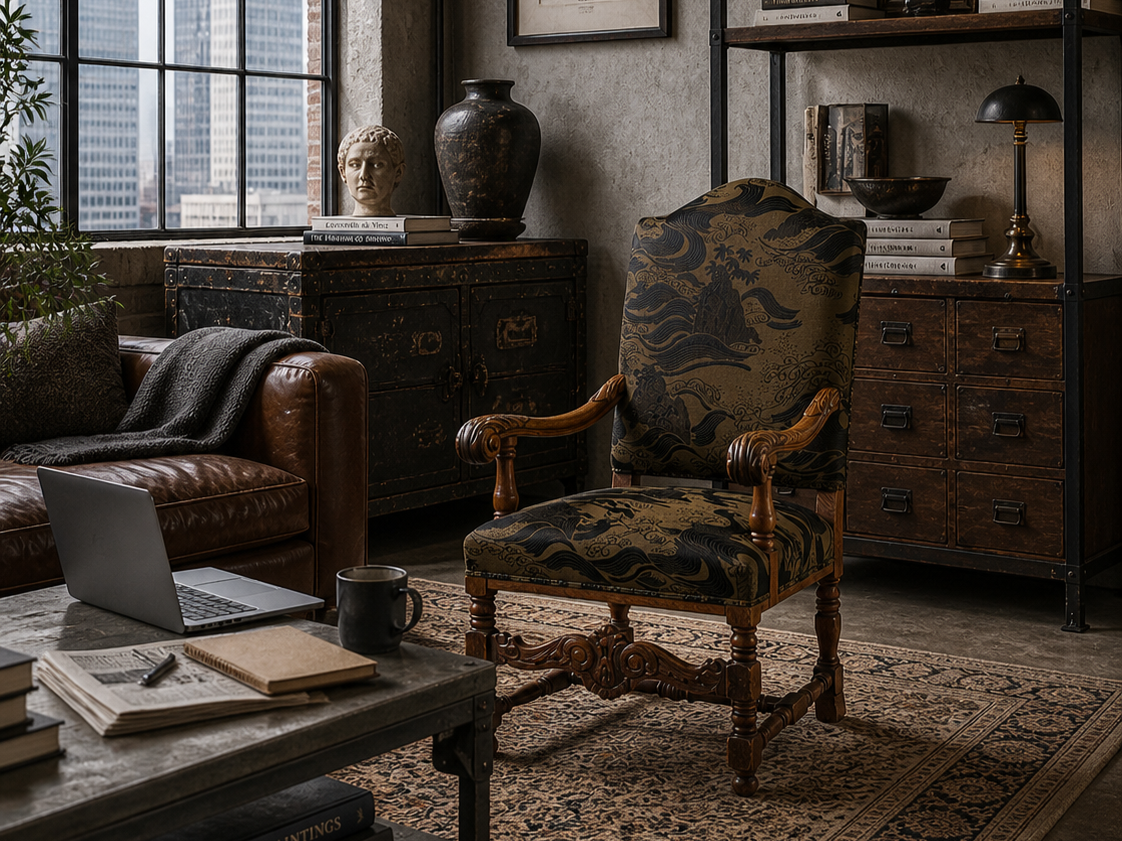
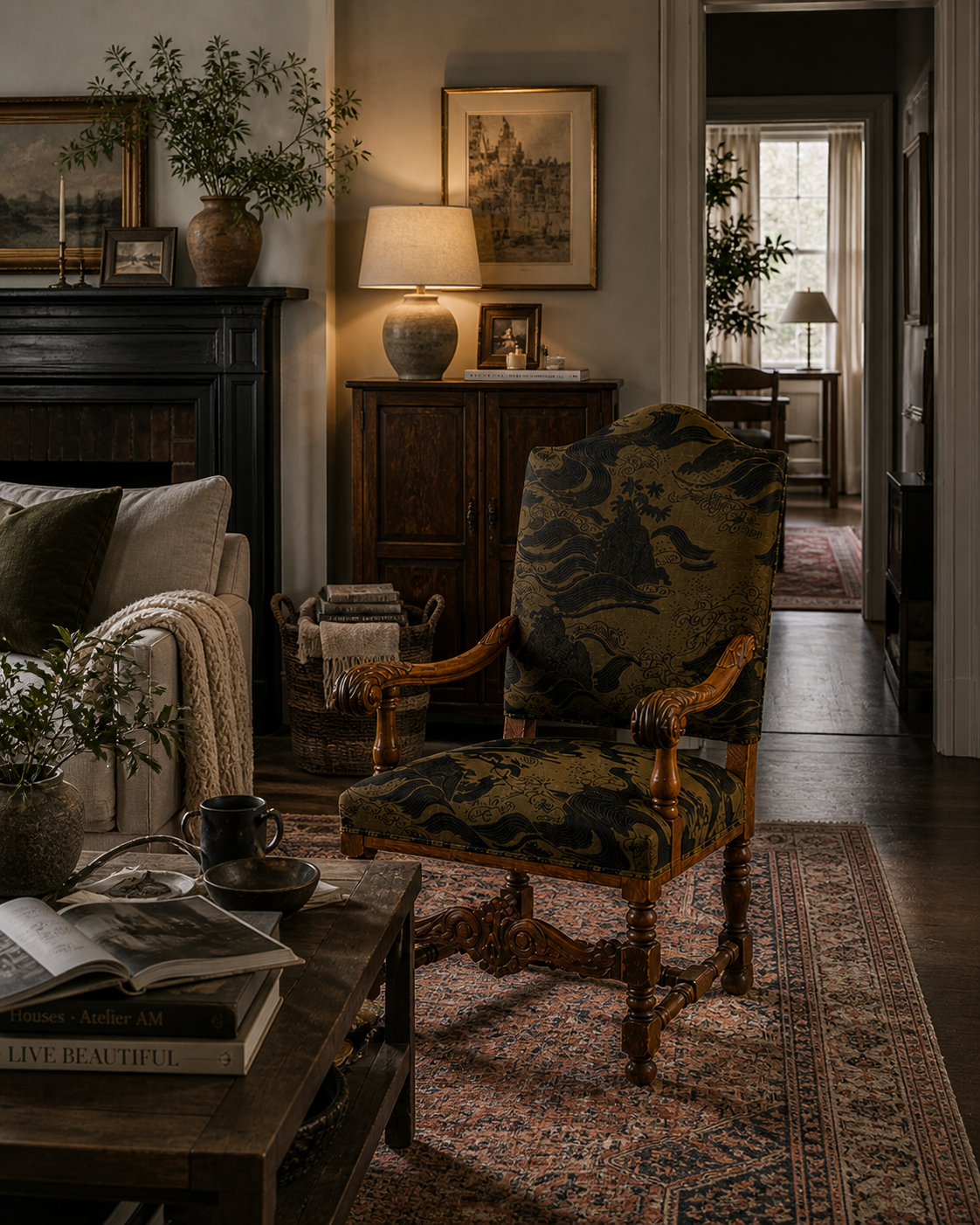
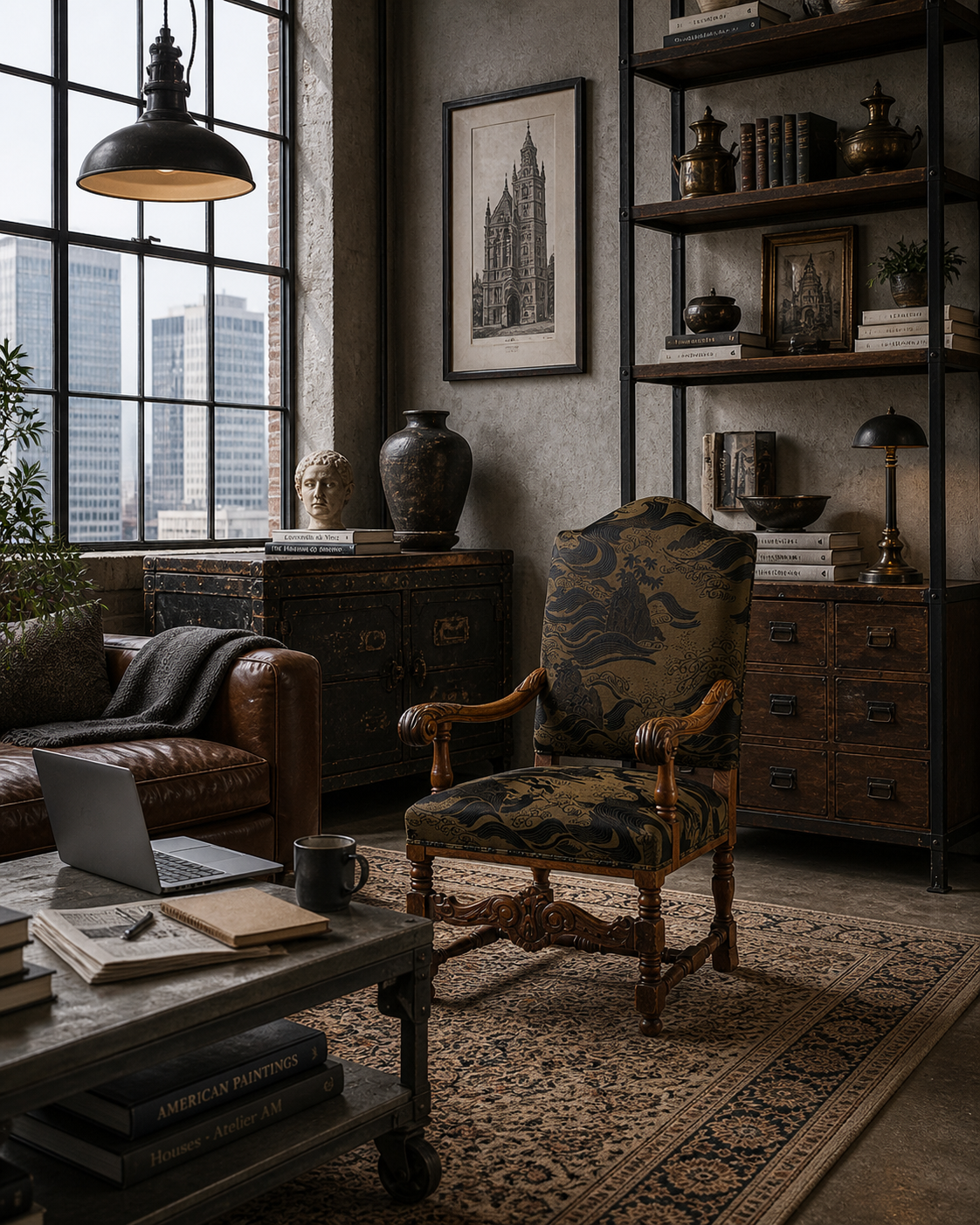
In a room, the chair reads as one strong upright form: the tall stuffed back rises to its arched crest, the scrolled arms open outward on turned supports, and the carved box stretcher anchors the base, so the eye follows the full height of the frame. The aged oak holds its own darkened tone against the bronze wave-patterned weave, and set beside its counterpart, The Horizon Crest, the two make a matched, architectural pair.The views below are AI visualizations, offered to suggest scale and character. They are rendered images, not photographs of the chair in this room.
-
The chair carries height and formality, so it belongs where seating does the work of architecture. Whether it stands in an entrance hall, settles into a study or library, takes the head of a table, or waits beside a fireplace, it suits the places where one strong upright form is wanted. Used singly, it gives a room its point of orientation; paired with its counterpart, The Horizon Crest, the two can frame a doorway, a console, or a hearth. The bronze tonal covering sits comfortably in both muted and jewel-toned interiors.
-
Type: Open-arm armchair (great-chair form)
Style: Baroque Revival, after 17th-century models
Date: Circa 1890–1910
Origin: Not established
Provenance: Earliest documented acquisition through a Los Angeles auction
Material: Solid oak, carved
Finish: Existing aged finish, retained; not refinished in this restoration
Construction: Carved show-wood arms on turned baluster supports; turned legs joined by a box stretcher with carved front member; stuffed seat and back
Maker & Origin: Unattributed; no maker documented
Condition: Sound; frame retained in its aged finish; seat and back recently reupholstered
Dimensions: 24 W × 22 D × 44½ H in.; seat height 20½ in.
Upholstery: Jim Thompson 'Railay', Bronze colorway, fully reupholstered (see The Jim Thompson 'Railay' Weave)
Cushions: Two, accompanying the chair, recovered in the same Jim Thompson 'Railay', Bronze colorway
-
Original: The carved solid-oak frame throughout: the scrolled arms, turned supports and legs, and the box stretcher with its carved front member, all retained in the existing aged finish.
Replaced: The show-cover of the seat and back, reupholstered in Jim Thompson 'Railay', Bronze colorway. The extent of foundation renewal beneath the new cover is not separately documented.
Reconstructed: No elements were reconstructed.
Repaired: No structural repairs are documented.
Finish Work: None was undertaken. The frame was reupholstered without refinishing the wood; the aged surface and the wear of long use were deliberately left legible.
-
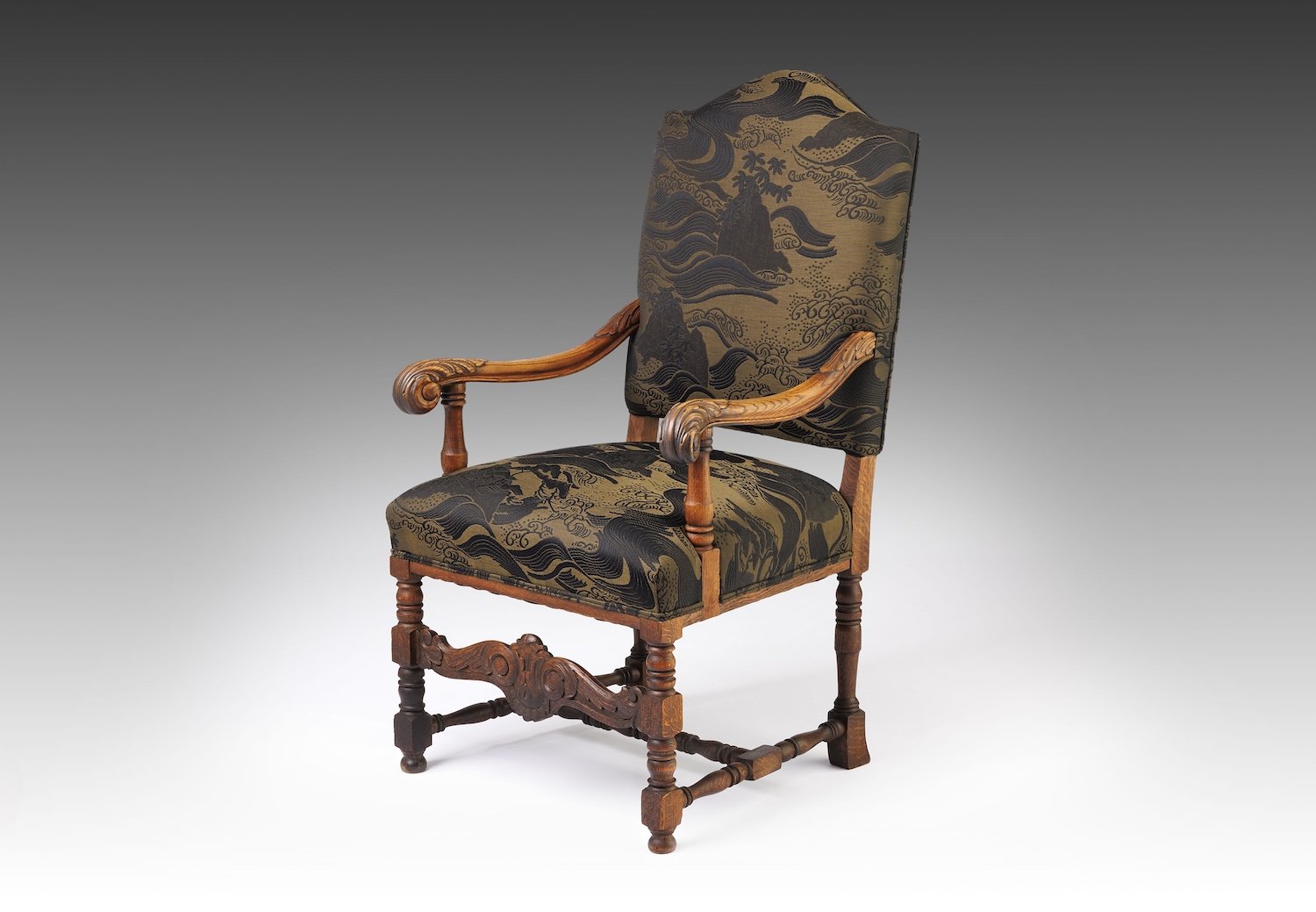
Each arm sweeps down to a carved rosette patera set within a fluted, lobed scroll, carried on a turned baluster support. Between the front legs, a flat front stretcher is carved with a central cartouche, a shell flanked by paired C-scrolls and acanthus, while the medial stretcher behind it is turned. The carving is worked into the solid frame rather than applied, and the relief is continuous, so the arms and the stretcher read as one carved program and hold up at close range.
-
No maker's mark, label, or documentary evidence naming a maker is recorded for the chair, so it is offered unattributed rather than assigned. The Baroque Revival classification rests on the form itself: the tall stuffed back, open scrolled arms, turned baluster supports, and carved box stretcher follow seventeenth-century great-chair models that returned to wide production in the decades around 1900, which supports the circa 1890–1910 dating. The country of manufacture is not established either, since this revival form was made in Britain, continental Europe, and North America, and nothing in the record settles it. "Baroque Revival" is used here as a style descriptor, not a claim of seventeenth-century manufacture.
-
The frame is solid oak, carved rather than applied with ornament. The arms scroll forward over turned baluster supports, with passages of floral relief in the show-wood, while the tall stuffed back rises to a scalloped, arched crest. The seat is stuffed and sits above turned legs joined by a box stretcher, its front member carved as the frame's principal lower ornament, anchoring the composition at the base. The legs flare gently, giving the upright form its lift.
-
Type: Open-arm armchair (great-chair form)
Style: Baroque Revival, after 17th-century models
Date: Circa 1890–1910
Origin: Not established
Provenance: Most recent documented acquisition through a Los Angeles auction
Material: Solid oak, carved
Finish: Existing aged finish, retained; not refinished in this restoration
Construction: Carved show-wood arms on turned baluster supports; turned legs joined by a box stretcher with carved front member; stuffed seat and back
Maker & Origin: Unattributed; no maker documented
Condition: Sound; frame retained in its aged finish; seat and back recently reupholstered
Dimensions: 24 W × 22 D × 44½ H in.; seat height 20½ in.
Upholstery: Jim Thompson 'Railay', Bronze colorway, fully reupholstered (see The Jim Thompson 'Railay' Weave)
-
Great chairs of this kind, with a tall stuffed back and open scrolled arms, belong to the seventeenth century, when seating at this scale carried rank as much as comfort; this example belongs to the revival of that form in the decades around 1900, made circa 1890–1910 by an unidentified hand. Its life since is written on the frame itself: the finish has aged in place and was deliberately left unrefinished in restoration, so the surface character of long use remains visible. Its earliest documented chapter begins with its acquisition through a Los Angeles auction before entering the Acanthus Home collection, where it was reupholstered in the present Jim Thompson 'Railay' weave. It is catalogued alongside a close counterpart, The Horizon Crest, though whether the two chairs began life together is not documented. The earlier chapters, the maker, the country, and the rooms it served remain unrecorded. The record ends where the evidence ends.
-
Is this an antique or a vintage chair? Antique. The chair is dated on its form to circa 1890–1910, the decades when the Baroque Revival great-chair was in wide production, which places it at least a century old and before 1926, the cutoff Acanthus uses. The dating is inferred, so it is stated as a circa range, never a single year.
What was restored, and is the finish original? Only the upholstery. The seat and back were recently reupholstered in the Jim Thompson weave; the carved oak frame was deliberately left alone. It was not refinished, so the aged surface and the wear of long use remain fully legible. What you see on the wood is the chair's own history.
What is the upholstery, and how should it be used? The covering is Jim Thompson's 'Railay' in the Bronze colorway, a woven cotton and polyester blend, 67 percent cotton and 33 percent polyester, made in Thailand. The maker rates it at 13,000 Martindale rubs for light domestic use, so the chair suits occasional seating rather than hard daily wear.
Is this chair part of a pair? The Solstice Crest is one of two closely related armchairs, and its counterpart, The Horizon Crest, is offered separately with its own record. Whether the two began life together is not documented, so each chair is described on its own evidence. Optional matching pillows in the same fabric are available.
Are the cushions part of the chair? Two cushions accompany it. They appear with the chair in the photograph taken before restoration, in its earlier covering, and again afterwards in the Jim Thompson weave, so they came with the chair and were recovered alongside the seat and back. Both are included with the chair.
Is the chair marked or attributed to a maker? No. No maker's mark, label, or documentation naming a maker accompanies the chair, so it is offered unattributed. The country of manufacture is not established either: the Baroque Revival armchair was made across Britain, continental Europe, and North America, and nothing in the record settles where this one was built.
Where did the chair come from before Acanthus Home? The earliest documented point in the chair's history is its acquisition through a Los Angeles auction. No earlier ownership records accompanied it, so the identities of previous owners, the country in which it was made, and the interiors it once occupied remain undocumented.