Victorian Slipper Chair | The Emerald Noir
What is a Victorian slipper chair?
A Victorian slipper chair is a low, armless seat built close to the floor, made in the nineteenth century to sit below the height of formal chairs. This one came to the workshop as a carved frame beneath tufted pink velvet that had worn through, the structure enduring where the upholstery had not.
The height is the point. A slipper chair sits low, close enough to the floor that a person could reach a hem, a fastening, or a shoe without rising. The form is associated with Victorian parlor seating and private dressing rooms, spaces where garments were fastened, removed, or altered, and where objects were handled without ceremony and returned to use without record. It does not anchor a room. It adjusts within it.
The Emerald Noir stands on casters set beneath all four legs. Easily moved, it was made to shift with use rather than to hold a single place. Its maker is not recorded. What remains instead is the object itself: a stable frame, repaired joinery, original ceramic casters, and the marks left by use. The spoon back resolves into the seat without interruption, and the curvature holds without distortion. A prior separation at the left side has been repaired and now holds without movement. The cabriole front legs sweep forward to carved scroll feet, the rear legs splay behind, and each leg ends in a ceramic caster. The carving remains intact across the crest and apron, where floral and scroll motifs are worked in relief. Minor compression and wear run along the edges. They record repeated contact without obscuring the form.
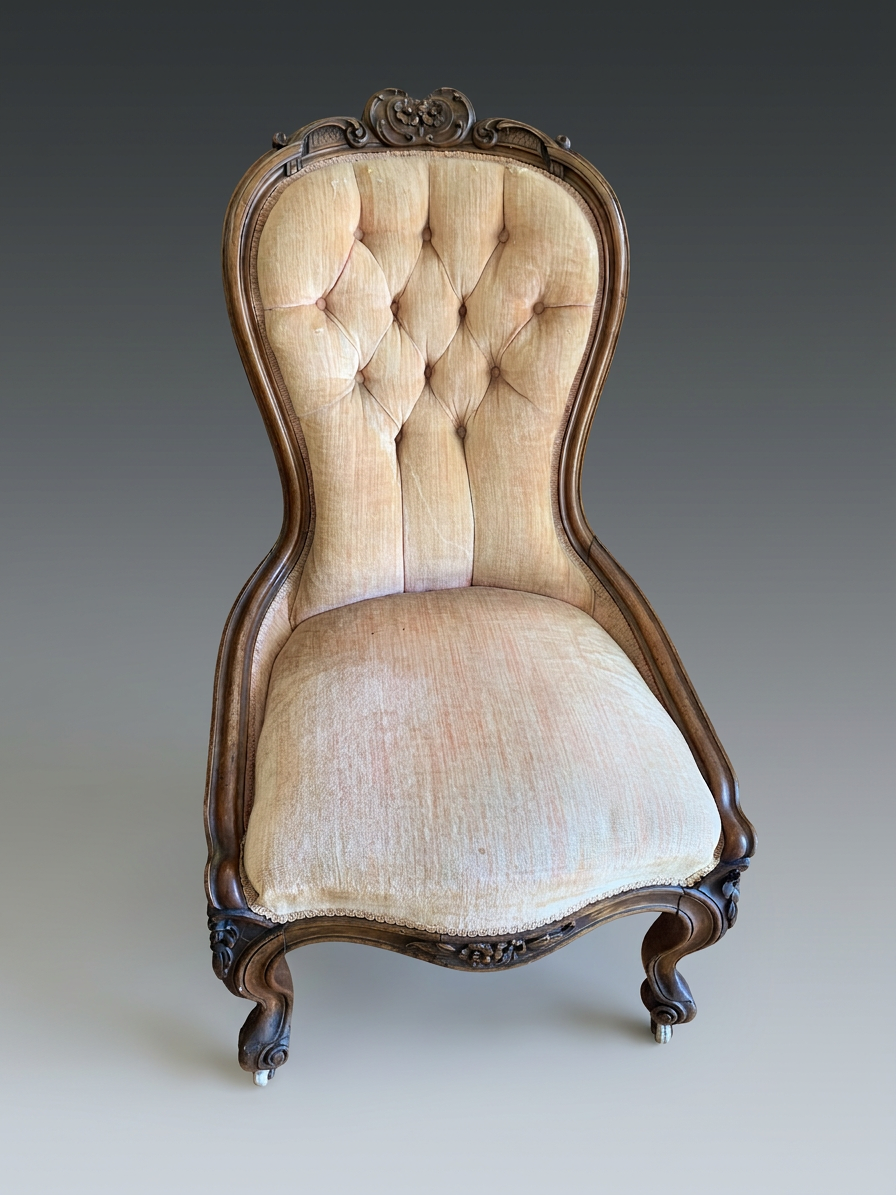
The Victorian slipper chair as found: tufted pink velvet worn through, the carved frame intact.
When the surface failed
The surface is where the loss gathered. The chair as found was upholstered in tufted pink velvet, reduced through long use to a softened, uniform field, with areas of thinning and puncture at the points most often touched across the back and seat. Along the reverse, the upholstery had opened at the edges, exposing the limit of the material while the structure continued unbroken beneath it. This is the interval in which an object begins to withdraw, not through failure of its frame, but through loss of its surface. Whether a chair in that condition is worth returning to use is a question the journal takes up directly in Velvet Revival.
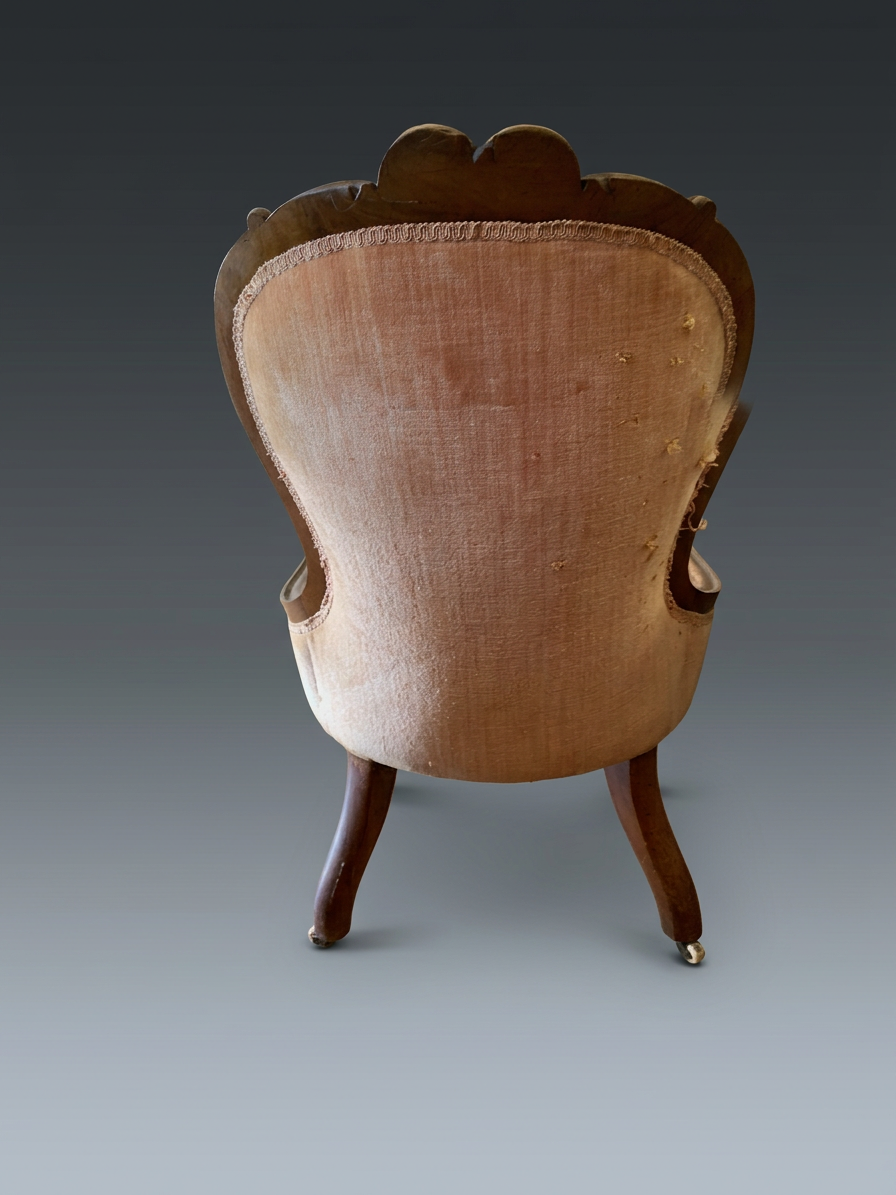
Reverse of the slipper chair before restoration. Surface loss along the edges, the structure continuous beneath.
The Emerald Field and the Ebonized Frame
During reupholstery the interior was opened, exposing the chair's underlying construction. The seat is sprung, with coil springs hand-tied with cord over webbing. Around and above them lay the stuffing and its covers: horsehair, coir, straw, and cotton wadding, with two different earlier cover fabrics among them, one a plain pink, the other a dark ground printed with a small orange figure. These materials were never ornamental. They formed a working system, built to be renewed as each surface wore through. The two surviving cover fabrics make the point plainly: what the frame held was not a single origin but duration, one campaign of use laid over another and kept in place by function rather than preservation.
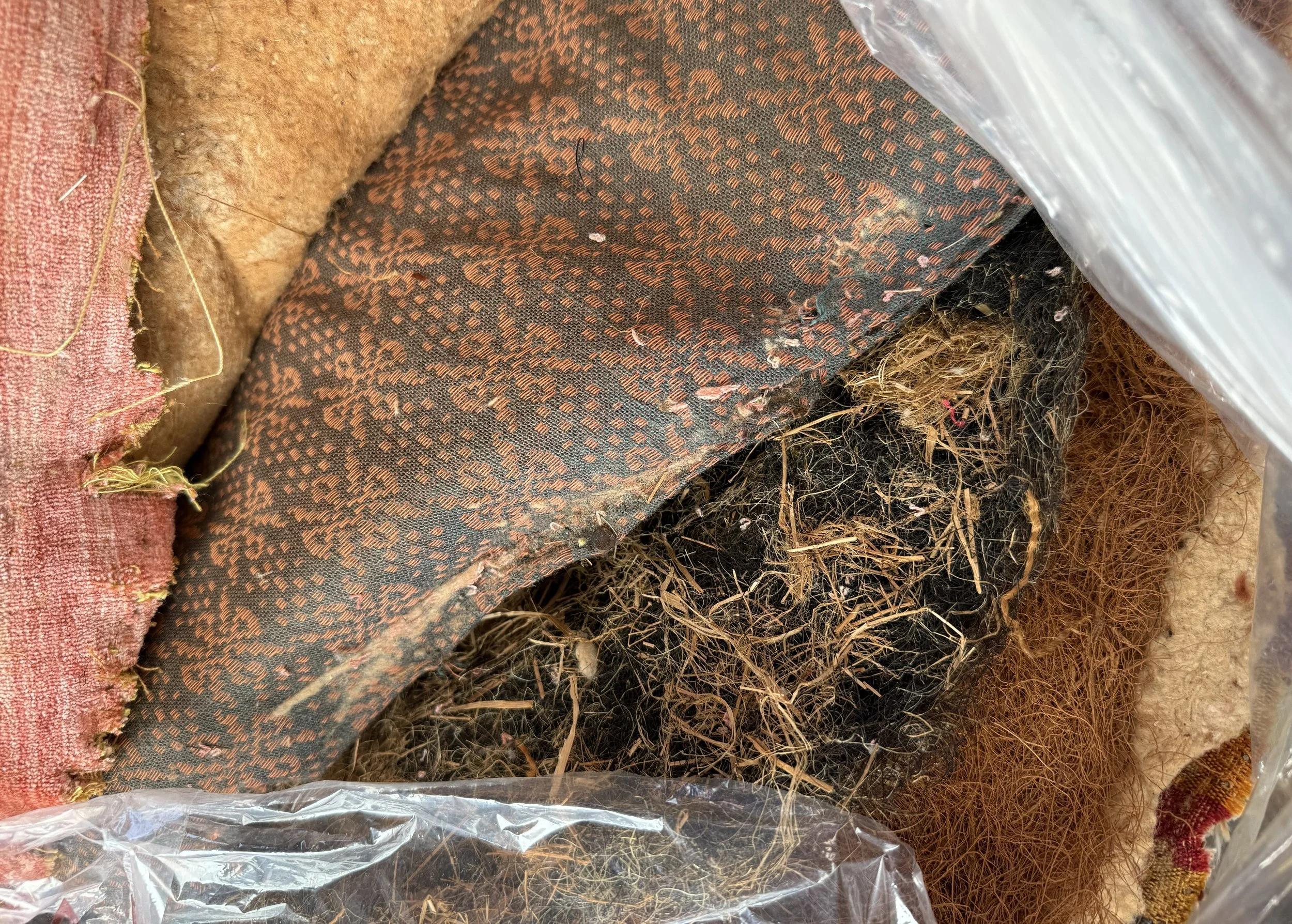
Interior materials removed during reupholstery: horsehair, coir, cotton wadding, and two different earlier cover fabrics.
The restoration renewed the upholstery and finish while preserving the chair's underlying form. The chair has been reupholstered in Bastian Sfumato, an embroidered textile produced by Pierre Frey. The pattern draws from Venetian marbled paper, long used on the endpapers of bound volumes. Here that field is carried in thread rather than ink. At a distance the surface reads as continuous; at close range it resolves into embroidery, moving from back to seat without a break, gathering and dispersing through slight variation so that it stays active rather than fixed.
The frame's finish was changed as well, and the change is worth stating plainly. The carved hardwood show-wood frame was given an applied ebonized finish during restoration rather than retaining its original finish. The darker boundary draws the carving into sharper relief, and against it the embroidered field comes forward. Before the work, the chair registered mostly as absence: present in the room but no longer holding a position within it. The chair was restored to use, not to prominence. It returns not to a prior state but to use.
The dark slipper chair is not a modern idea, and the form was never only a woman's. Describing President Arthur's White House dressing room in 1881, a Washington letter notes the chair he used for putting on his slippers was one "of ebonized wood with straight back and no arms."
A slipper chair persists because its function stays specific. It does not command space; it operates within it, positioned, moved, and returned. Its scale keeps it in relation to the body rather than the room, and its casters keep it responsive to use rather than fixed in an arrangement. What has been restored is not status but service, the chair returned to circulation within the kind of contemporary interior where antique and modern furniture are mixed.
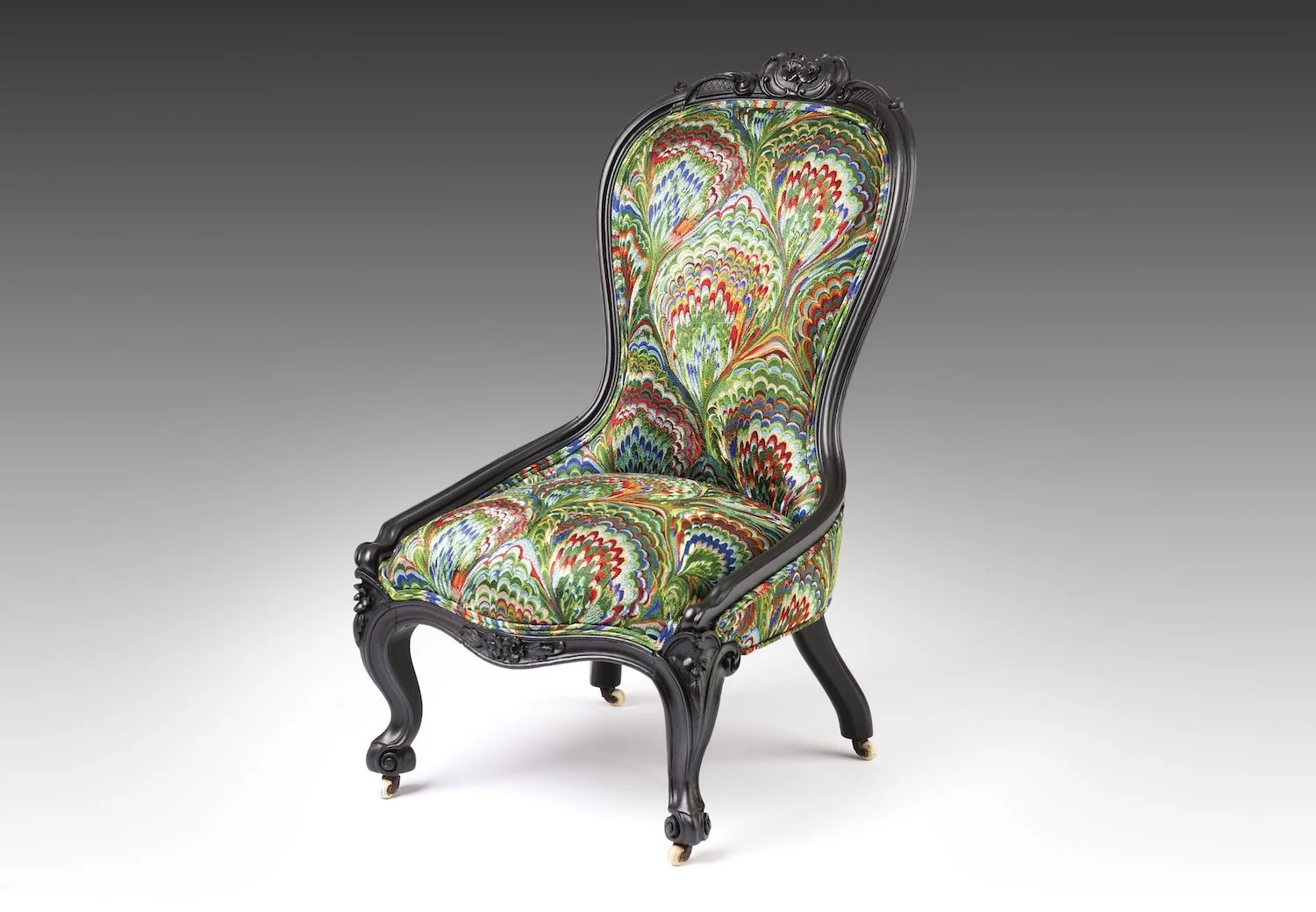
After restoration. The slipper chair reupholstered in Pierre Frey 'Bastian' Sfumato embroidery, the hardwood frame ebonized.
Object in this Journal
The Emerald Noir. A nineteenth-century Victorian slipper chair on ceramic casters, restored and reupholstered in Pierre Frey Bastian Sfumato embroidery, its carved frame ebonized in restoration. Acquire The Emerald Noir
See more of the collection's restored antique seating.
Related reading
Sources and Further Reading
"A Washington Letter" on President Arthur's rooms, The Fairfield News and Herald (Winnsboro, S.C.), December 21, 1881, p. 2.
Thoughtfully Collected. Quietly Shared.
