Käthe Kollwitz and the Afterlife of Compassion
Käthe Kollwitz's Hamburg Tavern (Hamburger Kneipe) is a soft-ground etching from 1901, a dark image of working people gathered in a modest room. The print kept in the Acanthus archive is not an original impression from Kollwitz's copper plate. It appears to be a later reproduction issued in Munich, and the journey of her image is the truer subject of this essay: how an image made in Berlin was carried, copied, and kept until it reached ordinary rooms an ocean away.
What is Käthe Kollwitz's Hamburg Tavern (Hamburger Kneipe)?
Kollwitz was born in Königsberg in 1867 and trained as an etcher before the First World War. Hamburger Kneipe, or Hamburg Tavern, is one of her early prints, made in 1901 by soft-ground etching, a process that uses a soft, waxy ground so the printed line retains something of the grain and softness of chalk. That is why the image reads like crayon rather than engraving. The National Gallery of Art, which holds an impression in the Rosenwald Collection, describes the scene as five figures in a small room, two of them embracing in the foreground, with a cloth-covered table, a few chairs, and an indistinct window. Nothing in it is raised above ordinary life. The feeling is carried by posture and proximity rather than by expression.
Kollwitz worked this way on purpose. She chose her subjects from the poorest working people, their tired parents and hungry children, and she pressed the drawing into the plate until the line held the weight of her attention. The meaning was not added over the image. It was formed in the contact between tool and copper, and it stayed there.
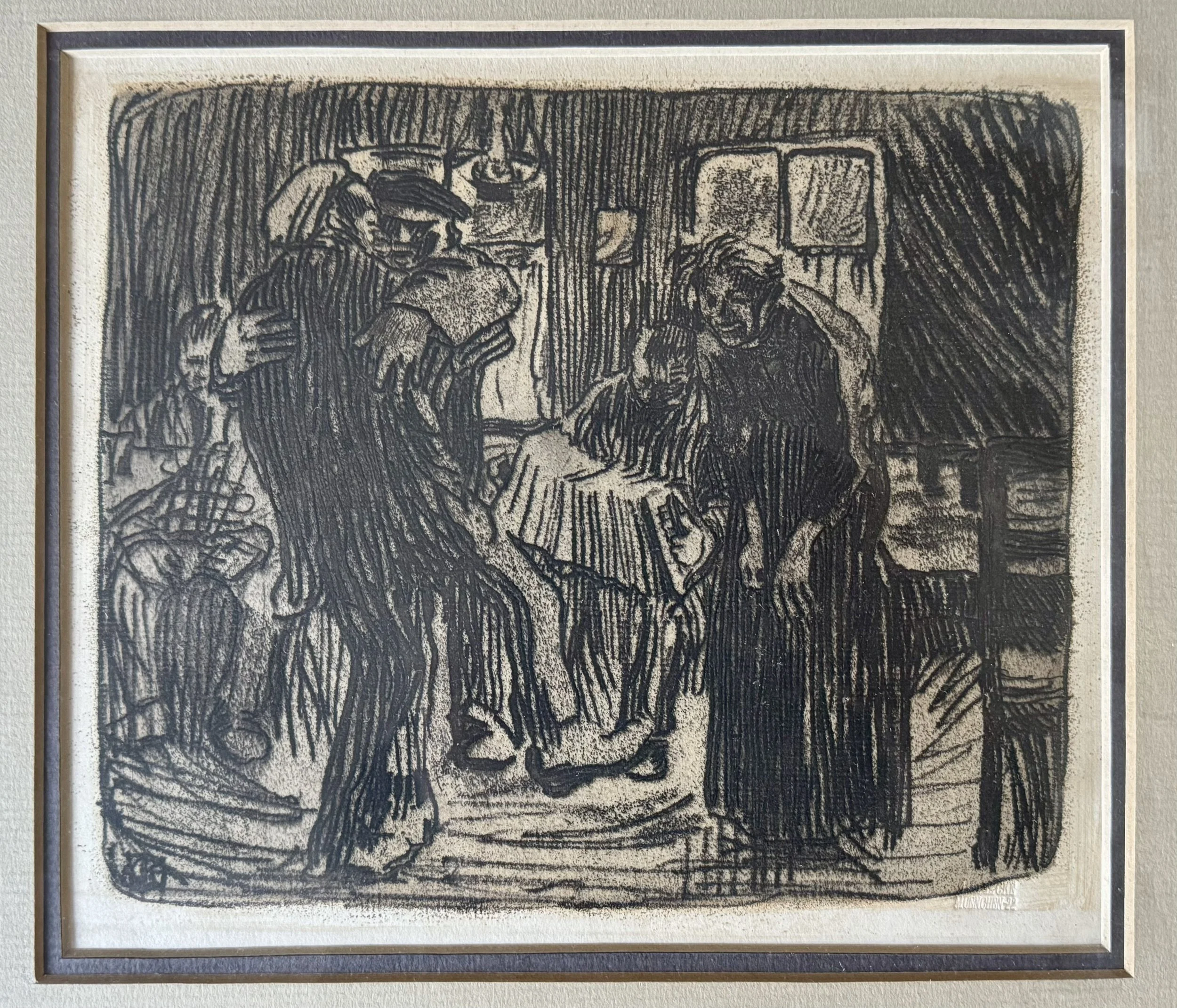
A reproduction of Käthe Kollwitz's Hamburg Tavern (Hamburger Kneipe), after the 1901 soft-ground etching; the sheet carries a Munich publisher's blindstamp in the lower right.
Three words are worth keeping straight, because they describe three different objects. An original impression is printed by the artist, or under her supervision, from her own plate or stone. A restrike is a later impression pulled from that same plate, often after the artist's death, when the surface has begun to wear. A reproduction is a photographic copy, the image rephotographed and printed by a commercial process such as collotype. All three can be faithful to what Kollwitz drew. Only the first two carry the pressure of her own plate.
The archive print appears to be the third. Its surface is soft and granular in the way a photomechanical reproduction is, and the lower-right corner holds an embossed blindstamp ending in "München 22," the mark and old postal district of a Munich publisher rather than of Kollwitz's own printer. The embossing is not a flaw. It is evidence: a record of the press that made this sheet and of the trade that carried her image outward. Naming it accurately takes nothing from the picture. It places the object honestly.
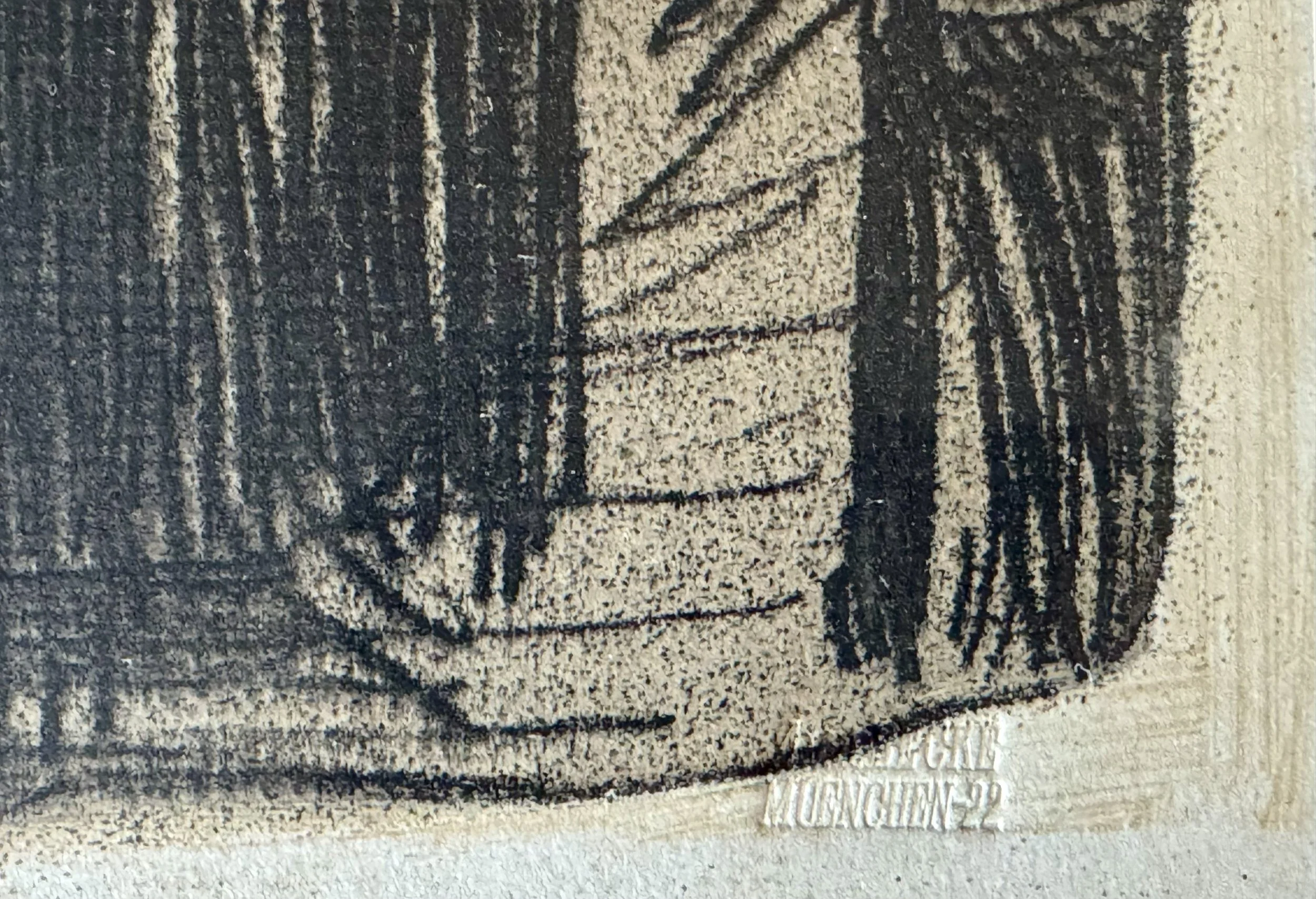
The embossed publisher's blindstamp, "… München 22," evidence of issuance through a Munich publisher.
Carried by Other Hands
What happened next is documented, and it is the part most worth telling. The precise path of this sheet is not. As Germany darkened under National Socialism and Kollwitz was forced to resign from the Prussian Academy, her images traveled without her. Kollwitz's work reached the United States both as reproductions and, in some cases, as original prints sent abroad for safekeeping. A group of her etchings and lithographs, "purchased in Germany… and sent to the United States for safe-keeping," was lent to the Houston Museum of Fine Arts in 1946. Curator Carl Zigrosser of the Philadelphia Museum of Art assembled traveling exhibitions that reached cities far from the major galleries. And the American Association of University Women circulated sets of her prints into small towns and school libraries; one such set, shown in the high-school library in Deming, New Mexico in 1945, was "sixty-three black and white prints, of which 62 are reproductions and one an original."
The American press reached for superlatives, and they recur across the clippings: "the greatest woman artist of modern times," "the world's greatest woman graphic artist." Romain Rolland had put it more carefully in 1927, calling her work "the greatest poem of this age in Germany" and Kollwitz herself "the voice of the silence of the sacrificed." The regime she outlived had once dismissed the same work as "the art of the gutter," and as far back as 1898 the Kaiser had vetoed a gold medal awarded to her for the Weavers cycle. What endured was neither the praise nor the insult. It was the image, and the fact that it could be carried.
A reproduction holds its image differently from an original impression. It preserves the picture through another printing process and another chain of custody. The furniture kept at Acanthus records wear, repair, and repeated use; this sheet records reproduction, circulation, and preservation. The evidence differs, but both are objects that remember through survival.
Kollwitz wrote in her diary in December 1922, "I want to have an effect on my time, in which people are so confused and in need of help." She did, and the effect continued past her time, wherever her image was reproduced, carried, and kept. The original impression preserves the touch of her hand. This reproduction preserves the reach of her work.
Notes
Descriptions of the work follow the National Gallery of Art's record of Hamburg Pub (Hamburger Kneipe), 1901 (Rosenwald Collection). Kollwitz's words are from her diary entry of 4 December 1922 (The Diary and Letters of Käthe Kollwitz, 1955). The account of her work in America draws on period notices: the American Association of University Women exhibition in Deming, New Mexico (The Deming Headlight, May 1945); a loan of prints purchased in Germany and sent abroad for safekeeping (The Houston Post, October 1946); Romain Rolland's tribute, quoted in Jacob Kainen's "Art" column (The Daily Worker, April 1937); and the Kaiser's "art of the gutter" and the 1898 veto of the Weavers gold medal (Brooklyn Daily Eagle, April 1937).
Object in this Journal
A reproduction of Käthe Kollwitz's Hamburg Tavern (Hamburger Kneipe), after the 1901 soft-ground etching, bearing a Munich publisher's blindstamp. This object remains in the Acanthus archive.
See the collection's antique writing desks and secretaries.
Related reading
Tom S. Fricano: The Afterlife of Process
Frances Josephine Hadley and the Shape of a Life
Thoughtfully Collected. Quietly Shared.
