The Coat and the Flag: How Objects Hold Family Legacy
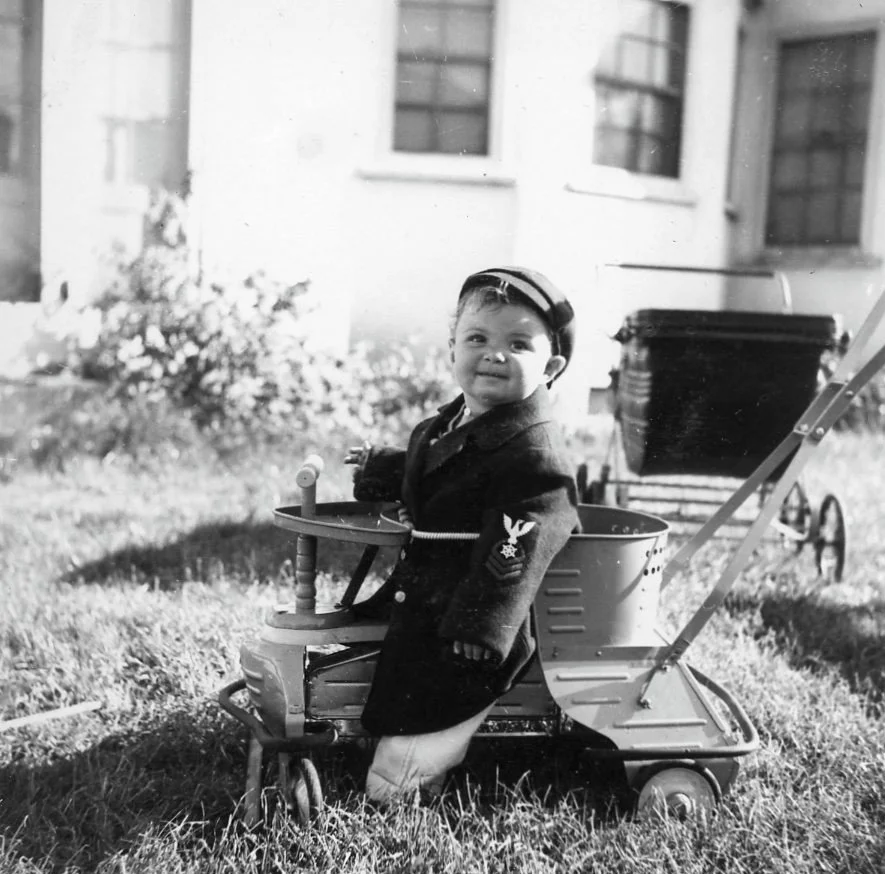
Los Angeles, 1945. A young boy sits in his uncle's oversized U.S. Navy coat, the sleeves folded past his hands, in a front yard near what is now UCLA.
A child sits swallowed in a coat far too big for him, in a photograph from 1945. Objects carry family legacy this way long before anyone explains them: by proximity, by weight, by remaining in the room until the person grows into what they mean.
How do objects carry family legacy when nothing is spoken?
They carry it by outlasting the moment that made them matter. Nothing here is stated aloud. A child sits upright in a front yard in Los Angeles, not far from what is now the University of California, Los Angeles. He is not yet walking, not yet speaking. The coat envelops him. The sleeves fold well past his hands. A Navy petty officer's rating badge rides high on the sleeve, on an arm that has not yet earned it. He wears the coat before anyone can tell him whose it was. That is the order in which a great many inherited objects arrive.
The Coat and the Man Who Stepped In
The coat was not his father's. His father, a U.S. Army corporal, was last seen wounded in the Battle of the Hürtgen Forest on December 6, 1944. The fighting there ran from September 1944 into February 1945 and became one of the U.S. Army's longest and costliest campaigns of the war. The terrain resisted both movement and survival. He would not be identified and brought home for five years.
The badge is a Navy petty officer's, and the father was Army. The coat belonged to the boy's uncle, who served in the Navy and, while his brother-in-law was missing, helped his sister raise her son. The aunts did the same. The family closed around the gap, a stepping-in they later set down in a memoir. So the child is not wearing his father's absence. He is wearing the presence that answered it.
The photograph records no performance of grief. There is no posture of mourning, no visible comprehension. There is only scale: the weight of an adult garment on a body not yet able to hold its meaning. This is how inheritance sometimes begins, not as instruction but as proximity.
He straddles a pressed-metal riding toy, a wicker pram behind him: the ordinary objects of a childhood that continued around the absence.
The Battle of the Bulge would later dominate public memory. The Hürtgen Forest remained comparatively overlooked, unresolved for those who passed through it and for those left waiting. Eighty years later, the photograph remains unchanged. A child wearing a coat not yet his own, present without comprehension.
The Flag Five Years Later
Five years on, a second photograph was taken. At a military funeral, the boy is handed a folded flag, a folded triangle of cloth, the standard tribute passed to the next of kin. Here the next of kin is a child. The ritual is precise, the gesture practiced, the object once again too large for his hands. Meaning has still not arrived.
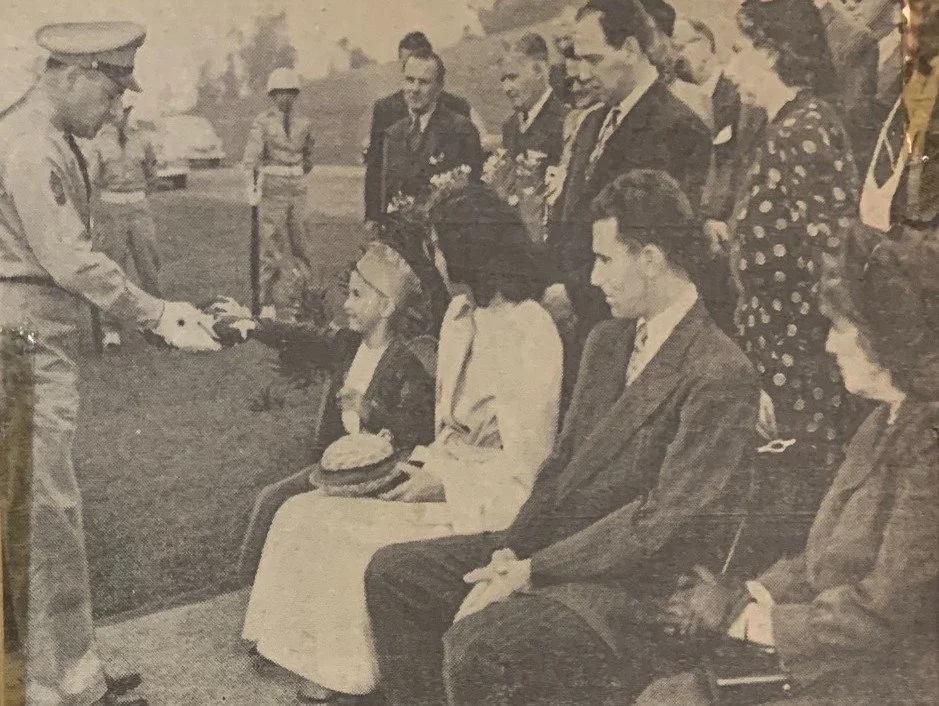
About five years after his father went missing in the Hürtgen Forest, the boy receives the folded flag at his father's funeral.
Now there are two objects, and two men. The coat on his back was his uncle's, the family who stayed. The flag in his hands is his father's, the one who was lost. One remained present long enough for the boy to grow into it. The other returned as a triangle of folded cloth. A family is often built exactly here, in the space between the one who is missing and the ones who step in.
Objects often live more than one life, and sometimes they belong to more than one story. The coat belonged first to the uncle and then to the boy. The flag marked a conclusion the child could not yet read. These are not symbols imposed after the fact. They are materials that waited.
A restored chair holds evidence in the same way. A seat rail loosens where a body settled into it, year after year. A finish goes thin where the wood was handled and not merely seen. Neither the chair nor the coat announces what it holds; each keeps the shape of its use until someone learns to read it. The coat kept a size the child had not reached. Some objects carry their meaning until the people who inherit them are ready to receive it.
One man is remembered through a folded flag. The other through a coat that remained within the family. Between absence and presence, a child was carried into adulthood.
The fuller account of this family's story appears in The Portrait of an Heirloom. The record remains even where understanding does not.
Some heirlooms are inherited. Others wait patiently until history makes them visible.
Objects in this Journal
Two family photographs (1945 and about 1950), the uncle's U.S. Navy coat, and the father's folded American flag. These remain in a private family collection.
See the collection's antique writing desks and secretaries.
Related reading
Thoughtfully Collected. Quietly Shared.
