The Velvet Courtship: An Heirloom Without a Lineage
A Victorian portrait medallion chair is a parlor seat whose crest is centered on a carved oval bust, and chairs like it were often made as matched pairs for the formal parlor. This pair, carved in walnut circa 1865–1875, carries no maker's mark and no record of the households it once furnished.
What the pair has instead is each other. Two like seats, carved in walnut to the same design, were meant to hold the symmetry of the most ceremonial room in a nineteenth-century house. The rest, the maker, the year, the family, is not recorded. Here, the pair is given the name The Velvet Courtship, and the record ends where the evidence ends.
What are Victorian portrait medallion chairs, and why were they made in pairs?
The form belongs to the Renaissance Revival tradition, a style that flourished during the third quarter of the nineteenth century within the broader Victorian period, and looked back to Renaissance and classical sources for its ornament. A portrait medallion chair sets an oval carved bust at the center of the crest, framed by paired finials, scrollwork, and a central palmette. The style was produced in more than one country, so the American origin of this pair is inferred from the form and construction rather than documented. Made as a matched pair, two like chairs let a parlor seat its visitors in balanced formality.
Seating ordered the formal parlor of the nineteenth century. It arranged conversation, etiquette, and precedence in the room a household kept for receiving guests. A matched pair gave that order physical form: two like chairs holding a fixed, formal symmetry that visitors could read at a glance. The form carries that symmetry on its own, and this pair still reads clearly with no mark to name its maker.
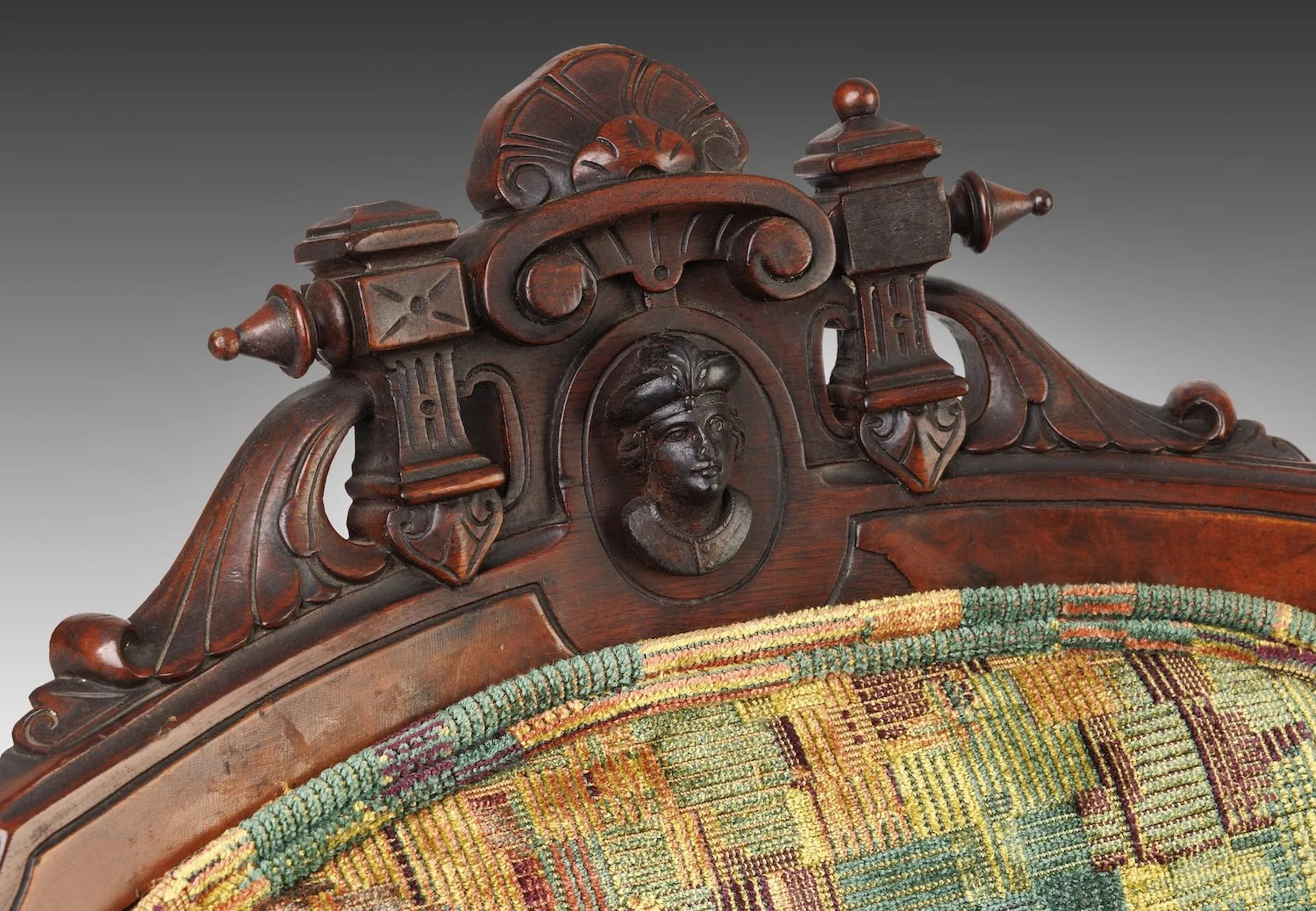
The gentleman's medallion, a bust in a plumed cap carved in relief on the walnut crest. Renaissance Revival, circa 1865–1875; American manufacture inferred. The small finial that once stood at the crown is missing, and the absence was preserved.
The Gentleman and the Lady
One crest is centered on the bust of a man in a plumed cap. The other carries a woman with bound hair. Both medallions sit in a dark, patinated finish that stands against the lighter walnut, and the material of the medallions themselves is not confirmed. The two crests do not mirror one another. They vary: the carving differs from chair to chair, worked by hand rather than duplicated.
That variation is worth pausing on. The deliberate difference between the two crests is the subject, a man on one and a woman on the other. The finer differences reflect hand carving, each medallion worked rather than mechanically duplicated. What holds them together as a pair is not perfect sameness, but a shared design interpreted by hand, close but never identical. Whether a pair of antique chairs has to match at all is a question worth its own essay, and the answer these two give is plain enough in the carving.
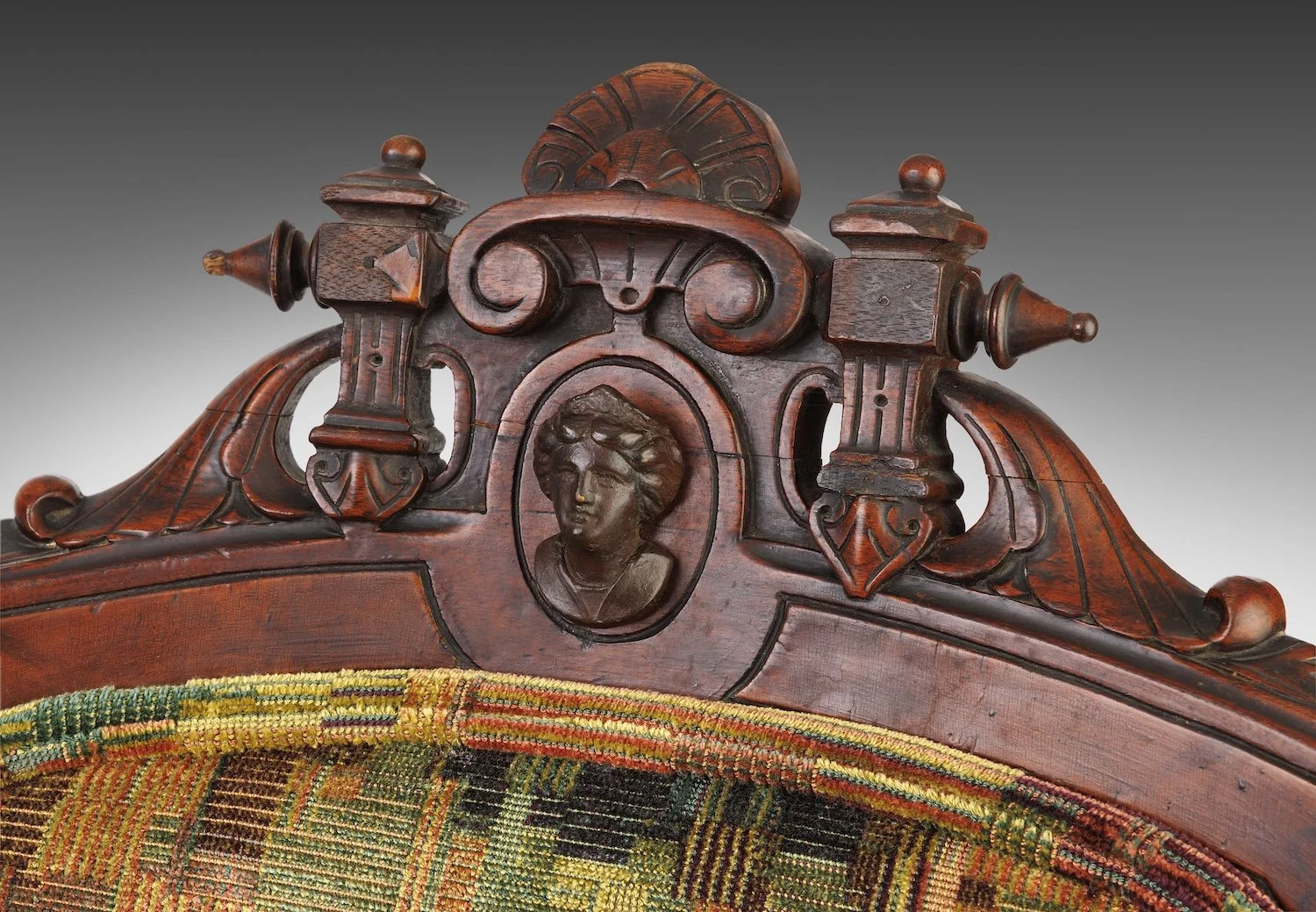
The companion medallion, a woman's bust with bound hair and a wreath, cut by hand in the same walnut. Renaissance Revival, circa 1865–1875; American manufacture inferred.
What the Restoration Kept
The chairs were reupholstered, and the carved frames were left intact through the work. The show covering is now a Pierre Frey ciselé velvet, the Gregorio pattern in the Sotto Bosco colorway, an abstract checkerboard weave in golds, greens, reds, and blues rated above 100,000 Martindale rubs for heavy use. Its warm range stays close to the tones of the walnut, so the cloth settles into the carving rather than competing with it. It is a contemporary velvet set against nineteenth-century carving, and it does not pretend to be a period textile.
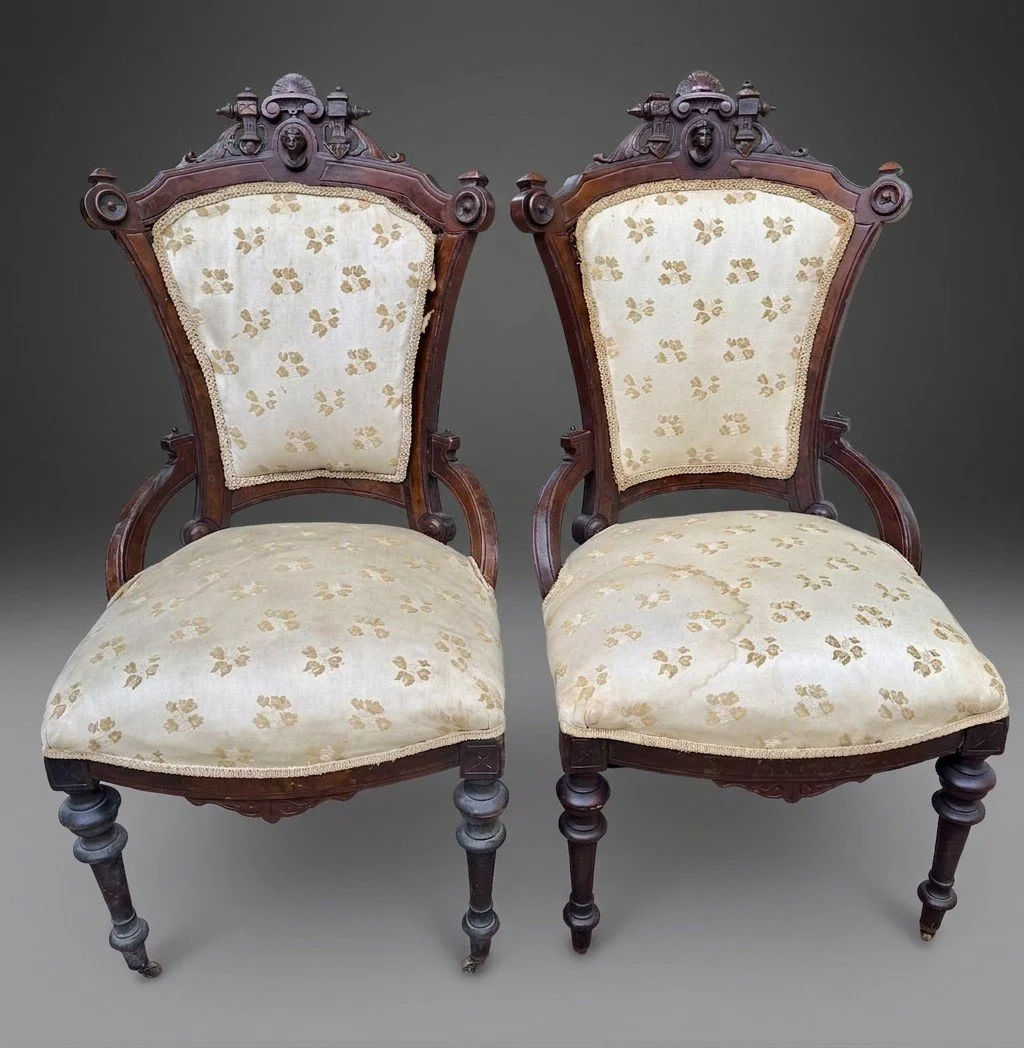
Before restoration: the pair in its earlier cream silk covering, woven with small gold floral sprigs and edged in gimp.
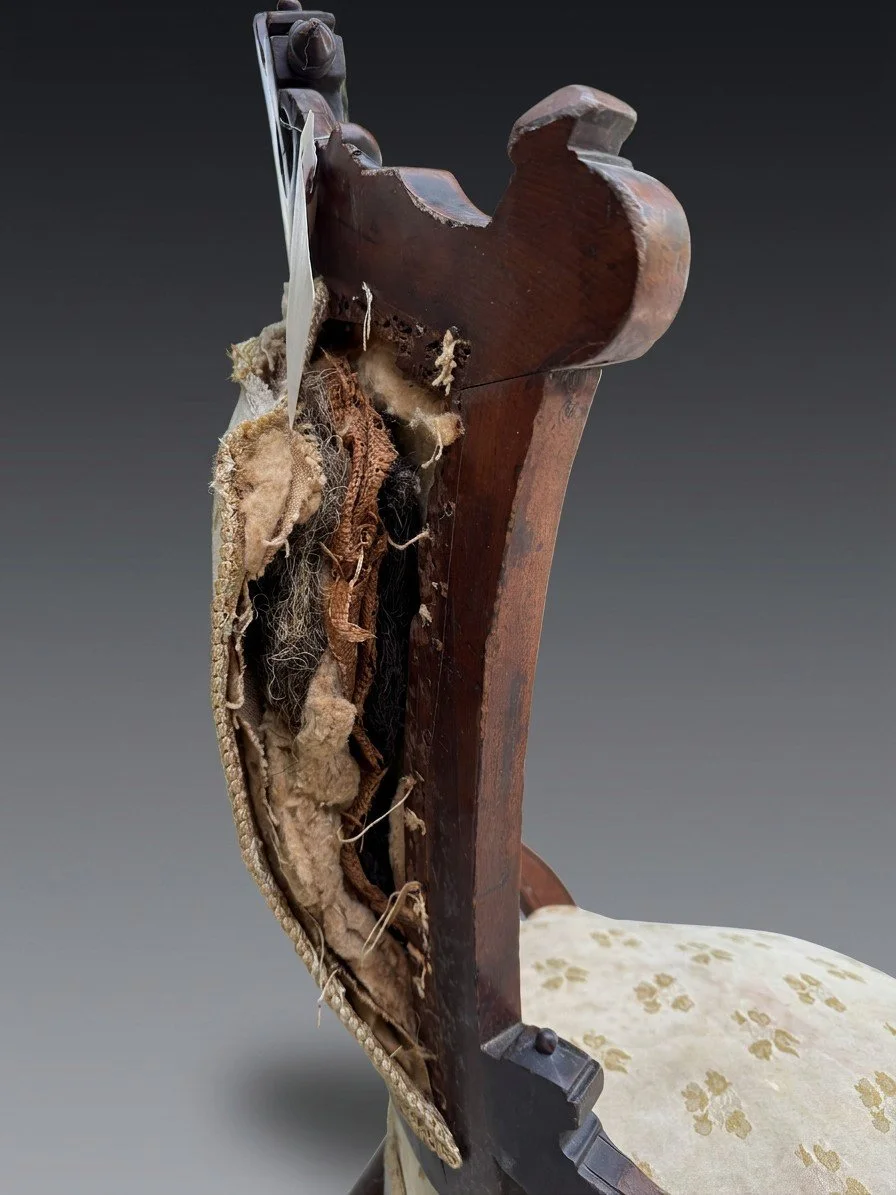
The seat opened before restoration: the original horsehair foundation over webbing and burlap, the traditional nineteenth-century build.
Beneath the covering, the construction is what the period used: mortise-and-tenon joinery throughout, a crest that is carved and pierced, incised geometric blocks at the front seat-rail corners, and a shaped front rail carrying a carved pendant. The front legs are turned and ring-turned; the rear legs are raked; the arms are low, open, and scrolled. The frames were not refinished. The original surface is retained, worn and tonally varied with age, and the turned front legs keep their darker ebonized finish above brass cup casters.
The carving carries minor age-related losses, and they fall differently on the two chairs. The raised work is rubbed at the high points on both. The gentleman's chair is missing the round turned knob from the top of one crest finial; the lady's chair has lost some of the incised X-carving from the squared blocks of its crest. The medallions themselves are intact. Both losses were left as found. They read not as damage to be corrected but as evidence that time passed through the object without undoing it.
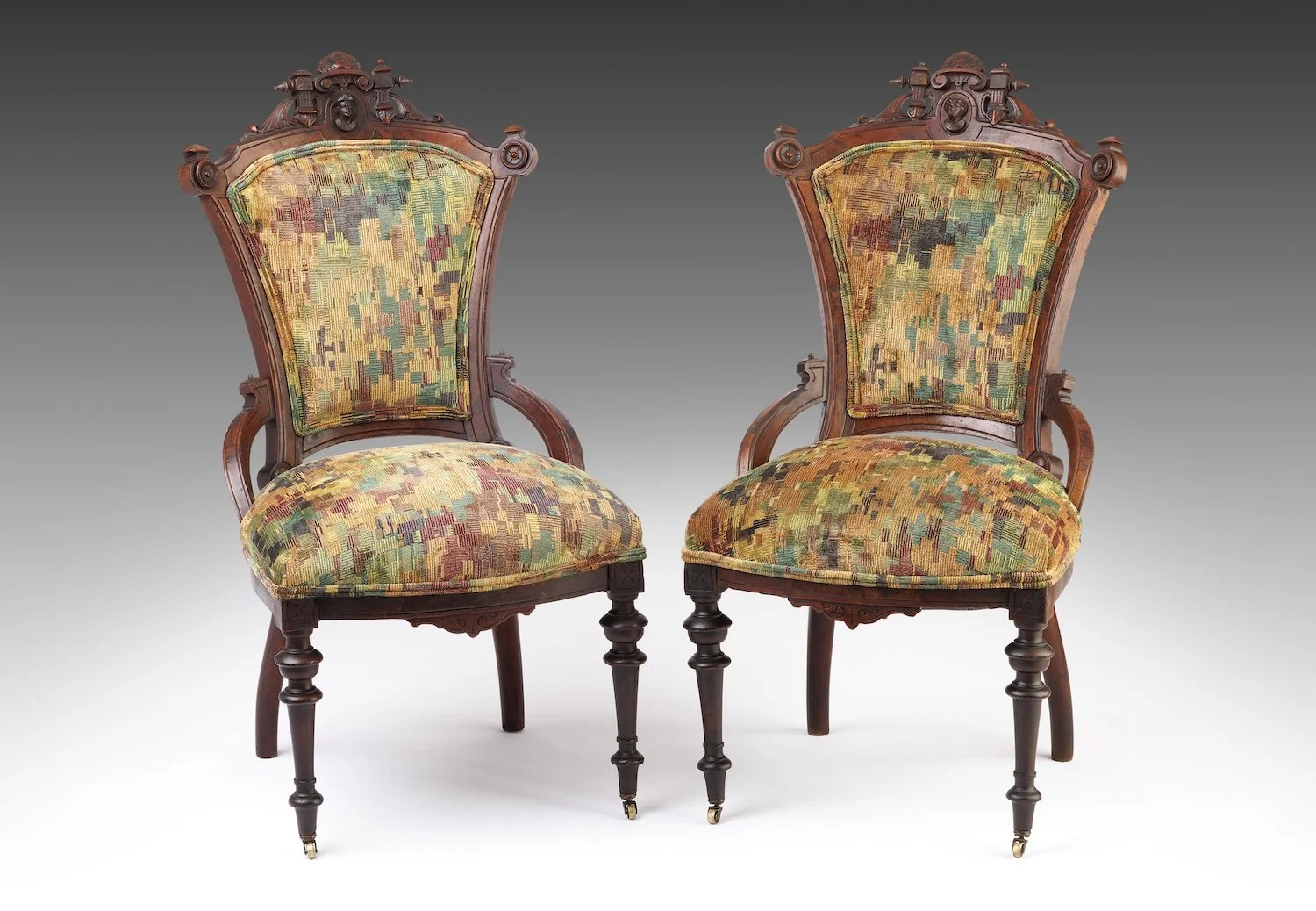
The pair as it survives, reupholstered in a Pierre Frey ciselé velvet, the carved walnut frames left intact.
A pair implies proximity. Placed side by side or across a room, two related chairs establish a visual conversation that survives whether anyone occupies them or not. This pair will never return to the household for which it was made, because that household was never recorded. What survives instead is something simpler: two objects that are still a pair, while nearly everything else about them went unrecorded. Whether they were always together, no document says. What remains is simply this: they are a pair, and that is the whole of what the record holds.
Object in this Journal
The Velvet Courtship. A matched pair of Renaissance Revival parlor chairs in carved walnut, circa 1865–1875, with portrait medallions of a gentleman and a lady, reupholstered in a Pierre Frey ciselé velvet. Acquire The Velvet Courtship
See more of the collection's restored antique seating.
Related reading
What Remains: A Pair of Restored Antique Chairs, on whether the two halves of a pair have to match. The Language of Threads, on choosing a fabric to reupholster an antique chair.
Thoughtfully Collected. Quietly Shared.
