What Remains | Restored Antique Carved Oak Chair
When an antique chair is restored with discipline, most of it is kept and very little is replaced. On the Solstice Crest, an antique carved oak armchair, the frame, joinery, and cleaned original finish were kept. Only the upholstery, the one layer intended to wear, was replaced.
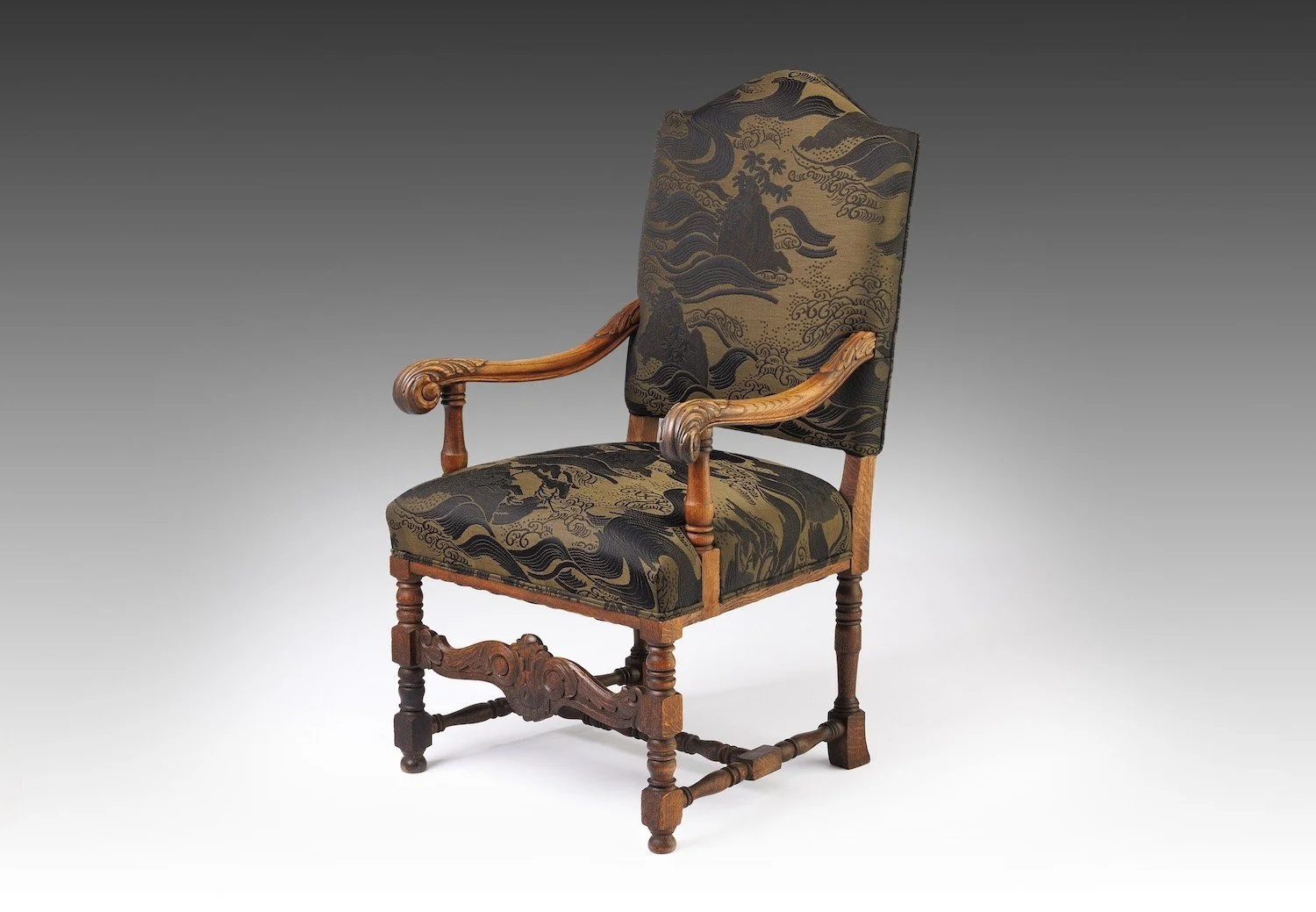
The Solstice Crest, an antique carved oak armchair, after restoration. The oak frame and its cleaned finish were kept; the seat and back were reupholstered in a Jim Thompson woven textile.
What is kept and what is replaced when an antique chair is restored?
A chair tells you which parts belong to its history and which belong to its maintenance. The frame, joinery, and finish record how it was made, handled, and lived with. Upholstery serves a different purpose. It is the wearing layer, expected to absorb use and eventually be renewed. Restoration with discipline preserves the first and replaces the second, changing nothing else unless necessary.
This distinction was understood by the furniture makers themselves. A well-made chair was built around a frame intended to outlast its upholstery, while coverings were expected to change with fashion, comfort, and use. Fabrics wore through, stuffing compressed, and coverings were replaced as part of ordinary maintenance. The wooden structure was not intended to be remade each time the surface wore out. Restoration follows that same logic by preserving what was built to last and renewing what was built to wear.
The result is an object that remains recognizably old without becoming fragile. The chair is structurally sound, yet the evidence of decades of handling remains visible in the wood. Restoration has not tried to erase age. It has simply returned the chair to use.
What Was Kept
The Solstice Crest is hand-carved from solid oak. Its turned legs are bound by a shaped, carved stretcher, and its arms reach forward in a restrained curve, ending in carved volutes. The carving follows the structure rather than disguising it, so the chair reads as a single carved form. That frame was left as it stood. The original joinery still holds, so nothing structural needed to be rebuilt.
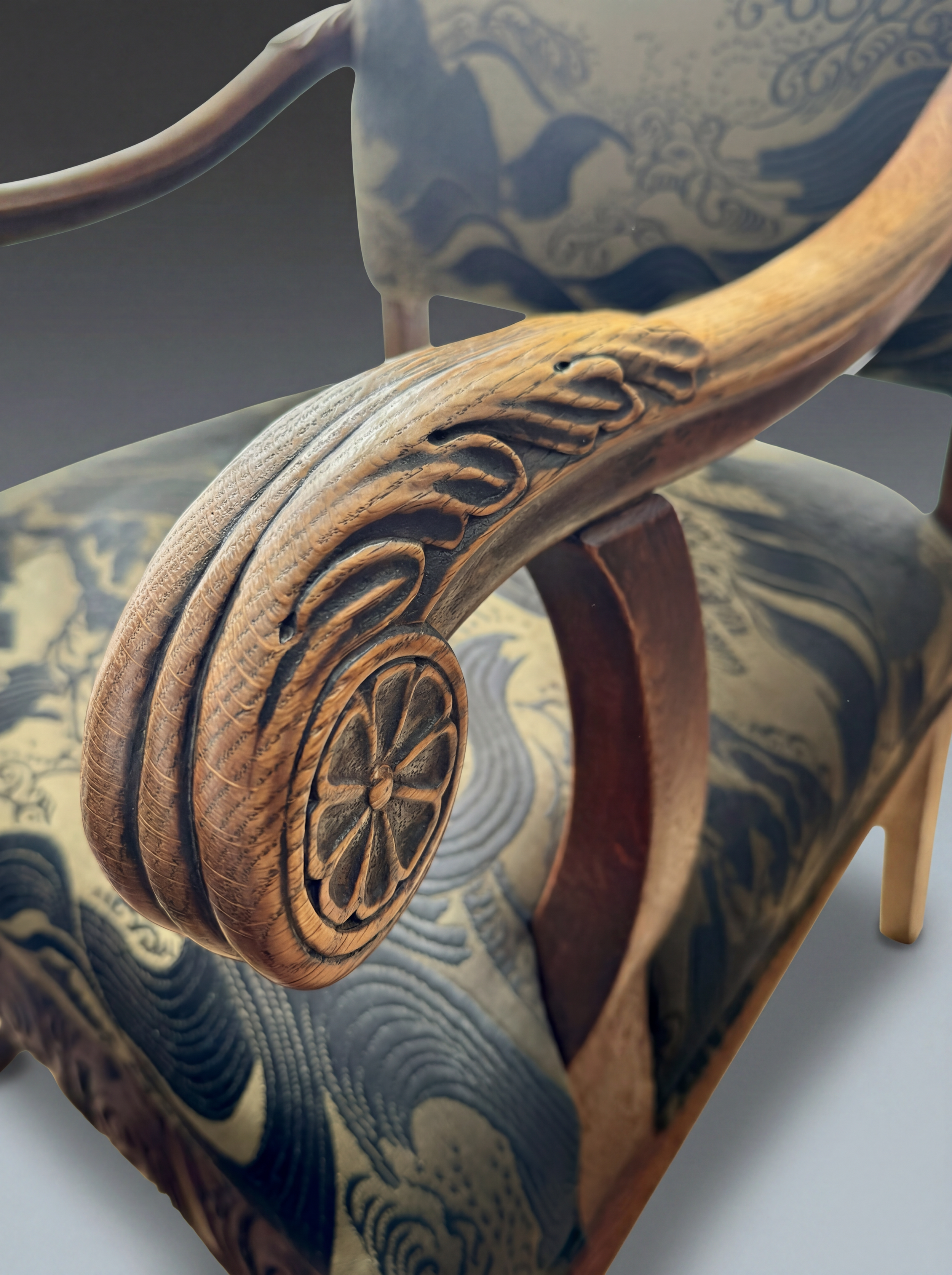
The carved arm of the Solstice Crest. Along the outer curve the tone deepens through repeated contact; the finish was cleaned rather than refinished, so this record remains legible.
The finish was cleaned, not stripped. The wood was neither sanded nor stained, so the tonal variation across the oak and the patina it has gathered remain legible.
The arms carry the clearest record. Along the outer curve the tone deepens where hands repeatedly rested and pressed. The surface has become smoother through repeated handling, and the carved terminals have softened at their edges. None of these changes weakens the chair. Together they form the visible record that careful restoration exists to preserve.
What Was Replaced
Only the upholstery was replaced, because it had stopped doing its work. The earlier textile had relaxed beyond the tension needed to define the frame beneath it. A covering that no longer performs its function is not evidence to preserve; it is the one component meant to be renewed.
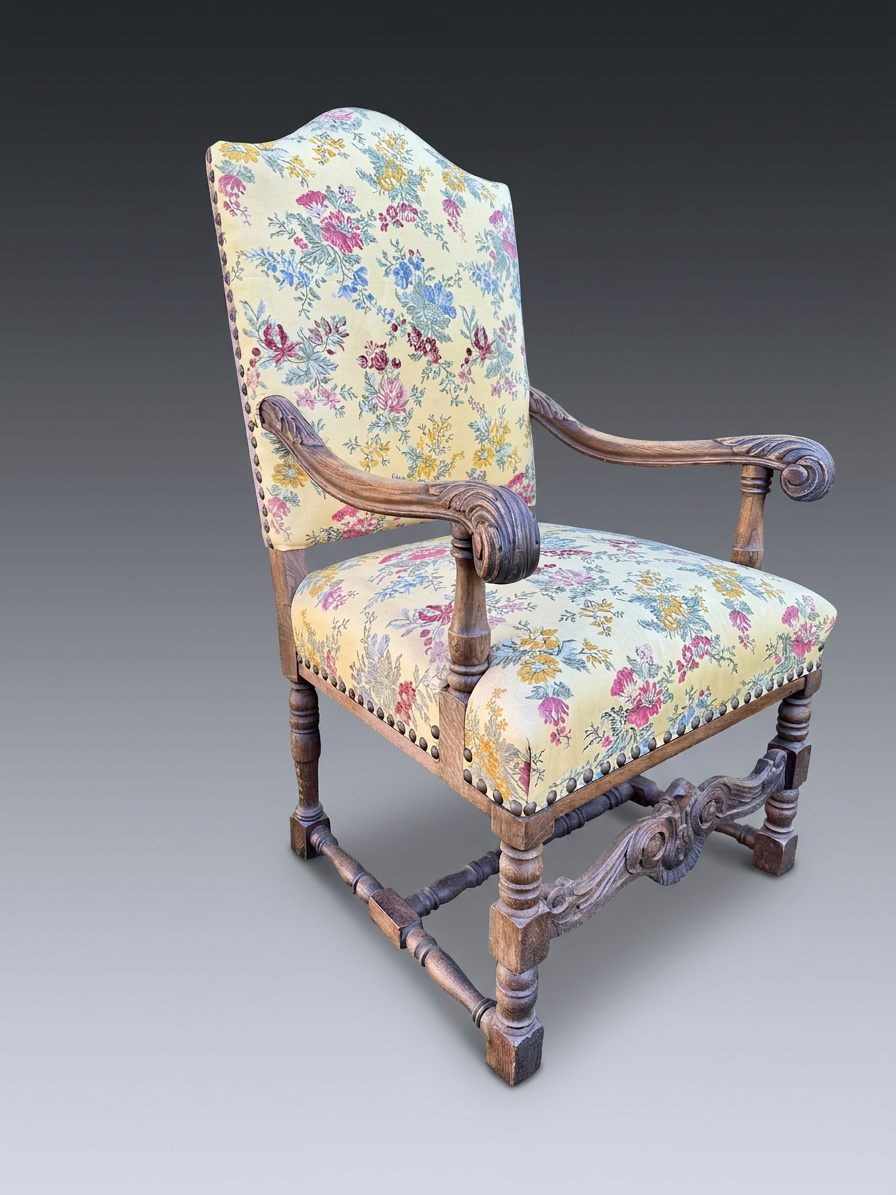
The Solstice Crest before reupholstery. The carved oak frame and its cleaned finish were retained; only the show covering, which had lost its tension, was replaced.
The replacement is a Jim Thompson woven textile in a restrained bronze field, a cotton-polyester blend suited to light domestic use. Its low, even surface lets the carved oak remain visually dominant, while the new upholstery, drawn to its proper tension, restores the crisp profile of the back and seat. Rather than compete with the carving, it gives the frame a quiet ground from which the carving can be read.
Kept and replaced are not opposites here but a single discipline. The chair leaves the workshop looking neither untouched nor remade. It leaves looking like itself, prepared for ordinary use. Restoration has not erased its age. It has simply allowed its working life to continue.
Object in This Journal
The Solstice Crest. An antique carved oak armchair, one half of the Cliffs of Gold pair. The oak frame, its joinery, and the cleaned original finish were kept; only the upholstery was replaced, in a Jim Thompson woven textile.
Related Reading
What Remains | A Pair of Restored Antique Chairs
Thoughtfully Collected. Quietly Shared.
