The Afterlife of Objects: Why Antiques Still Matter
Antique furniture still matters in a modern interior because it carries something a new object cannot: evidence that a form was worth keeping. A matched pair of Victorian reclining parlor chairs, made between 1870 and 1900 and found in the window of a thrift shop, still reclines on its original mechanism, and that persistence is the evidence this essay examines.
Many contemporary furnishings are designed around efficiency, trend, and ease of replacement. Antiques stayed for a different reason. They remained useful. Their proportions kept working, their presence continued to matter, and fashion moved on without taking them along.
Why does antique furniture still matter in modern interiors?
The answer is not sentiment but use. The anthropologist Arjun Appadurai, in the 1986 volume he edited, The Social Life of Things, argued that objects have social lives of their own: their meaning is written in how they are used and the hands they pass through, not fixed at the moment they are made. Long before interiors were recorded in images or text, they were recorded in the objects a family kept. To study old furniture is to study what stayed.
The objects selected for restoration are chosen with that test in mind. Chairs, benches, and settees that have survived several generations rarely did so as protected artifacts. They survived because someone kept sitting in them. An antique often survives by remaining useful rather than by being set apart, and the objects that reach us are the ones that were never quite ready to be retired..
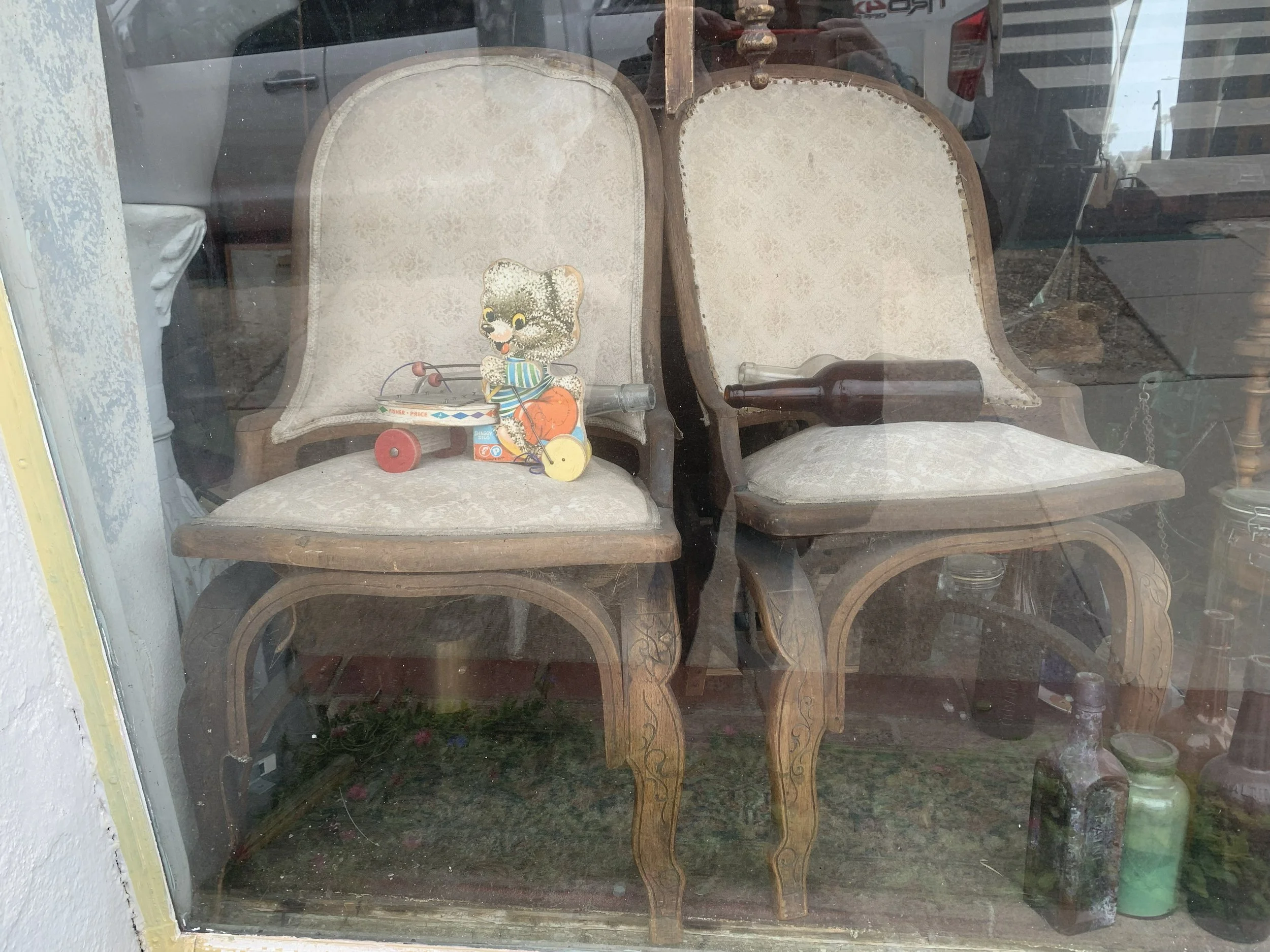
The Crimson Canopy as found in a thrift shop window, before restoration. The pair still wore its earlier upholstery, and the spring-back mechanism was not visible from the front.
The Chair in the Window
Before it became The Crimson Canopy, the pair sat in the window of a thrift shop, its form intact and its authority muted by neglect. Nothing set it apart from what surrounded it. Even its mechanism stayed hidden: the back reclined, but discreetly, the movement concealed within the structure.
That much came to light only on contact. A hand on the back found that it tilts rearward on a single coil spring and rights itself when released, while the seat stays fixed: a self-returning reclining back, what the period trade called a self-acting reclining chair. The spring sits in a steam-bent or laminated frame, and the mechanism appears integral to the chair rather than added later, though no maker's mark or patent survives to confirm it. The chairs stand on a close-grained hardwood consistent with beech, and they measure nineteen inches wide by fifteen deep by thirty-five high, with the seat set at eighteen. None of that declares itself across a room. Old furniture tends to withhold its complexity rather than advertise it, which is one reason it rewards a second look.
Reading an object this way, from its wear and its joinery rather than its label, is its own discipline, and one worth learning to do slowly.
What Restoration Keeps
Restoration, approached with restraint, is continuation rather than transformation. On this pair the frames were refinished in an ebony stain applied during the work, not original to the chairs, and both original mechanisms were retained and left operational. The seats were rebuilt with new padding and reupholstered in Pierre Frey's Broderie Le Rocher, an embroidery worked in crimson, chestnut, soft rose, and pale blue. The surface reads differently now, but the period structure remains evident beneath it.
What the chairs became does not erase where they were found. The condition they arrived in is part of their record, and a restrained restoration leaves that record readable rather than scrubbing it away. The objects chosen for this work are kept legible on purpose. The aim is not a new object. It is an old one allowed to keep working.
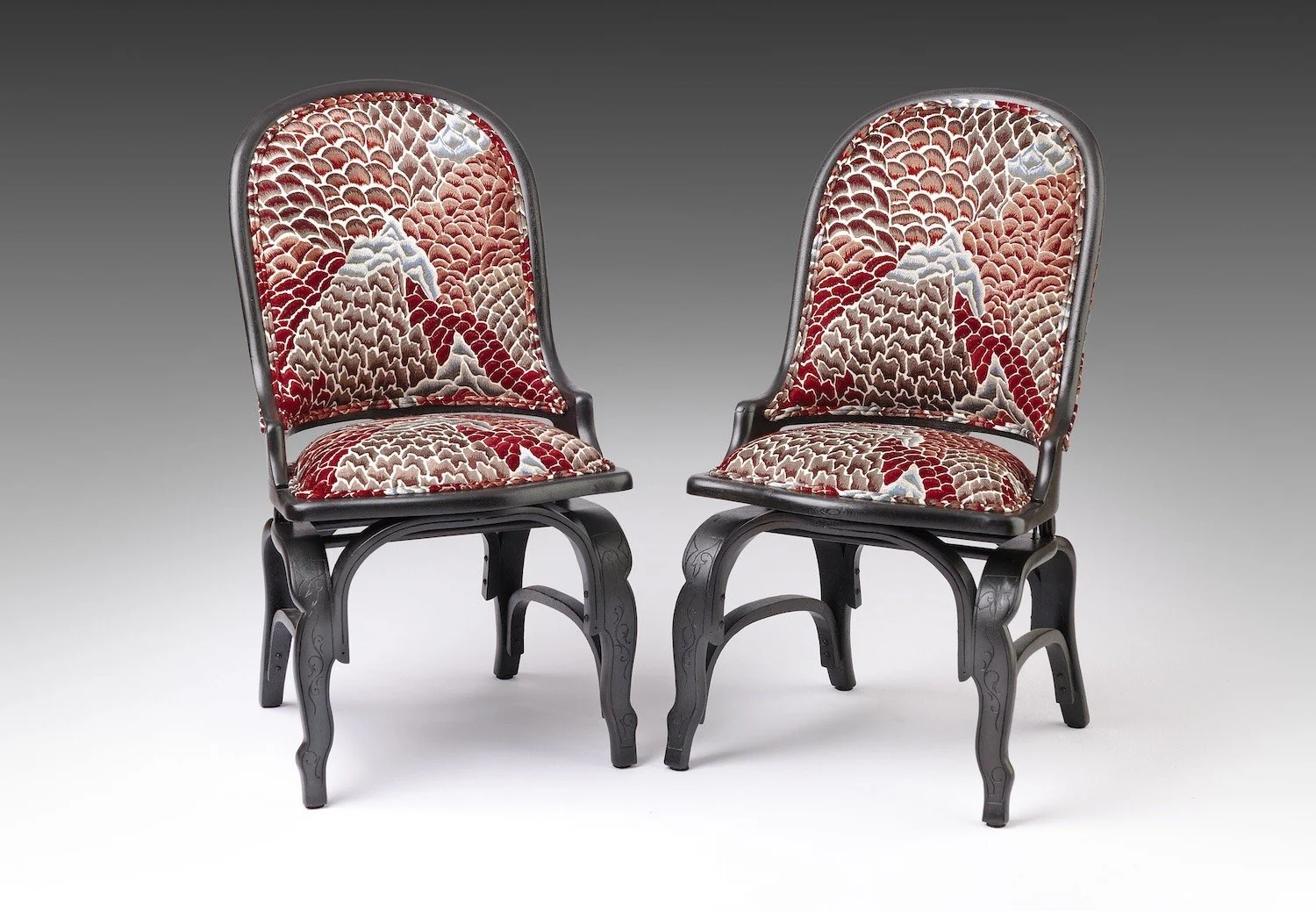
The Crimson Canopy after restoration: the matched pair, ebonized frames reupholstered in Pierre Frey Broderie Le Rocher.
In a room, a single antique chair changes the balance of everything near it. It gives the eye a place to settle and offers contrast without argument. It does not dominate the room. It anchors it, which is why the quietest interiors often turn on one old object rather than many new ones.
Value here is not a matter of novelty. It sits in how long something has been worth keeping, and in whether it can go on being used. The chairs that reach a second life are the ones that were never designed to disappear.
Object in this Journal
The Crimson Canopy. A matched pair of Victorian reclining parlor chairs, circa 1870–1900, ebonized and reupholstered in Pierre Frey Broderie Le Rocher, their original recline retained. Acquire This Pair
See more of the collection's restored antique seating.
Related reading
The Rose Obscura: On the Intimacy of Seating
The Bench Was Empty: A Love Letter from 1919
Thoughtfully Collected. Quietly Shared.
