The Rose Obscura: On the Intimacy of Seating
A tub chair is a seat whose back curves in one continuous line from arm to arm, low and close, so that the sitter is held rather than presented. The Rose Obscura, an early twentieth-century parlor tub chair, feels intimate for a reason that is structural rather than atmospheric: the curve turns the body inward, and the low arms shorten its reach.
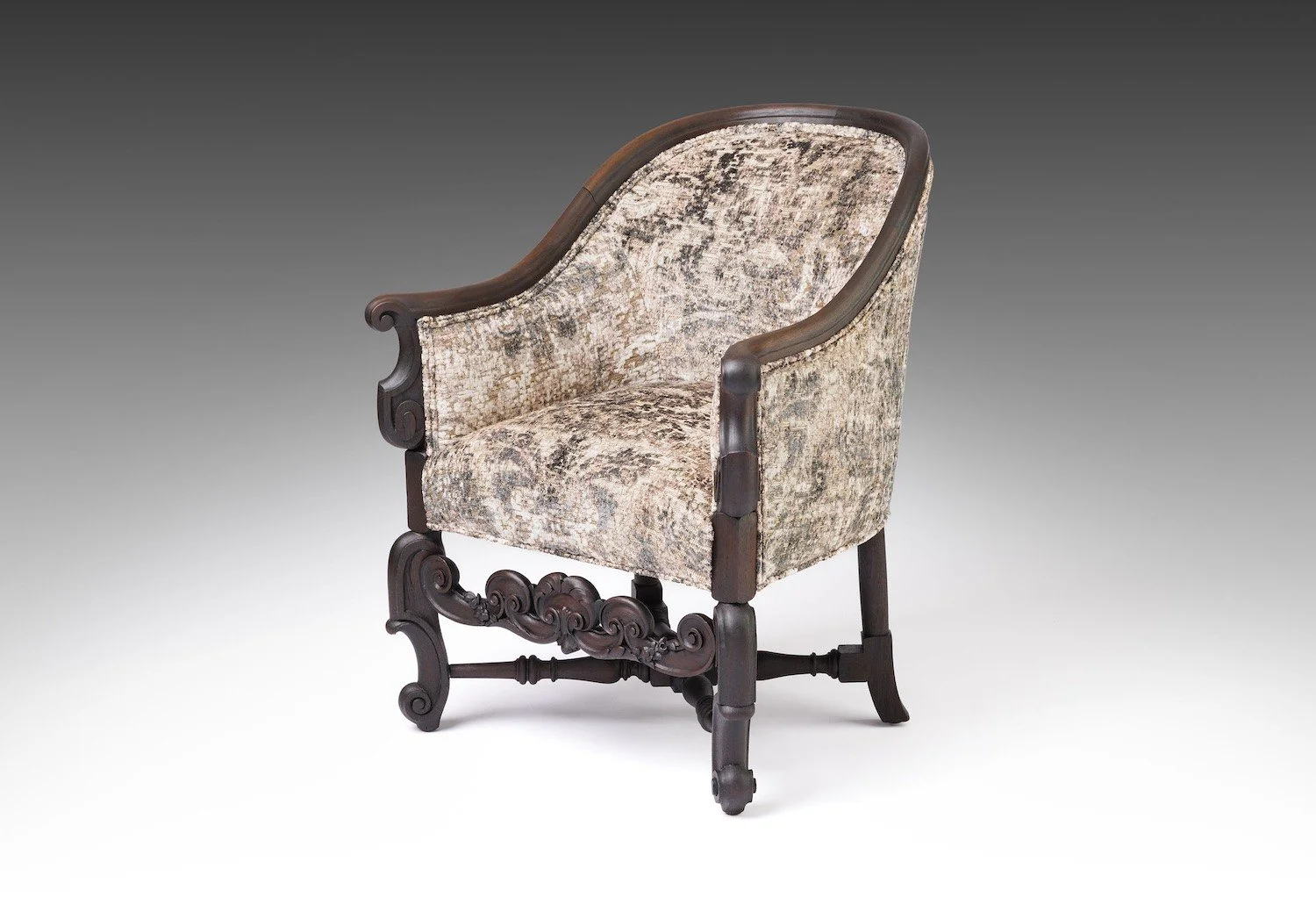
The Rose Obscura, an early 20th-century parlor tub chair, its continuous curved back and low arms upholstered in Black Edition "Jacinta Rhodonite" velvet.
What is a tub chair, and why does its form feel intimate?
A tub chair is defined by its shape rather than its maker. Its back is semicircular, and it joins the low arms in one continuous upholstered piece, so the seat encloses on three sides. The English name describes that enclosing shape, recalling the rounded walls of a tub, and it was already in use two centuries ago: the Metropolitan Museum of Art holds an early nineteenth-century British drawing titled Design for Three Tub Chairs.¹
The enclosing form is older than the English word for it. In eighteenth-century France, the Rococo pursuit of comfort produced the bergère, a chair with closed, upholstered arms made for longer and easier sitting.² The rounded version, whose back curves without a break into the arms, was called en gondole: the Louvre keeps a gondola bergère of 1808, its frame carved and gilded, made during the Empire period.³ By the middle of the nineteenth century, the same rounded form appears in English work, plainer, in the gondola armchair of about 1830 to 1860 recorded by the Metropolitan Museum of Art.⁴
The Rose Obscura carries that habit into the early twentieth century. It measures 27 inches wide and 23 deep, standing 33¼ inches high, with the seat 18 inches from the floor. Its compact width and depth reinforce the chair's enclosing form. The frame is carved hardwood; the species is not confirmed because the finish obscures the grain. Below the seat, a carved scroll stretcher is cut in low relief, with turned cross-members beneath it and legs that splay outward. These elements are consistent with the revival styles of the early twentieth century; on the evidence of its form, the chair is dated circa 1900 to 1925. The maker is not recorded, no mark has been found, and nothing of its earlier ownership survives.
Intimacy, here, is a matter of measurement before it is a matter of mood. A chair that encloses on three sides and holds its arms low leaves less room for outward gesture. The body settles toward the center.
The Form That Turns Inward
Seating records the body more directly than any other furniture. A table holds what is set on it. A cabinet holds what is placed inside. A chair answers posture: it takes weight, meets pressure, and over years keeps the shape of how a person preferred to sit. The tub chair narrows that exchange further. Its continuous back and arms limit lateral movement more than an open armchair, gathering the body into a single, centered position.
Furniture of this kind is often called accent or occasional seating, as though its role were supplemental. The classification is incomplete. A chair that draws the body inward becomes a fixed point in a room, not because it commands the space, but because it is where movement stops.
The upholstery follows the same restraint. The chair is covered in Black Edition "Jacinta Rhodonite" velvet, woven in the United Kingdom, in rose, mauve, and charcoal over a gold-toned ground. The colors hold together rather than contrast. At a distance the surface stays quiet; up close it deepens. The velvet does not announce the chair. It lets the form do the work.
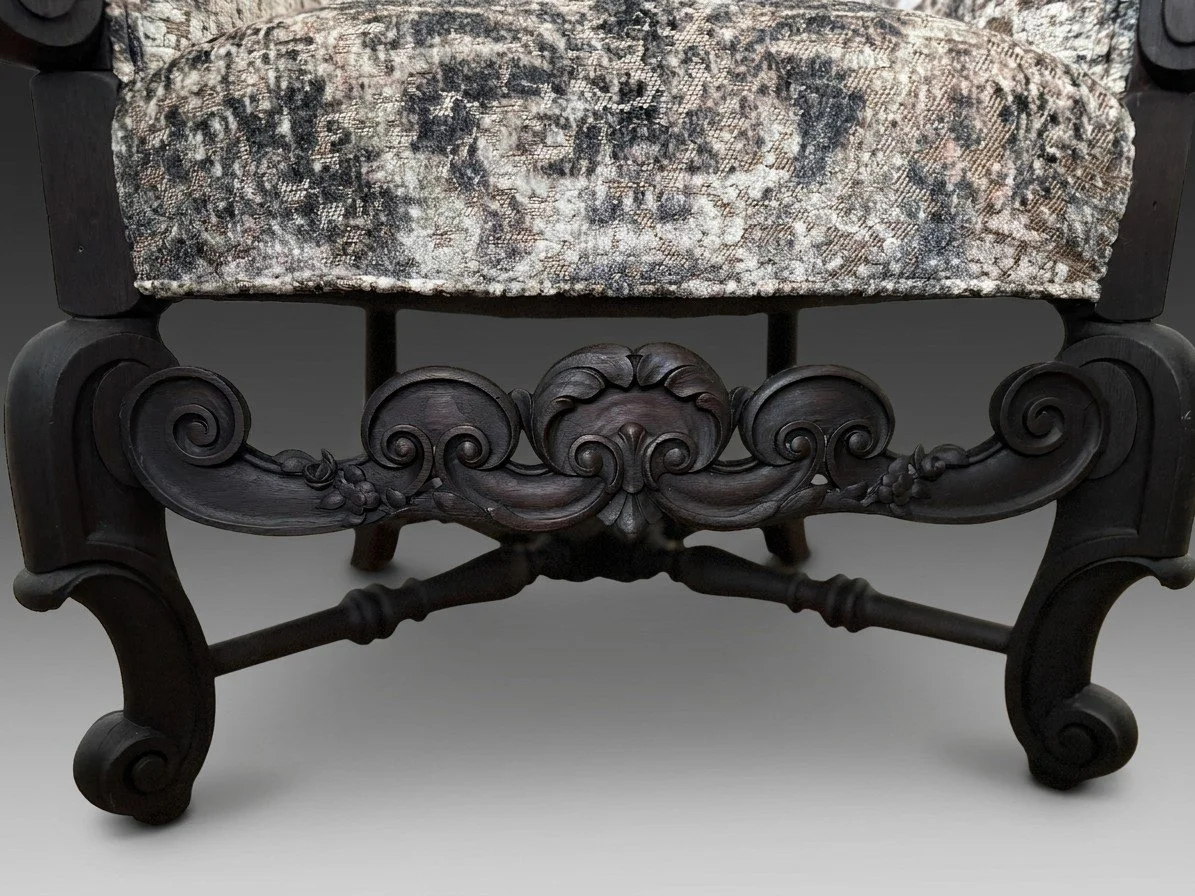
Carved scroll stretcher in low relief with turned cross-members below, on the tub chair's refinished hardwood frame.
What the Restoration Kept
The Rose Obscura has been restored, and the honest account matters more than the result. The frame was refinished in a dark, even stain. That stain is not the original surface; it was applied in restoration. The seat and back were reupholstered in the current velvet. A crack in the seat frame was stabilized with two support brackets, and the chair is now sound and sturdy.
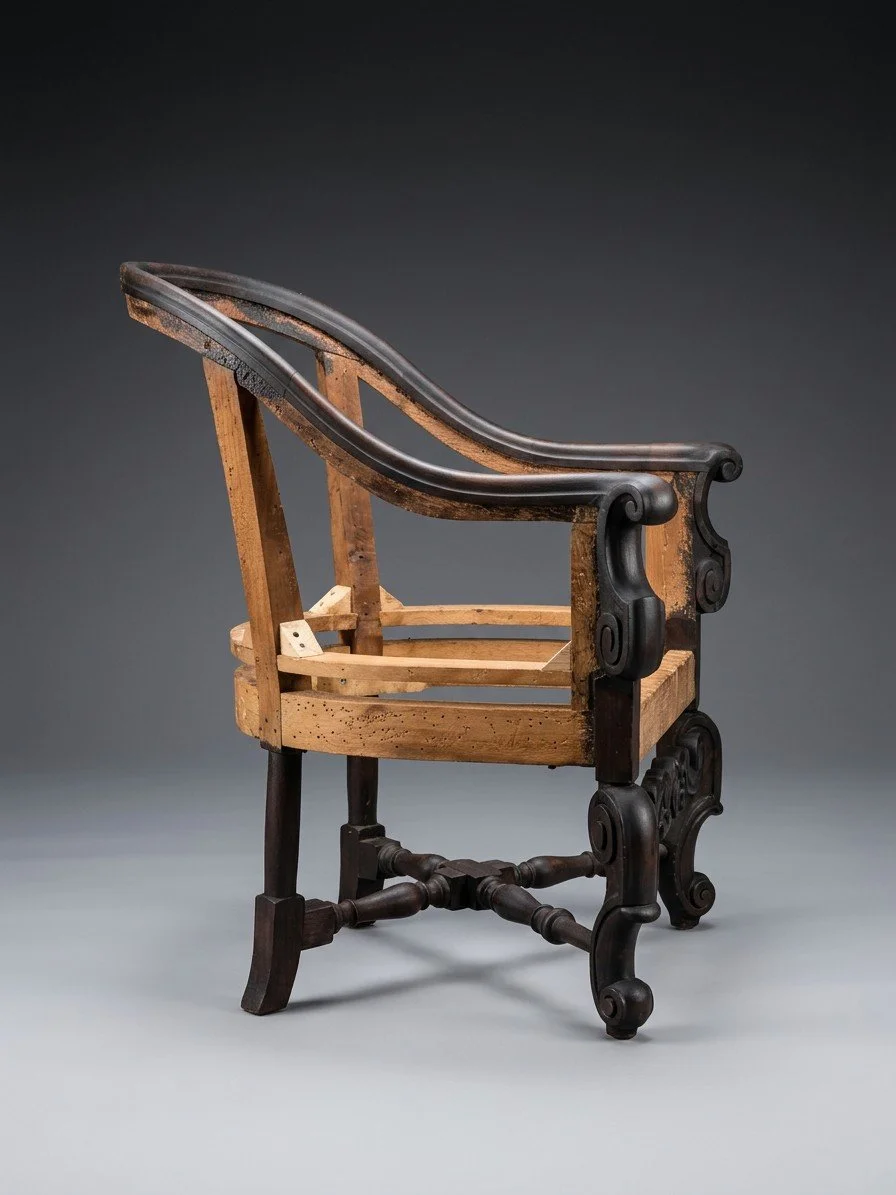
The frame during restoration, before reupholstery. The crest rail and arms carry the dark stain, which is not the original surface; the seat rails are bare where the new upholstery attaches.
None of that work changed what the chair is for. The enclosing curve is in the frame, and the frame held. What restoration renewed was the surface through which the chair receives the body, not the geometry that turns the body inward. The intimacy is built into the frame, not applied to the surface. A chair like this can be reupholstered again in fifty years, in another color, and it will still gather whoever sits in it toward its center.
Some furniture arranges a room. This chair arranges the person in it, and then holds still.
Notes
Anonymous, British, Design for Three Tub Chairs, early 19th century. Pen and ink, brush and wash, watercolor. The Metropolitan Museum of Art, Harris Brisbane Dick Fund, 1938 (38.37.75). https://www.metmuseum.org/art/collection/search/386825
Daniëlle O. Kisluk-Grosheide, "French Furniture in the Eighteenth Century: Seat Furniture," The Metropolitan Museum of Art, October 2003. https://www.metmuseum.org/essays/french-furniture-in-the-eighteenth-century-seat-furniture
Fauteuil gondole (bergère), 1808, attributed to François-Honoré-Georges Jacob-Desmalter, with upholstery by Michel-Jacques Boulard. Musée du Louvre, Paris. https://collections.louvre.fr/en/ark:/53355/cl010110042
Gondola armchair, probably British, ca. 1830–60. The Metropolitan Museum of Art. https://www.metmuseum.org/art/collection/search/461345
Object in this Journal
The Rose Obscura. An early twentieth-century parlor tub chair, carved hardwood frame refinished, reupholstered in Black Edition "Jacinta Rhodonite" velvet. Acquire The Rose Obscura
See more of the collection's restored antique seating.
Related reading
Reading Furniture Like a Text: Wear and Patina — how wear and patina record use.
The Chair, the Bench, and the Spaces In Between — what seating in old photographs records of a life.
Thoughtfully Collected. Quietly Shared.
