 Image 1 of 3
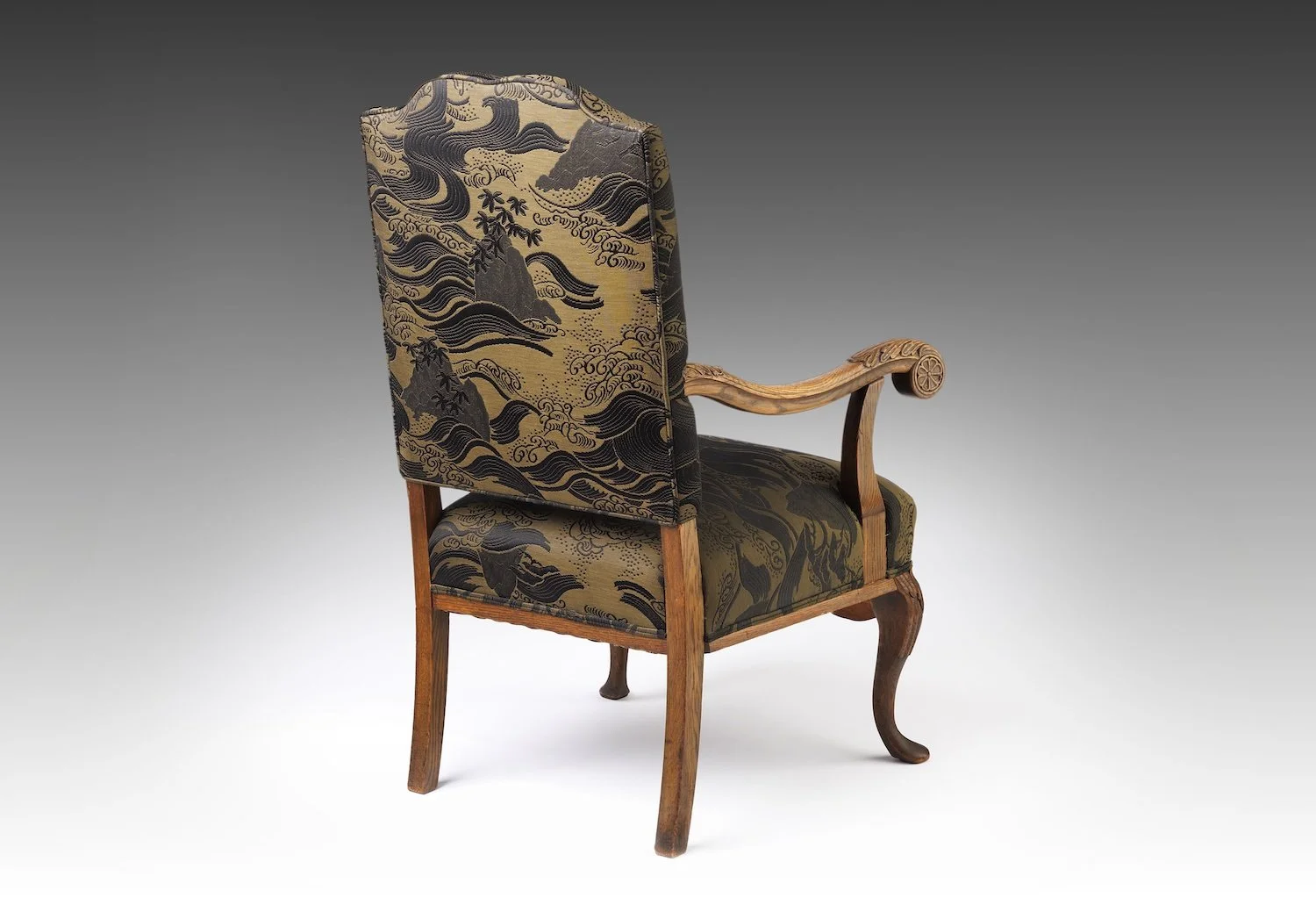 Image 2 of 3
 Image 3 of 3
Living With This Object
The following images are AI-generated visualizations intended to illustrate scale, proportion, and possible interior settings. They are conceptual, not photographs of the object in an existing room, and they preserve the documented proportions, finish, hardware, repairs, mirror, and construction of the piece.

-
Its height and carving let the chair anchor a room rather than furnish it: place it at the head of a long dining table, in a library or study, or standing alone in an entry hall. It was conceived as one half of a sculptural pair in the house's Cliffs of Gold Collection, and where a doorway or hearth calls for symmetry it can be joined by its counterpart, The Solstice Crest. Because the outer back is covered in the same textile, the chair also holds its own floated in the middle of a room, not only against a wall.
-
Type: Open-arm armchair; the Gainsborough (library armchair) form
Style: Gainsborough style, the 18th-century English open-arm form known in the period as a "French chair"
Date: Circa 1890–1910 (on stylistic grounds)
Origin: Not established (unmarked)
Provenance: Most recent documented acquisition through a Los Angeles auction
Material: Carved show-wood consistent with oak (catalogued as oak at auction; not independently tested)
Finish: Original, aged; retained, not refinished
Construction: Show-wood frame consistent with oak; carved arms, apron, and front legs; stuffed seat and back; internal foundation and joinery not yet examined
Maker & Origin: Unattributed; no mark located
Condition: Sound; restored; recently reupholstered; aged original finish retained
Dimensions: 25¾ W × 23¼ D × 46 H in.; seat height 21½ in
Upholstery: Jim Thompson 'Railay' weave, Bronze colorway, reupholstered (see The Jim Thompson 'Railay' Weave)
Cushions: Two, accompanying the chair, recovered in the same Jim Thompson 'Railay', Bronze colorway
-
Original: The carved show-wood frame throughout, consistent with oak, and its aged original finish, retained.
Replaced: The show covering. The seat and back were recovered in Jim Thompson 'Railay' and the prior covering was removed.
Reconstructed: No elements were reconstructed.
Repaired: No structural repairs were required or observed; the frame is sound.
Finish Work: No finishing work was carried out. The frame was not stripped, touched in, or refinished during reupholstery; age and surface character were deliberately left legible.
-
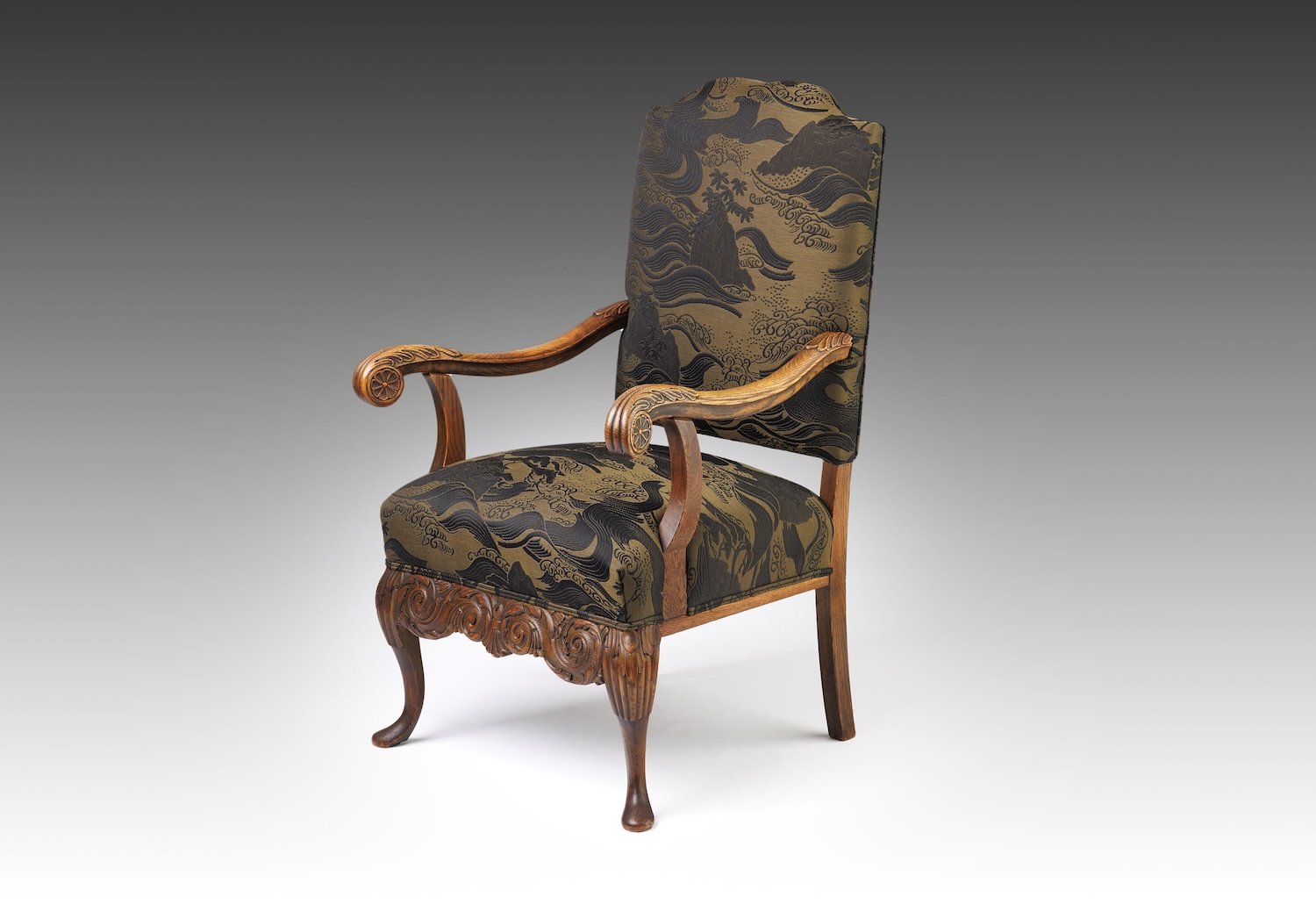
Each arm sweeps down to a carved rosette patera set within a fluted, lobed scroll. The seat rail carries a continuous, shaped apron of bold C-scrolls and acanthus, centered on a fluted shell drop, and the cabriole front legs are carved with acanthus at the knee and finish in plain pad feet. The carving is worked into the solid frame rather than applied, and the relief runs continuously from one element to the next, so the carved members read together rather than as separate motifs and hold up at close range.
-
The covering is Jim Thompson's 'Railay' in the Bronze colorway, chosen for this restoration rather than original to the chair. It is a woven cotton and polyester cloth in a warm metallic bronze, and its abstract pattern of scrolling waves builds depth through texture and restrained tonal variation rather than contrast. On this frame the pattern earns its place: the woven scrolls echo the carved scrolls of the arms and apron, so cloth and carved frame come to read as one composition. Optional matching pillows in the same textile are available.
Manufacturer: Jim Thompson
Pattern: Railay, colorway Bronze
Design: Abstract scrolling-wave pattern
Composition: 67 percent cotton, 33 percent polyester (as stated by the manufacturer)
Performance: Rated by the manufacturer at Martindale 13,000 rubs, for light domestic use
Care: Manufacturer care guidance not documented in the record
Textile origin: Thailand (Jim Thompson)
Reupholstered: Yes; seat and back recovered in this restoration
-
No maker's mark, label, or stamp has been located, and no documentation naming a maker accompanies the chair, so it is offered unattributed. Its design lineage is the Gainsborough armchair, also called a library armchair: the wide, high-backed open-arm form of mid-18th-century England, known in the period as a "French chair" for its Louis XV Rococo influence. This example revives that form rather than descending from the period, since the style points to a circa 1890–1910 date rather than an 18th-century one. The date is an inference from style, held as a range and not narrowed to a single year; construction has not yet been examined, and because the Gainsborough form was reproduced continuously into the 20th century, the range will be revised if construction evidence narrows it. The country of manufacture is not established; the chair carries no mark to settle it, and the style descriptor is not a claim of place.
-
The show-wood is a coarse, open, ring-porous hardwood whose grain and ray figure are consistent with oak, and the chair was catalogued as oak at auction; the species has not been independently tested, so it is recorded as consistent with oak rather than as a confirmed identification. The carving is concentrated where the hand and eye naturally fall. The arms scroll forward and down, each ending in a carved rosette patera; the apron is shaped and carved with scrolling acanthus; and the front legs are cabriole, ending in pad feet. The carved ornament is composed principally of scrolling acanthus foliage and volutes rather than naturalistic botanical carving. The rear legs are comparatively plain and rake backward, as is typical of the form. The tall back rises to a shaped crest, while the seat and back are stuffed and upholstered. The internal seat foundation and the frame joinery have not yet been examined, so no claim is made about springing or about a construction-based date.
-
Three chapters are legible. The first belongs to the form: the Gainsborough open armchair, an English 18th-century library-chair type, known in its day as a "French chair" for its Rococo influence, where carving worked as architecture and a chair was built to order a room as much as to seat one person. The second is this chair's own making, circa 1890–1910 on present stylistic evidence, when that form was reproduced by an unidentified maker in an unestablished country; only the object itself speaks to this chapter, and construction evidence, once examined, may adjust the date. The third is recent and documented: its acquisition through a Los Angeles auction, the earliest documented point in its history, followed by its restoration for Acanthus Home, recorded under Condition & Restoration, in which the covering was renewed while the aged original finish was deliberately retained. No ownership records predate that sale, and the maker, the first rooms it stood in, and the route it travelled remain unknown. The record ends where the evidence ends.
-
Is this an antique or a vintage chair? Antique, on the present evidence. The chair is catalogued as circa 1890–1910, an informed inference from the Gainsborough style rather than a documented date. Even at the latest end of that range it predates 1926, the cutoff Acanthus uses for antique rather than vintage. Because the Gainsborough form was also reproduced later in the 20th century, this classification rests on the stylistic date and will be confirmed, or revised, when the chair's construction is examined.
What wood is the frame? The show-wood is consistent with oak. It was catalogued as oak at the auction where the chair was acquired, and the coarse, open, ring-porous grain and ray figure visible under the aged finish support that identification, but the species has not been independently tested. The record therefore says "consistent with oak" rather than naming it as confirmed, in keeping with the house rule to describe rather than name an untested wood.
Has it been reupholstered, and what was restored? Yes. The seat and back were recently recovered in the Jim Thompson textile, and the earlier covering was removed. The restoration stopped there: the frame was not stripped, repaired, or refinished, so the surface you see is the chair's aged original finish, kept intact.
Why a new Thai textile on an antique European chair? Because the reupholstery is documented as restoration, not disguise. The covering is stated plainly as a choice of this restoration, never passed off as period fabric, and it was selected so the weave would converse with the carving (see The Jim Thompson 'Railay' Weave). Nothing about the cloth is claimed as history.
Is the fabric durable enough for daily use? The maker rates the weave at Martindale 13,000 rubs, a light-domestic figure by upholstery standards. That suits occasional and accent seating, a reading chair or a head-of-table seat, rather than heavy daily use. Optional matching pillows in the same textile are available.
Are the cushions part of the chair? Two cushions accompany it. They appear with the chair in the photograph taken before restoration, in its earlier covering, and again afterwards in the Jim Thompson weave, so they came with the chair and were recovered alongside the seat and back. Both are included with the chair.
Where did the chair come from before Acanthus Home? The earliest documented point in the chair's history is its acquisition through a Los Angeles auction, in the same sale as its counterpart, The Solstice Crest. No earlier ownership records accompanied it, so the identities of previous owners, the country in which it was made, and the interiors it once occupied remain undocumented.