Beyond the Label: How Antique Furniture Is Identified
An antique chair almost always arrives already named. The real question is whether the name is true and answering it means setting the label aside and reading the object itself: its form, its wood, its construction, and the age those things will and will not support. Identification is that patient work, and it is most of what a curator does.
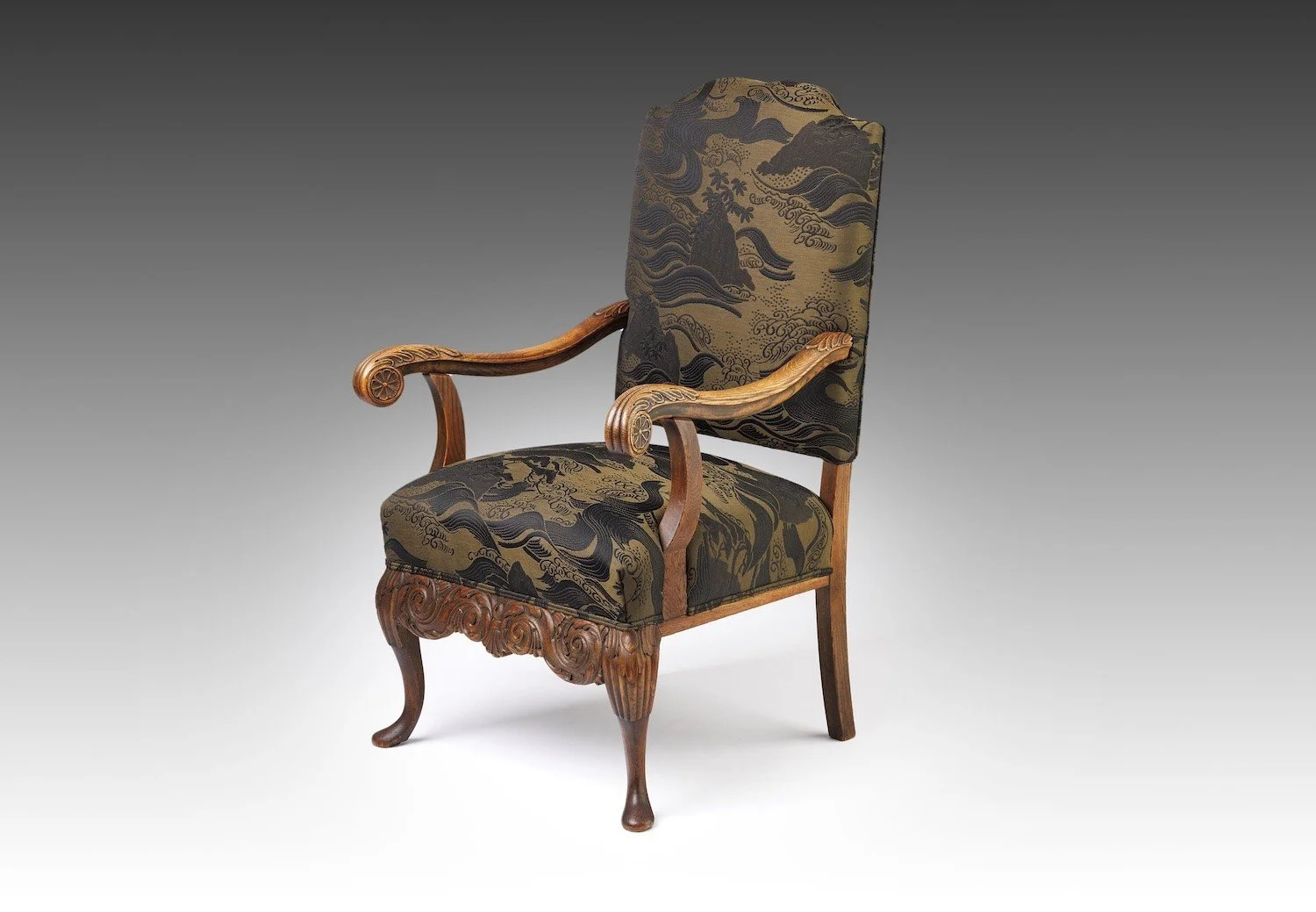
The Horizon Crest, a carved oak open armchair in the 18th-century French taste, after restoration. The frame was cleaned but not stripped or sanded; the seat and back were reupholstered.
How do you identify an antique chair?
You start by separating two things that are easily confused: what a piece is called, and what it is. The two usually arrive together, in an auction listing, an old family attribution, a dealer's tag, and the description is often confident. But a description is a claim, and a claim is only as good as the evidence beneath it. To identify a chair is to check each part of that claim against the object and to say plainly where the evidence runs out. It is less like naming a thing than like building the case for a name.
What the Label Says
Take a single chair, the Horizon Crest. It came through a Los Angeles auction described as one of a pair of Baroque-style carved oak armchairs. That short phrase makes three separate claims: a style, Baroque; a material, oak; and a form, armchair. It is worth seeing how differently each one holds up. None is dishonest. Auction catalogues are written quickly, and "Baroque-style carved oak" is a reasonable first pass. A first pass is exactly what it is.
Reading the Object
Form comes first, because it is the most legible. This chair has a tall upholstered back, open arms set back on carved, downswept supports, a carved apron, and cabriole front legs. Those features place it in the family of 18th-century English open armchairs made in the French, Rococo taste, the kind Chippendale's Director illustrated and the Metropolitan Museum holds in period examples. That is a more precise reading than "Baroque," whose heavier, earlier vocabulary this chair does not really speak. Here the names multiply rather than settle: collectors call this form a Gainsborough chair, the trade calls it a library chair, the 18th century called it a French chair, and a related American form is sometimes called a Martha Washington chair. The names overlap, and no single one is the answer. What they all point to is the form, and the form is what the chair plainly has.
The wood is the next claim, and it is where discipline shows. The grain is coarse and ring-porous, with the fleck that reads as oak, and the auction called it oak. But a grain read is an inference, and a catalogue is not a test, so the honest record says the wood is consistent with oak, not that it is oak, until someone puts a sample under a lens.
The date is the hardest claim, because style cannot carry it alone. This form was made from the middle of the 18th century and reproduced steadily into the 20th, so its silhouette fits almost any decade between. On style the chair reads as a revival of about 1890 to 1910, but the evidence that would actually settle it, the construction underneath, the joinery, the screws, the seat foundation, has not yet been examined. So the date is held as an estimate and marked as one.
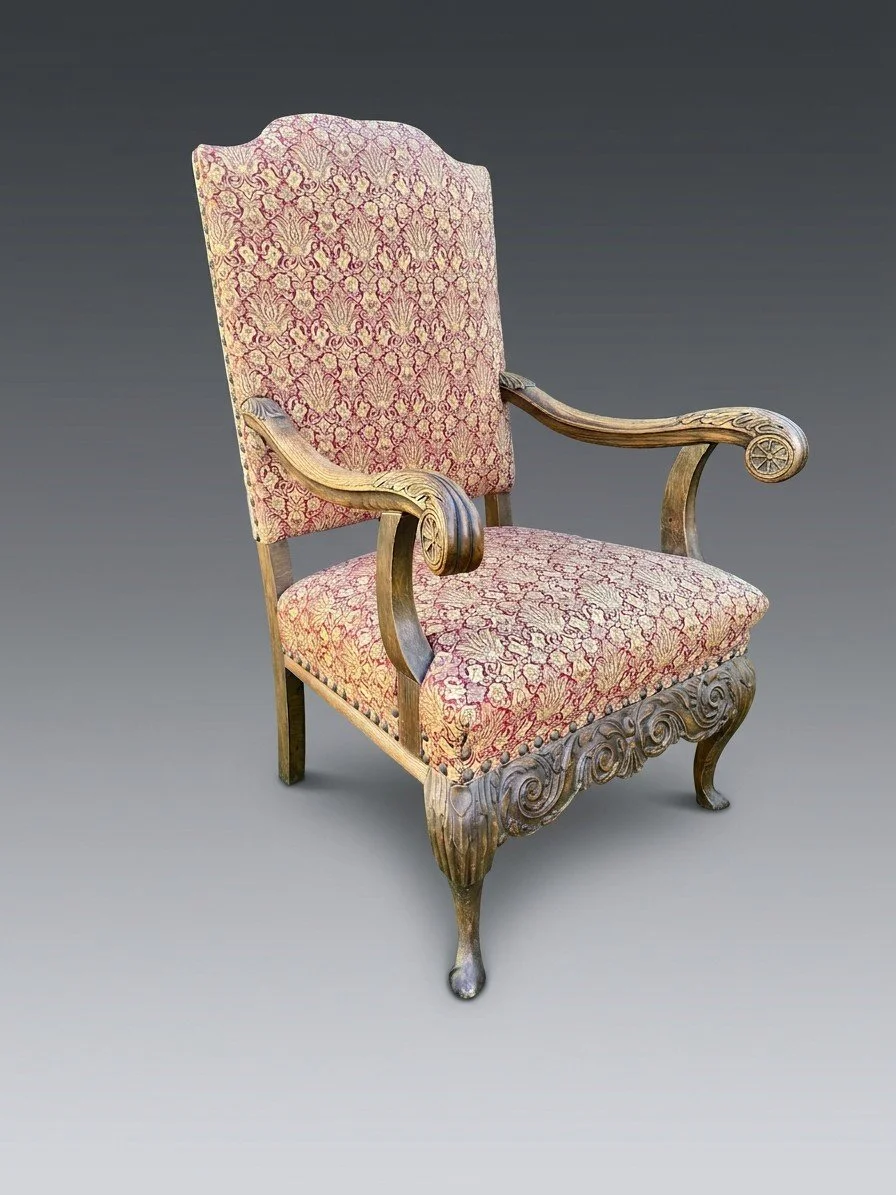
The Horizon Crest before restoration. The oak frame required no structural repair; the earlier red and gold damask show covering was later replaced.
What careful identification produces is not certainty but a clear line between what is known and what is not. For this chair the known is specific: an open armchair of the English French-taste form, a show-wood consistent with oak, a restoration that renewed the covering and cleaned the frame without stripping it. The unknown is named just as specifically: the maker is not recorded, no earlier owner has a name, and the exact date waits on the construction evidence. A label hides that line. An identification draws it.
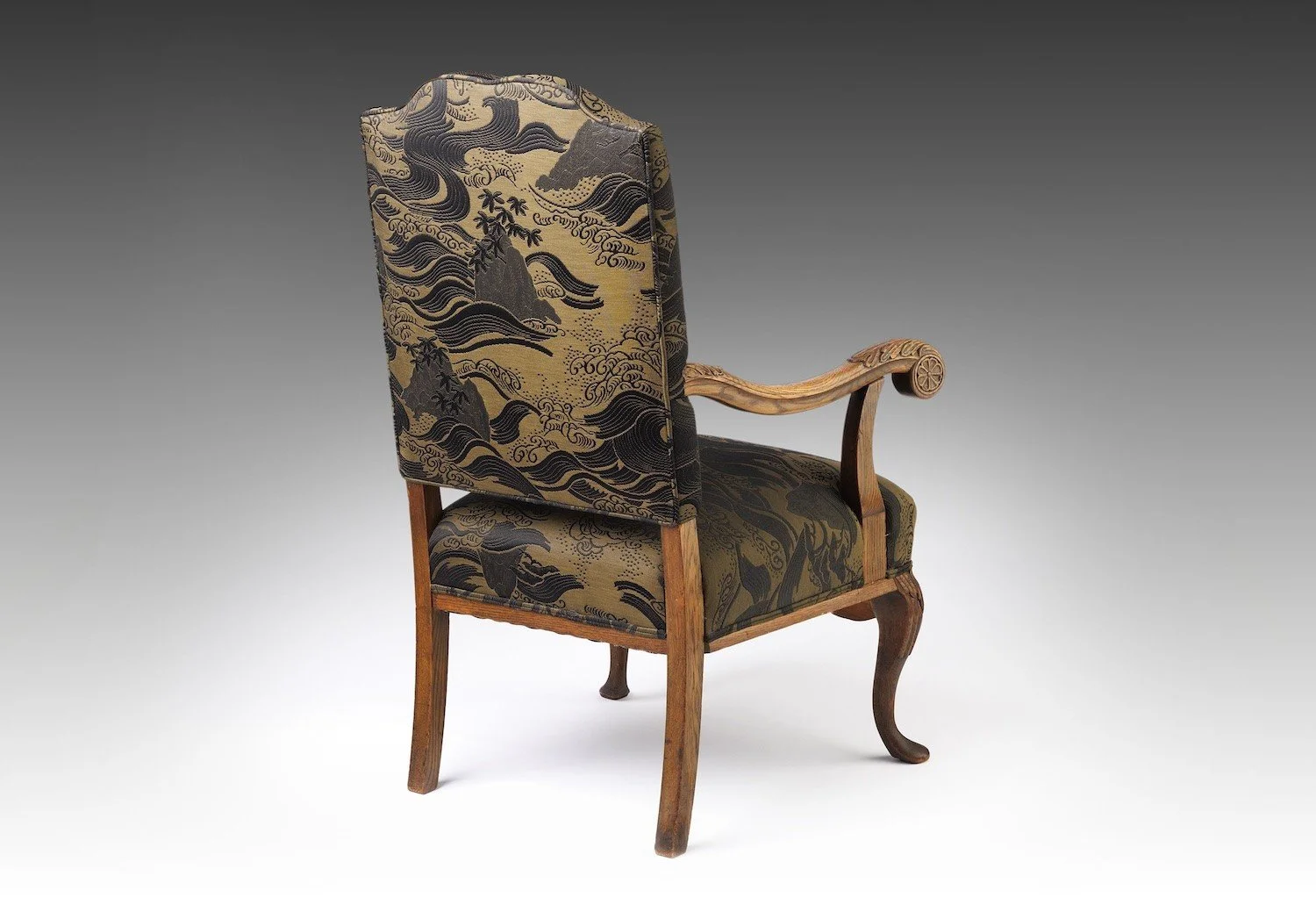
The restored Horizon Crest from the rear, showing the carved arm terminal and the reupholstered back panel in a dark bronze weave.
That is the difference between describing an object and understanding one, and it is the same discipline whether the object is a chair, a cabinet, or a photograph. The name is where you start. The evidence is where you arrive.
Object in This Journal
The Horizon Crest: A carved oak open armchair in the 18th-century French taste, dated circa 1890 to 1910 on stylistic grounds. The original finish was retained; the seat and back were reupholstered.
See more of the collection's restored antique seating.
Related Reading
Thoughtfully Collected. Quietly Shared.
