A Method of Looking: How We Read the Objects We Keep
Every entry in this journal begins the same way. An object is put on a table, and the same questions are asked in the same order. What is it. What is it made of. What has happened to it. What can be shown. What can only be supposed. The order is the whole discipline, because it is easy to arrive at a story first and then find the evidence that flatters it.
This is the introduction to the Heirloom Design Journal. It sets out the method the entries that follow use, so that a reader can see how the claims in them were arrived at, and where they stop.
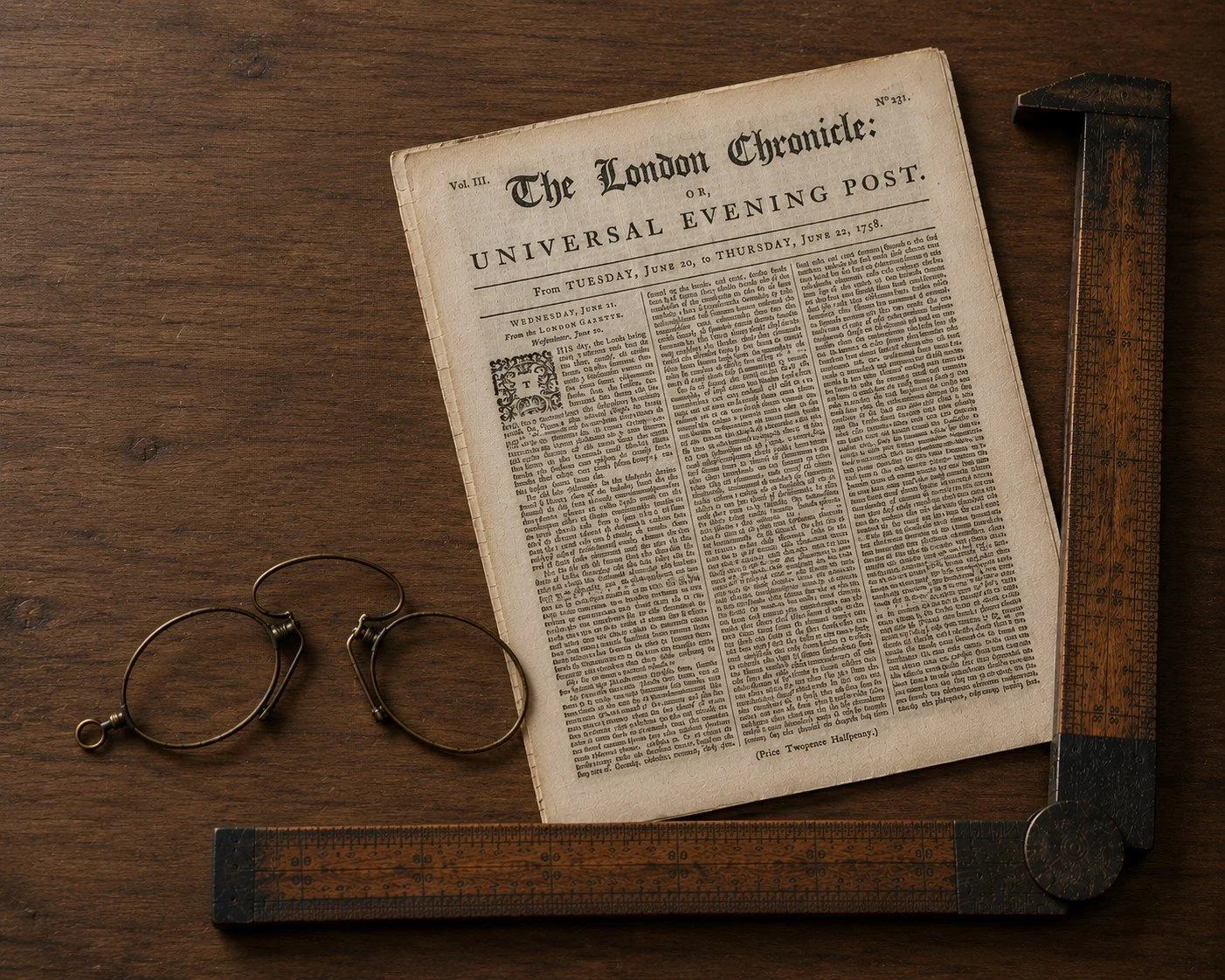
The reading table. The newspaper is Vol. III, No. 231 of The London Chronicle, or Universal Evening Post, 20 to 22 June 1758, one of several issues in the Acanthus Home archive by family descent.
What can an object actually tell you?
More than most people expect, and less than a good story would like. A chair records how it was sat in. Wear gathers where hands and shoulders went. A finish thins at the arm terminals and stays deep inside the carving, where no sleeve ever reached. None of that was designed and none of it was intended to be read, which is exactly what makes it worth reading. Nobody arranged it.
Paper records differently, and often more precisely. A dinner menu printed aboard a ship in 1918 fixes a date, a route, a printer, and a meal. A letter fixes a hand, an address, and a day. Journal 19 works from a set of menus carried off the Tenyo Maru and kept by one family for more than a century. Journal 3 works from a letter written in 1919, in which a man returns to a bench in Westlake Park and finds it empty. In both cases the document says what it says. The work is in not making it say more.
What an object cannot tell you is usually the part people most want. It rarely names its maker. It almost never names its owners. It does not explain why it was kept.
How do you tell evidence from assumption?
By writing them in separate sentences and never letting one borrow the authority of the other. An auction catalogue that says oak is making a claim about a chair, not a test of it, and until the wood has been examined the honest phrasing is that the piece is consistent with oak. A date assigned on stylistic grounds is a reading of a form, not a reading of the construction, and forms were reproduced for decades after they were introduced. Both of those hedges appear throughout this journal. They are not hesitancy. They are the record being accurate about its own limits.
The Velvet Courtship, in Journal 8, is a plain case. A pair of Victorian parlor chairs came through auction untitled and unlisted, with no provenance, no inscription, and no handwritten note. What can be described is what is there: walnut, carved medallion backs, a gentleman on one chair and a lady on its companion, and one round knob missing from the top of the gentleman's crest. What can be said about the pair beyond that is that portrait medallion chairs of this kind were made in pairs because the pairing was the point. What cannot be said is whose they were. The entry says so.
It is also why these pages say plainly, when it is true, that a place or an archive has not been seen firsthand. Consulting a source is not the same as verifying it, and the difference belongs in front of the reader rather than behind the writing.
What should be kept, and what should be renewed?
The distinction is between the record and the wearing layer. A finish that has darkened unevenly over a century holds evidence of age and handling, and stripping it removes that evidence permanently in exchange for uniformity. Upholstery is the layer built to absorb contact and light. Renewing it does not erase anything the frame is carrying. So the finish stays and the covering changes, and each decision is recorded, including the ones not taken and why.
To curate is to decide what may continue. That is the sentence this whole journal rests on. It is not a claim to authority over an object's meaning. It is a much smaller and more practical claim: that someone has to decide which parts of a thing carry its history and which parts are simply worn out, and that the decision should be made deliberately, in the open, by someone who has looked closely and can say what they saw.
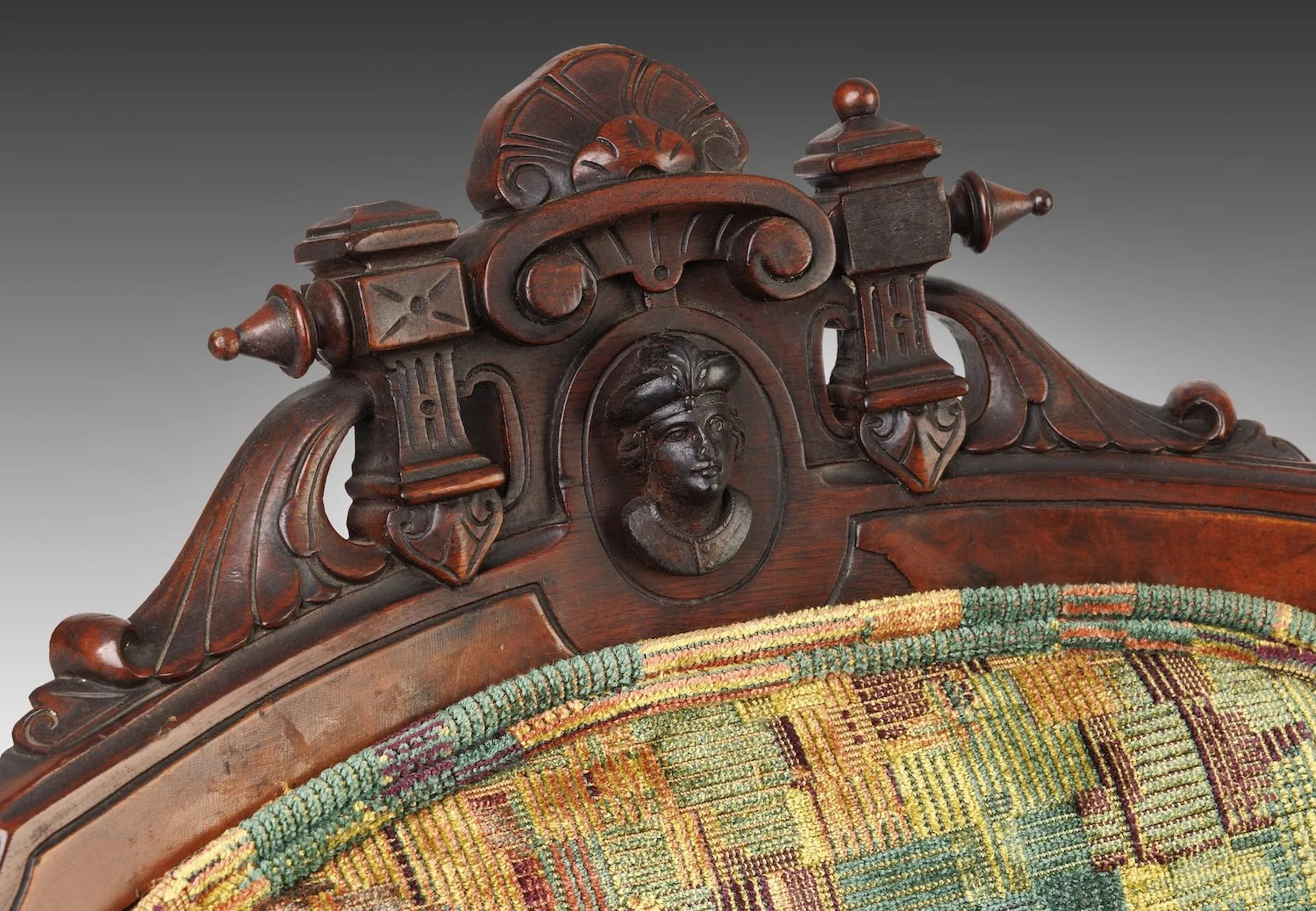
The gentleman's crest from The Velvet Courtship, Journal 8. The bust is carved in relief in the walnut. The small finial that once stood at the crown is missing, and the absence was preserved.
Journal 2 sets this out in detail on a single Eastlake armchair, taking the mark first and the meaning second. Every restoration described in these pages follows the same order.
What follows in this journal?
Objects, and the records attached to them. Furniture, photographs, letters, commencement programs, menus, postcards, and the occasional archive that turned out to hold more than it was catalogued as holding. Some entries end with a life reconstructed in detail. Others end with a name and very little else, which is also a result and is reported as one.
Every room keeps something of the decisions made within it. The curator's task is to help ensure those decisions are worth keeping.
The journals that follow continue this method, examining objects and records through the lives, uses, and decisions they preserve.
About This Journal
The Heirloom Design Journal is the working record of Acanthus Home: what came in, what was found out about it, what was done to it, and what remains unknown. The objects examined here are restored not to recreate the past, but to continue it.
Related Reading
Reading Furniture Like a Text: Wear and Patina
Beyond the Label: How Antique Furniture Is Identified
Thoughtfully Collected. Quietly Shared.
