 Image 1 of 3
 Image 2 of 3
 Image 3 of 3
Living With This Object
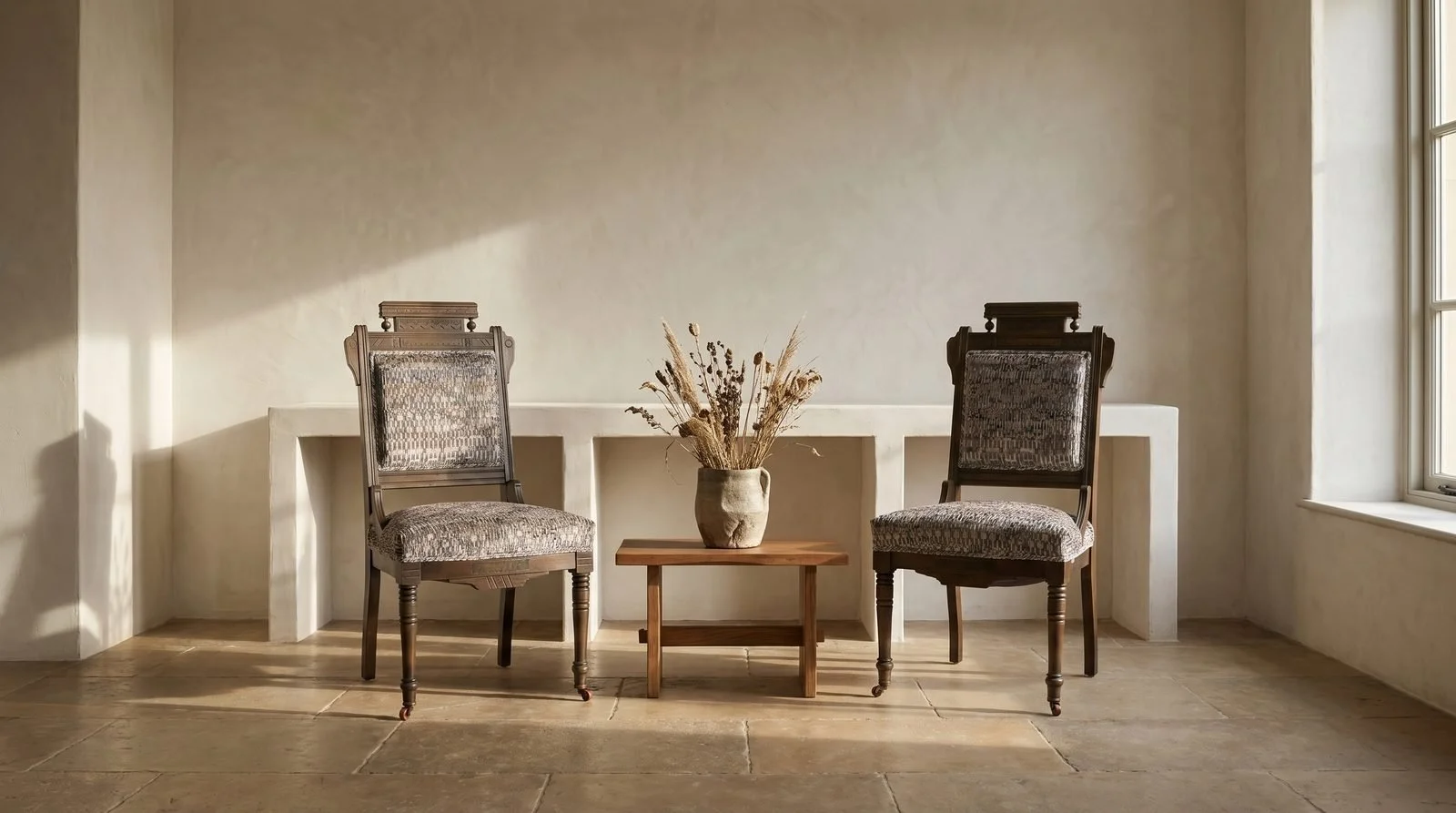
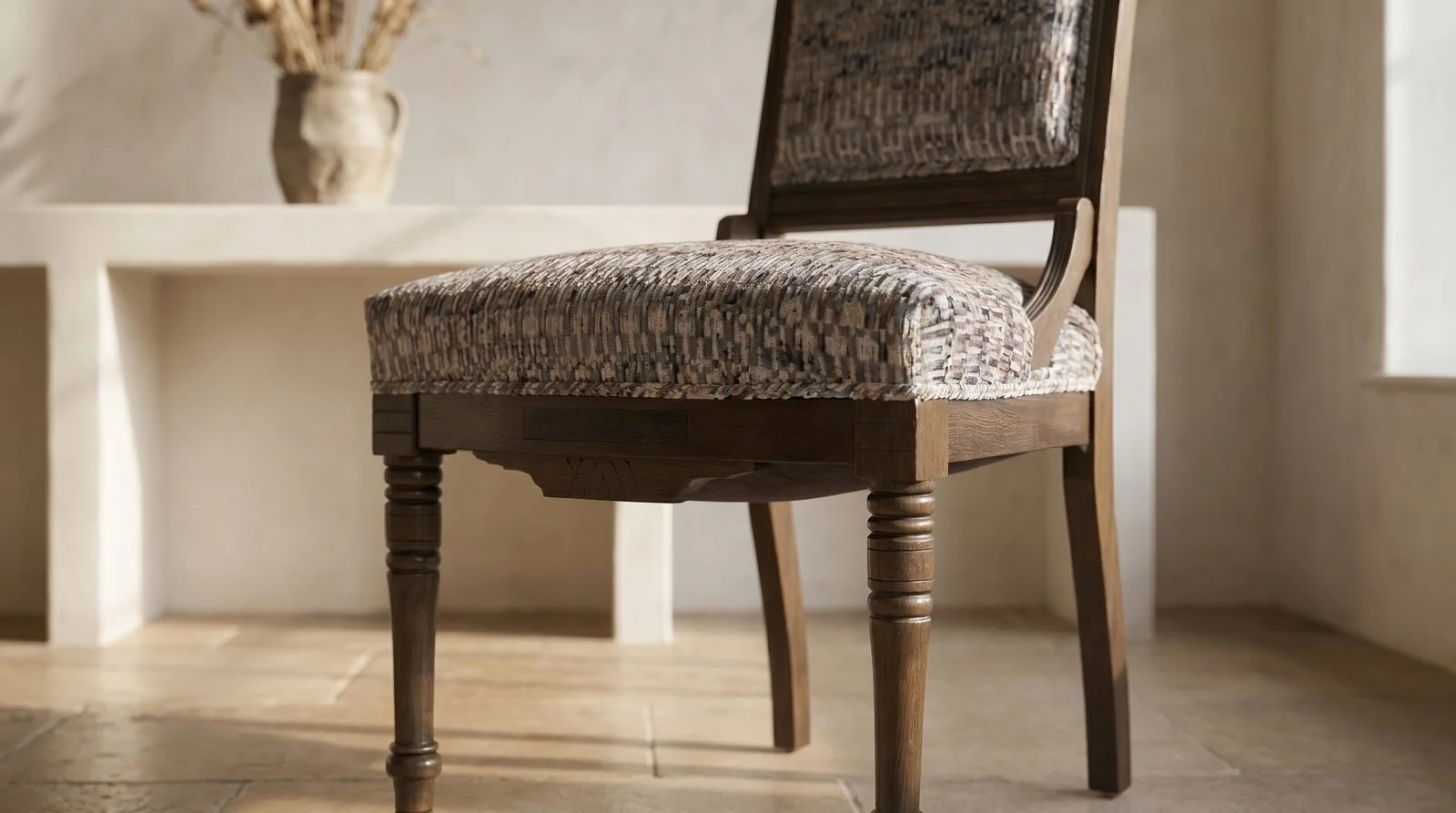
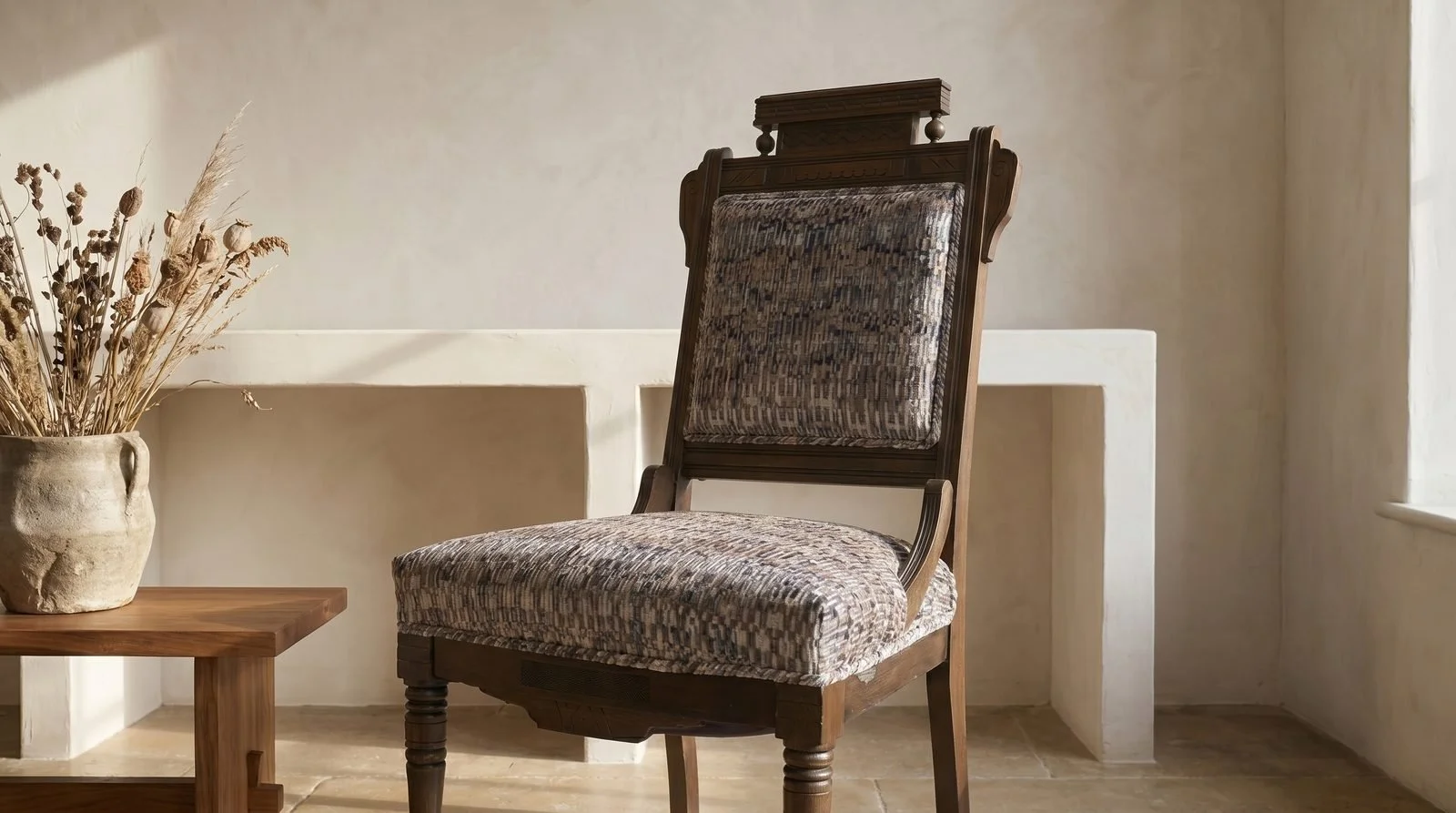
The following images are AI-generated visualizations intended to illustrate scale, proportion, and possible interior settings. They are conceptual, not photographs of the object in an existing room, and they preserve the documented proportions, finish, hardware, repairs, mirror, and construction of the piece.
-
Whether set as host chairs at the ends of a table, flanking a console, or gathered into a composed seating group, the pair works through alignment and proportion rather than bulk. The upright backs define edges and thresholds within a room, while the casters let each chair be drawn out and returned with ease. Because the backs are upholstered on both faces, the chairs present a finished appearance whether placed against a wall or floated within a room. The two can stand together, apart, or rejoined with the Vantelle Settee from the same suite.
-
Type: Side chairs, matched pair (set of two)
Style: Eastlake (Aesthetic Movement)
Date: Circa 1885–1900
Origin: Not established
Material: Hardwood frames; brass-collared casters
Finish: Refinished in restoration, deep grey-brown tone
Construction: Turned and carved frames; ring-turned front legs on casters; squared, raked rear legs; back panels upholstered on both faces
Maker & Origin: Unattributed; no mark located
Condition: Restored; frames refinished, seats and backs reupholstered; internal seat materials retained; sound and usable
Dimensions: 20 W × 17¾ D × 37⅝ H in. each; seat height 17½ in.
Upholstery: Tiano Gunmetal printed jacquard velvet, Black Edition, fully recovered (see The Tiano Gunmetal Velvet)
-
Original: Both frames, intact with no evidence of rebuilt joinery; the casters, which appear original; and the internal seat materials, kept rather than renewed, so each seat carries the softening of long use.
Replaced: Show-fabric only. The seats and the back panels, upholstered on both faces, were recovered in the Black Edition velvet detailed under The Tiano Gunmetal Velvet; the materials beneath were retained.
Reconstructed: No elements were reconstructed.
Repaired: No structural repair was required beyond the finish and upholstery work recorded here.
Finish Work: The frames were stripped and refinished in a deep grey-brown tone. The refinishing clarified tone rather than erasing wear; dents and other marks of age remain visible beneath the new finish.
-
Seen up close, each crest reads as a small architectural composition: a recessed tablet carved with a scalloped wave, flanked by incised geometric bands, dot-and-line registers, and small rectilinear panels, capped by a molded, bead-carved top rail. Turned ball finials stand on short spindles at each end, above scrolled ear brackets, and reeded stiles carry the ornament down the frame of the upholstered back. This is Eastlake vocabulary at its most legible, ornament incised into the surface rather than applied onto it, and it repeats consistently across both chairs and across the Vantelle Settee from the same suite. The finials and crest are decorative; they carry no mechanism.
-
No maker's mark, label, or stamp has been located on either frame, so the pair is offered unattributed. The form belongs to the Eastlake taste of the Anglo-American Aesthetic Movement, popularized through Charles Eastlake's writing on household furnishing and produced on both sides of the Atlantic. The incised geometric carving, ball finials, and angular bracketing are consistent with American Eastlake manufacture of the 1880s and 1890s, and the circa 1885–1900 date rests on those stylistic and constructional features rather than on documentation. Because the form was made in more than one country and no mark survives, the place of manufacture is not established. "Eastlake" is used here as a style descriptor, not as a maker's name.
-
The frames are a close, straight-grained hardwood, the grain visible along the exposed edges. Walnut and ash were both common in furniture of this type, so with the species unconfirmed it is left unnamed. The front legs are ring-turned and end in brass-collared casters; the rear legs are squared and raked for stability. The back panels are upholstered on both faces. The covering chosen for this restoration is described under The Tiano Gunmetal Velvet.
-
The covering was chosen for this restoration and is not original to the chairs. Tiano is a printed jacquard velvet whose small geometric repeat runs in layered tones of charcoal, slate, bronze, and softened metallics; depth comes through tonal variation rather than contrast, so the surface reads as continuous, and the pile carries a controlled luster that responds to light without gloss. Its geometry sits with the incised geometric carving of the frames.
Manufacturer: Black Edition
Collection: Nuala
Pattern: Tiano, colorway Gunmetal
Design style: Geometric
Fabric type: Printed jacquard velvet
Composition: 58 percent polyester, 42 percent viscose; pile 100 percent viscose (as stated by the manufacturer)
Performance: Martindale 40,000 rubs; suitable for high-use upholstery, including everyday seating
Certifications: Oeko-Tex Standard 100; REACH compliant; PFAS free
Textile origin: United Kingdom (Black Edition)
Reupholstered: Yes; seats and both faces of the back panels recovered in this restoration, internal seat materials retained
-
Side chairs like these formed the movable seating of the late-Victorian parlor, lighter than the settees they accompanied and set on casters so they could be drawn into conversation and returned to the wall. These two were originally part of the same suite as the Vantelle Settee and remained together until the twenty-first century, when all three pieces were acquired from the same private home in Port Hueneme, Ventura County, California. Their documented association survives even though they are now offered separately. No ownership history predates that acquisition. The restoration that followed refinished the frames and recovered the seats and backs while intentionally preserving the original interior seat materials beneath. Their maker, precise date of manufacture, country of manufacture, and earlier ownership remain undocumented. The record ends where the evidence ends.
-
Are these chairs antique or vintage? Antique. Acanthus uses the 100-year line, dated on the evidence rather than rounded up. The incised Eastlake carving, ball finials, and construction of this pair of antique Eastlake side chairs place them at circa 1885–1900, comfortably past the threshold, though no maker's mark documents an exact year.
Are the two chairs a matched pair, and how do they relate to the settee? Yes. The two chairs were originally part of the same suite as the Vantelle Settee, with which they were acquired from the same private home in Port Hueneme, Ventura County, California. Crest carving, ball finials, turned legs, and the new velvet remain consistent across all three pieces, so the pair reads as part of a documented suite rather than as near-matches assembled later.
Have they been restored or reupholstered? Both. The frames were stripped and refinished in a deep grey-brown tone, and the seats and double-faced back panels were recovered in Black Edition's Tiano velvet in Gunmetal. The internal seat materials were deliberately retained, so each seat keeps the softened feel of long use. No structural work was needed.
What wood are the frames? The species is not named. The frames are a close, straight-grained hardwood, and both walnut and ash were common in Eastlake furniture of this period, but the refinished surfaces do not allow a confident reading. Following house practice, the wood is described rather than named until it can be verified.