 Image 1 of 3
 Image 2 of 3
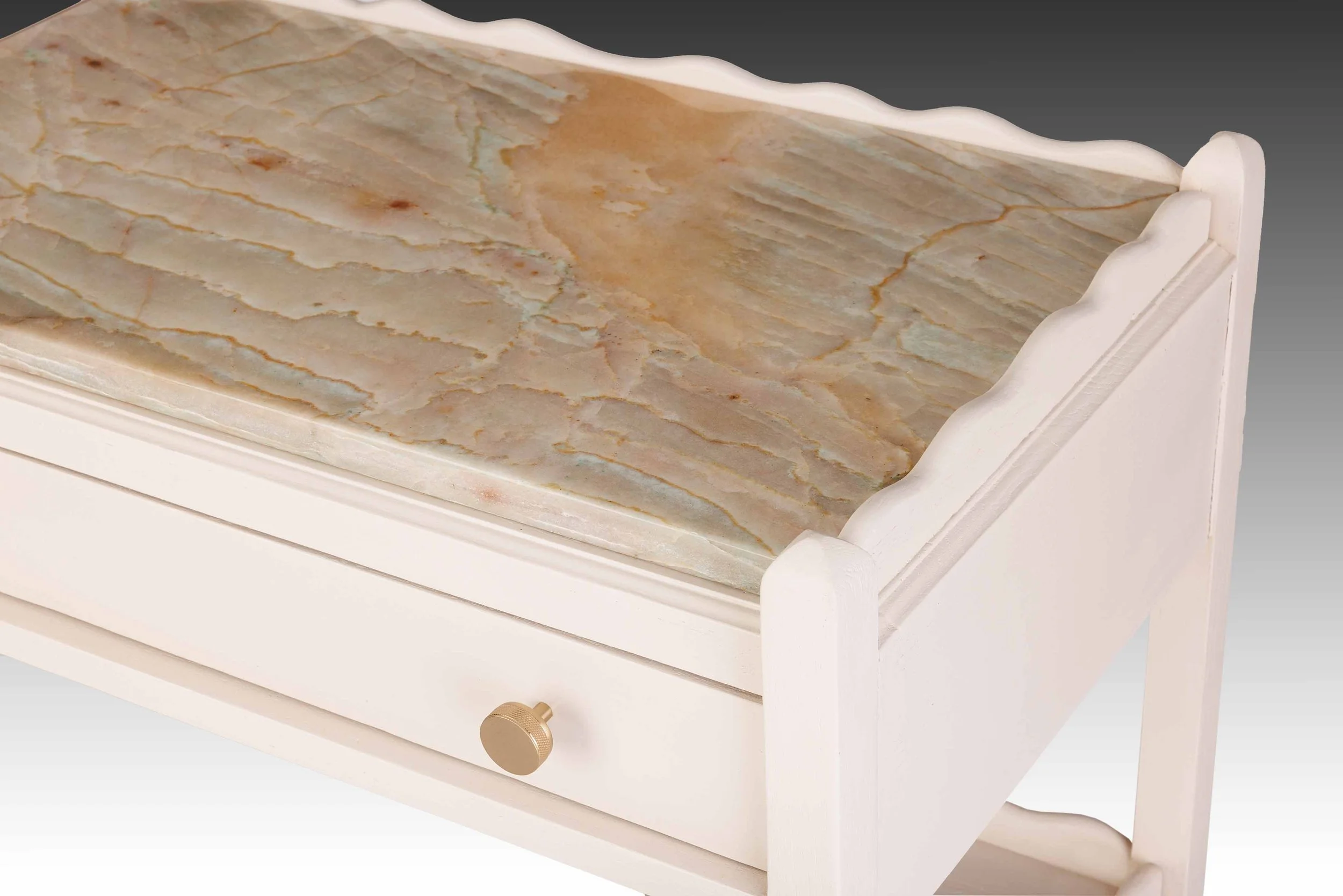 Image 3 of 3
Living With This Object
The following images are AI-generated visualizations intended to illustrate scale, proportion, and possible interior settings. They are conceptual, not photographs of the object in an existing room, and they preserve the documented proportions, finish, hardware, repairs, mirror, and construction of the piece.

-
Whether it stands beside a reading chair, next to a bed, or as a compact drinks and serving stand, the table offers a surface for a lamp and the small things a room collects. The single drawer keeps what should stay out of sight, the lower shelf holds what should stay in reach, and the original casters let it roll easily between rooms.
-
Type: Side table, two-tier, on original swivel casters (a rolling side table)
Style: Edwardian
Date: Circa 1900–1920
Origin: Not established (unmarked)
Material: Oak; quartzite top; drawer in a secondary hardwood
Finish: Refinished in a pale blush tone (applied in restoration, not the original finish)
Construction: Solid oak frame, square tapering legs, single drawer, integrated lower shelf
Maker & Origin: Unattributed; no mark located
Condition: Restored; refinished, drawer pulls replaced, quartzite top added; original frame and casters retained
Dimensions: 30 W × 18 D × 31½ H in.
-
Original: The oak frame, both galleried tiers, the drawer, and the swivel casters. The casters were removed for refinishing and reattached.
Replaced: The original brass drop pulls on shield backplates were removed; the drawer now carries two knurled cabinet knobs, the Emtek Selected knob at 1¼ in. in satin brass.
Reconstructed: No elements were reconstructed.
Repaired: No structural repair was required or performed.
Finish Work: The original finish was stripped and the oak refinished in a pale blush tone. The finish is applied in this restoration, not original, and it is opaque; the grain does not read through it.
Other: A slab of Alexandrita quartzite was added to the top by Acanthus Home, set within the gallery over the original wood top. The stone is detailed under Materials & Construction.
-
The scalloped gallery is what gives the piece its name. A shaped oak crest of shallow, repeating lobes rises along the back and sides of the top and is echoed on the lower shelf, cut from solid stock and following the line of each tier. The same wave profile sets the rhythm for the rest of the form.
-
Maker: Unattributed. We found no maker's mark, label, or stamp on the drawer, the underside, or the frame.
Origin: Not established. The galleried two-tier form, the oak, and the shield-backed drop hardware are consistent with the English Edwardian tradition, but that is a style association, not a manufacture record; oak tables and washstands of this kind were made in more than one country, and the piece is unmarked. Where this example was made is not documented.
Date: Circa 1900–1920, read from the style and construction. With no mark or document on the piece, the date stands as an informed inference.
Provenance: The table's most recent documented ownership places it with a family in Santa Ynez, California, where it remained for decades before acquisition by Acanthus Home. No earlier ownership records accompany the piece.
-
Wood: Oak runs through the frame, both tiers, the drawer front, and the legs, identified from the grain, open pore structure, and ray figure visible on the bare wood during restoration. The drawer is built from a lighter secondary hardwood, species unconfirmed.
Construction: Solid oak frame with square tapering legs, a single drawer set in the apron, and an integrated lower shelf; the drawer runs on wood bearers.
Stone: The top is set with a slab of Alexandrita quartzite, selected and fitted by Acanthus Home, its veining running in rose, green, and neutral tones across a polished surface; the figure is natural to the stone.
Hardware: The original swivel casters are retained at the feet.
-
The light two-tier table on casters belonged to a class of movable service furniture in the late Victorian and Edwardian home, drawn to where it was needed and kept tidy by a raised gallery; forms of this kind served as washstands and as occasional and serving tables. This example carries the wear of long use beneath a finish Acanthus Home stripped and renewed, its top now fitted with a slab of Alexandrita quartzite and its drawer fitted with replacement knobs. Before entering the Acanthus Home collection, the table remained with a family in Santa Ynez, California, for decades. Its maker, exact date, and earlier history are not recorded. The record ends where the evidence ends.
-
Is this an antique or a vintage piece? Antique. We catalogue this antique rolling side table to circa 1900–1920 on its style and construction: the original shield-backed drop hardware, the oak, the galleries, and the casters. Under the house rule a piece under 100 years old is vintage; this piece sits beyond that line, so the antique call holds, stated as an informed inference.
What wood is it? Oak. It was identified from the grain, open pore structure, and ray figure visible on the bare wood during restoration. Because the finish is opaque, the identification rests on the bare wood examined during restoration rather than the finished surface. The drawer is built from a lighter secondary hardwood whose species has not been confirmed.
Has it been restored? Yes, and the work is fully disclosed. The original finish was stripped and the oak refinished in a pale blush tone; the original brass drop pulls were removed and the drawer fitted with knurled knobs; and a slab of Alexandrita quartzite was added to the top, while the original swivel casters were retained.
Why the stone top and the plain knobs? Both are choices Acanthus Home made in restoring the piece and are disclosed as such. The added quartzite gives the table a hard, figured surface in rose, green, and neutral tones over the original wood top. The ornate original drop pulls were exchanged for plain knurled knobs, a quieter fitting against the shaped gallery.