 Image 1 of 4
 Image 2 of 4
 Image 3 of 4
 Image 4 of 4
-
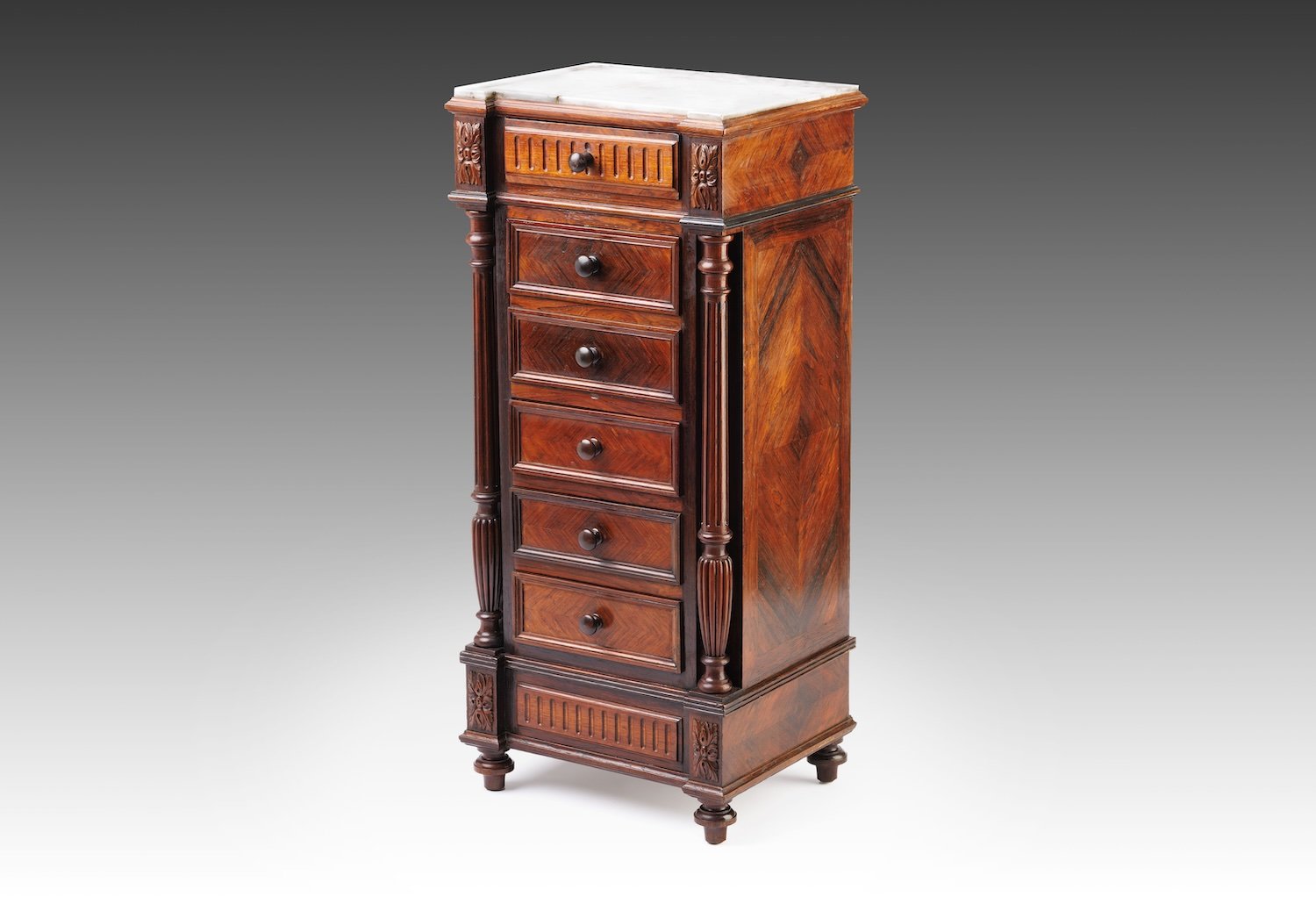
Whether it stands beside a bed, next to a chair or sofa, in an entry or hallway, or within a dressing room, this cabinet asks little of the floor: its tall, narrow footprint settles into places where width is limited, and it keeps concealed storage beneath a durable marble surface. Conceived as a bedside cabinet, it is equally at home anywhere a vertical architectural accent is welcome.
-
Type: Bedside cabinet (nightstand); marble-top, with concealed chamber
Style: Renaissance Revival (Henri II)
Date: Circa 1880–1900
Origin: Not established (unmarked); a French table de nuit form, also made across Continental Europe
Maker: Unattributed (no mark located)
Provenance: Acquired from a family estate in Rancho Palos Verdes, California
Material: Hardwood frame with figured hardwood veneers; white marble top and chamber lining; turned wood knobs; brass fall-front fitting
Finish: Original, revived by hand (not stripped or refinished)
Construction: Frieze drawer; fall-front enclosing a marble-lined chamber, faced as two false drawer fronts; three graduated drawers below; fluted plinth base; turned feet; flanking fluted half-columns
Condition: Original surface revived, sound; stable crack across the marble top; light discoloration to the chamber lining from use
Dimensions: 17 ⅝ W × 14 ⅝ D × 39 ⅜ H in.
-
Original: The white marble top and marble-lined chamber appear original; the turned knobs, the fall-front's brass fitting, and the veneered surfaces show no evidence of replacement or relaying.
Replaced: Nothing was replaced in the documented work.
Reconstructed: No elements were reconstructed.
Repaired: No structural repairs are documented, and none were required.
Finish Work: The original finish was retained, not stripped; the wood was cleaned and revived by hand to bring up its figure and tone.
Other (disclosures): A crack runs across the marble top, consistent with age; it is stable, with the slab intact and seated. The marble chamber lining shows light discoloration consistent with age and use. The fall-front board carries honest wear on its inner face. None of these affect the working of the drawers or the fall-front.
-
The chamber is the diagnostic feature of the form, and it gives the cabinet its name. Behind the frieze drawer, a fall-front faced to match the cabinet lowers to reveal a chamber lined on five faces in white marble. A brass plate is set into the fall-front edge; no key is present, and no lock function is claimed.
-
No maker's mark or label was located, so the cabinet remains unattributed, and its country of manufacture is not established. The understructure carries earlier pencil inventory or stock inscriptions and an indistinct handwritten name, the kind of marks left by prior owners or the trade rather than by a maker, so they do not establish authorship. The marble-topped, fall-front bedside cabinet with its marble-lined chamber is a French form, the table de nuit. The same form was also made in Belgium and across Continental Europe, so, unmarked, it is consistent with French or Continental European manufacture rather than tied to one country. Its Renaissance Revival carving, drawing on Henri II forms, together with the marble-chamber form, supports the assigned range of circa 1880–1900. The cabinet was acquired from a Rancho Palos Verdes, California, family estate. Descendants reported that it had remained in their family for generations, although that earlier ownership has not been independently documented.
-
The drawer fronts and case sides are veneered in figured hardwood laid in chevron and herringbone, bookmatched across the fronts, exhibiting the fine striping and color variation associated with the imported decorative hardwoods used on Continental furniture of the late nineteenth century. The solid carved elements (the half-columns, the foliate corner blocks, and the plinth) are consistent with walnut or a comparable close-grained hardwood, also unconfirmed. Narrow ebonized (stained-black) moldings frame the upper case, reading as lowered contrast over the figure rather than as an added film. The fall-front is hinged at its base. The marble of the top and chamber is gray-veined white stone of Carrara character; the top is a separate, removable slab seated in a wooden surround. The carcass and the top well are a pale softwood secondary, consistent with pine or poplar, their surfaces hand-worked. The species of the primary veneer is not confirmed without a wood identification.
-
The table de nuit was the bedside cabinet of the nineteenth-century European bedroom, its marble-lined chamber built to hold a chamber pot or washing service out of sight behind a fall-front in the years before fitted plumbing reached every room. The marble lining made the chamber practical for daily use and remains the defining feature of the form.
This example retains its original surface rather than a replacement finish and still bears earlier inventory and ownership inscriptions beneath the case. Oral history preserved by the family from whom it was acquired indicates that the cabinet remained in their ownership for generations, although that earlier chain of ownership has not been independently documented. That family's estate also yielded The Stratelle Spanish Colonial cabinet, The Lost Spindle side chair, and The Spindle Crest Eastlake chair, all documented separately by Acanthus Home. Together, these acquisitions document that all four objects were present within the same Rancho Palos Verdes household when they were acquired by Acanthus Home.
Its maker is not recorded, its exact country of manufacture remains unconfirmed, and the people and interiors that first gave it life remain unknown. The documented record therefore ends with the evidence presently available.
-
Is this antique or vintage? Antique. This antique marble-top nightstand dates to circa 1880–1900 on its form and ornament: the marble-chamber bedside type with Renaissance Revival carving current in the late nineteenth century, not on a dated mark. That places it well past the hundred-year antique threshold, so it is not called vintage.
What is the marble-lined chamber for? The fall-front lowers to a marble-lined niche, reached behind two false drawer fronts, that once held a bedroom service in the years before fitted plumbing. Cabinets of this form were lined in marble so the chamber could be wiped clean, a practical surface for its original use.
What wood is it? The figured veneers show the fine striping and color of the imported decorative hardwoods used on Continental furniture of this period, and the solid carved elements are consistent with walnut. Neither can be confirmed without a wood identification, so the record describes the wood rather than naming an unverified species.
Has it been restored? Yes, in a limited way. The wood was cleaned and revived by hand, not stripped or refinished, so the original surface is retained rather than replaced, and no structural work was needed. The disclosures are a stable crack to the marble top and light discoloration to the chamber lining; the drawers and fall-front operate.
Does the crack in the marble affect use? There is a crack across the marble top, consistent with the age of the slab, which sits intact and seated in its wooden surround. It is stable and does not affect how the top carries weight in normal bedside use, though as with any old marble the area should not be stressed.