 Image 1 of 2
 Image 2 of 2
Living With This Object
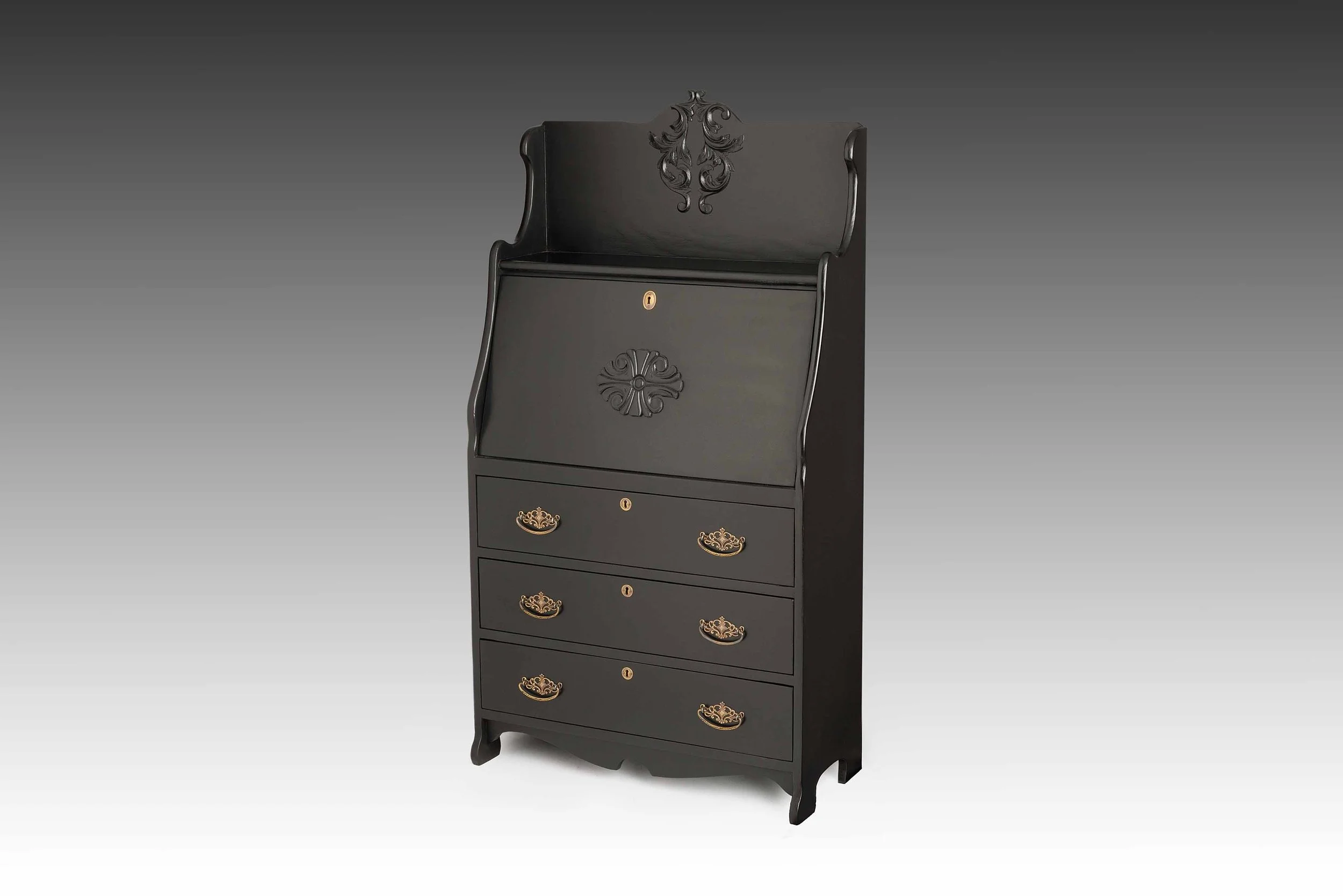
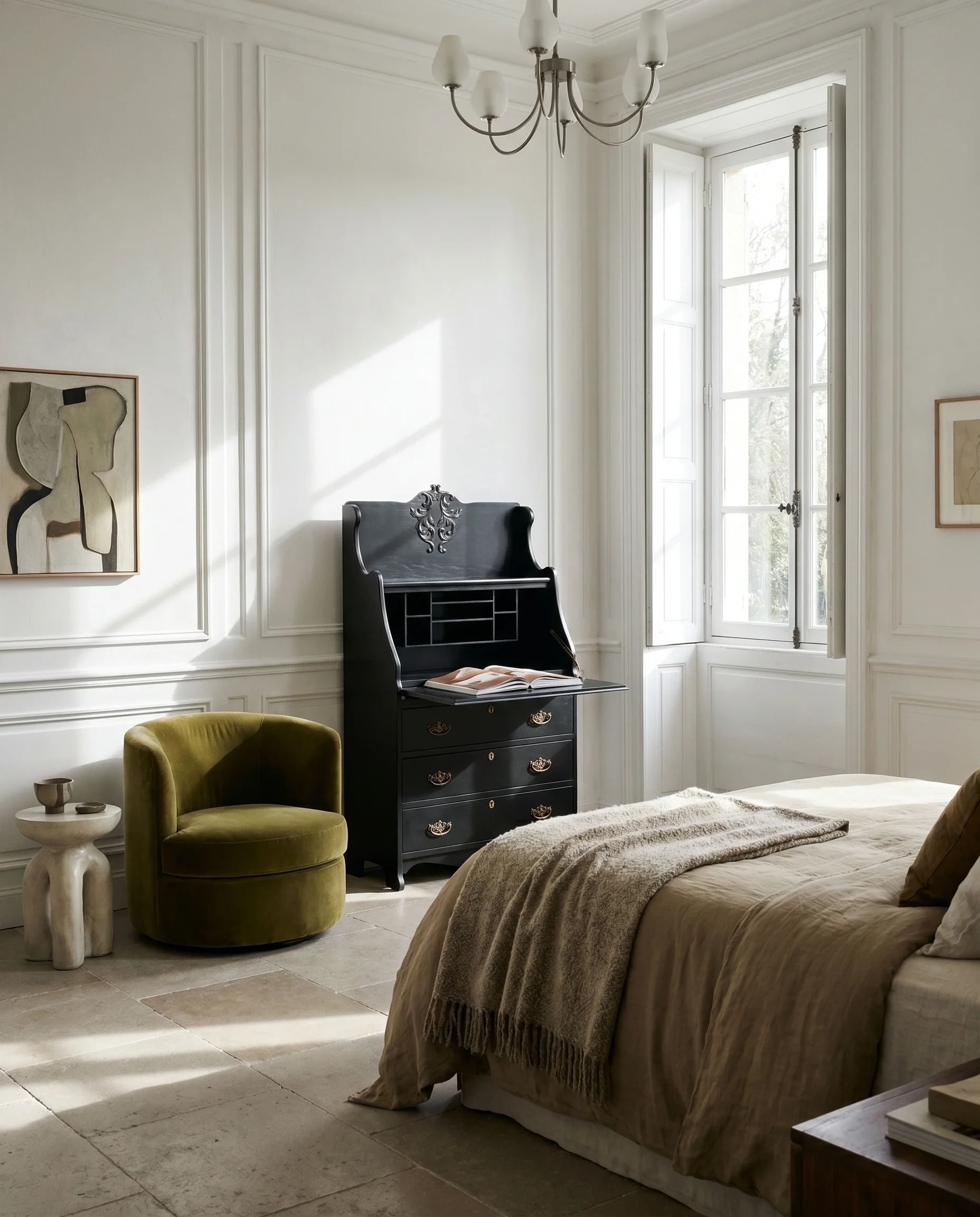
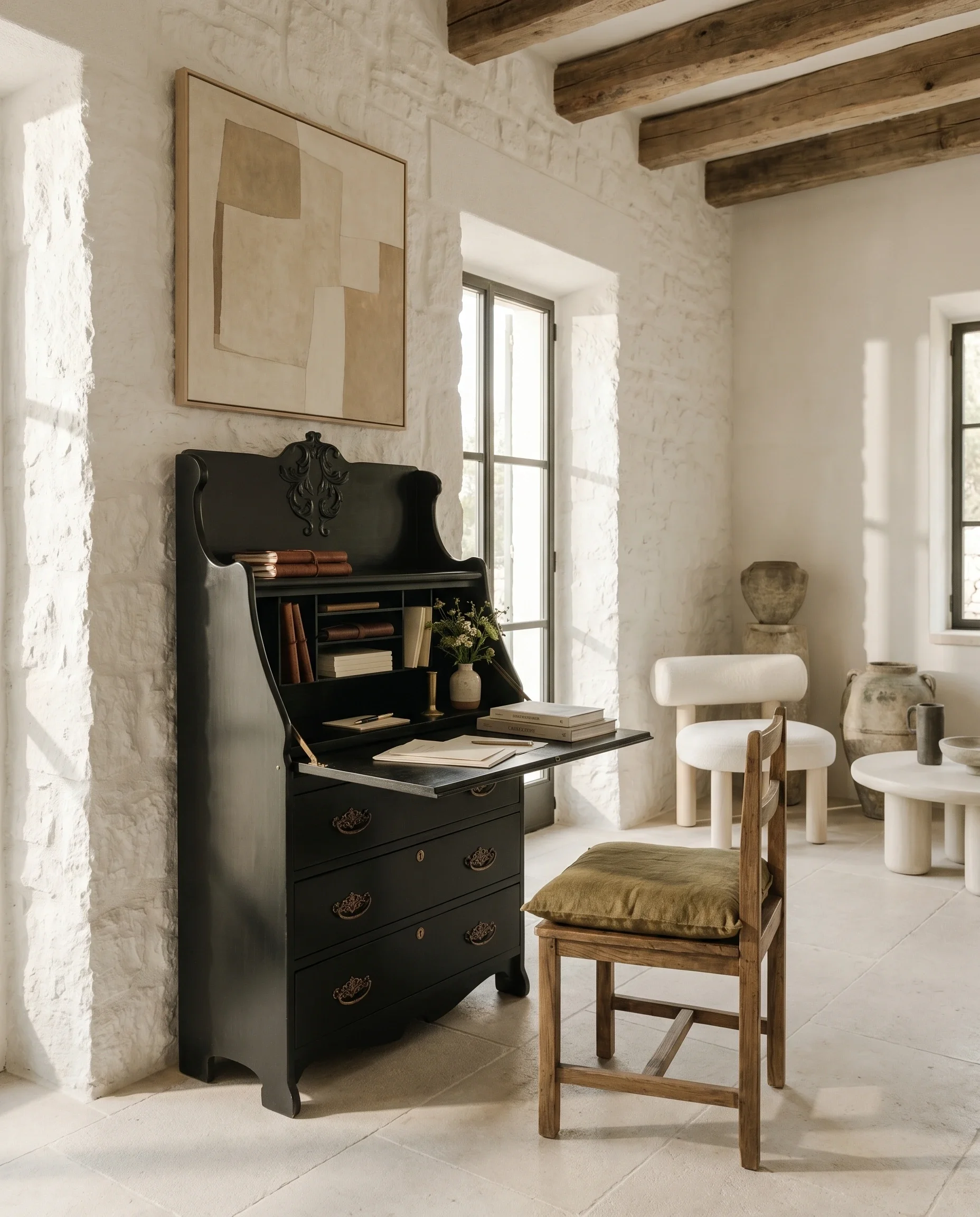
Open, the desk becomes a working surface: the fall-front drops to a writing plane, and the fitted gallery of open compartments and small dividers stands ready above the three graduated drawers. Closed, the same piece reads as a tall, narrow cabinet held close to a wall. The black finish emphasizes the desk's silhouette, with the carved crest and brass pulls catching the light while the grain remains subdued beneath the lacquer.
The room view below is an AI visualization, offered to suggest scale and placement. It is a rendered image, not a photograph of the desk in this room.
-
Tall and shallow, the desk holds close to a wall and settles easily into a study, an entry hall, or a narrow room where a writing surface is wanted but floor space is short. Closed, it reads as a contained cabinet; opened, it becomes a desk. The restrained black finish allows the desk to sit comfortably among both period furnishings and more contemporary interiors. Where the room wants an open writing table rather than a case that closes, the kidney-shaped Inkwell Bloom carries the same duty in a lower form.
-
Type: Slant-front secretary desk
Style: American Victorian (golden-oak period)
Date: Circa 1900–1915
Origin: Probably United States (attributed by form and construction)
Provenance: Most recent documented acquisition through a charity shop in Lomita, California
Material: Oak; plywood back panel
Finish: Black lacquer, applied in restoration
Construction: Slant fall-front over three graduated drawers; fitted compartment gallery; raised back gallery with carved crest
Maker & Origin: Unattributed; no mark located
Condition: Restored; refinished from oak to black lacquer; pulls, escutcheons, and fall-front pivot pins replaced; original plywood back retained
Dimensions: 29 W × 12 D × 56 H in.
-
Original: The oak case, including its applied carved crest, fall-front medallion, and plywood back panel, is believed original.
Replaced: The drawer pulls, the keyhole escutcheons on the drawers and fall-front, and the fall-front pivot pins were all replaced with new hardware selected to suit the form. The original handles were broken, and some of the keyhole escutcheons were broken and no longer aligned with the holes.
Reconstructed: No elements were reconstructed.
Repaired: No structural repairs are documented.
Finish Work: The desk was originally oak under a clear finish. That finish was stripped to bare wood and the piece refinished. The surface now carries an applied black lacquer finish that covers most of the wood, though some of the oak grain remains faintly visible through it.
-
A scrolled, leafy crest rests on the raised back gallery above the writing plane, and a carved roundel sits at the center of the fall-front. Both are applied carved ornaments of the kind used on golden-oak furniture, and the dark finish draws out their silhouette and relief rather than the grain of the wood. Together they are the desk's decorative signature, echoed at the top and on the fall.
-
No maker's mark or label is present, so the desk is left unattributed rather than assigned. The form and its machine-cut, golden-oak construction point to American factory manufacture of the early twentieth century, probably circa 1900–1915, and the original plywood back sits comfortably within that period. "Victorian" is used here in the American trade sense for golden-oak-period furniture, a convention for that window rather than a reign date.
-
The primary wood is oak, identified from its cathedral grain and ray figure. The desk is machine-cut throughout: a slant fall-front drops on a metal stay to a writing surface, opening to a gallery of open compartments and small dividers; three graduated drawers sit below; above them a raised back gallery with scrolled side supports rises, and the case stands on bracket feet over a shaped apron. The upper back is solid boarded, while the lower back is a plywood panel that carries handwritten pencil markings. The replacement drawer pulls are pierced brass bails over backplates; replacement keyhole escutcheons are fitted to the fall-front and drawers; and replacement pivot pins hinge the fall-front to the case.
-
By the turn of the twentieth century, expanding factory production had brought the secretary desk within reach of many middle-class households: once a costly household fixture, it became an attainable piece of domestic furniture, carrying record-keeping and correspondence into homes that earlier generations might never have furnished with a dedicated writing desk. Its fall-front closed the day's paperwork away when the work was done. Letters, household accounts, recipes, school papers, and family records all passed across desks like this, making them quiet witnesses to ordinary lives.
The journal reads one survival of that paper world closely: The Handbook of Return, a student handbook printed in 1918. The Handbook of Return, a student handbook printed in 1918
This antique secretary desk likely spent much of its working life as plain oak and has since entered a second chapter: refinished and darkened, its pulls renewed, recast for a different kind of room. Its most recent documented acquisition was through a charity shop in Lomita, California, before undergoing restoration. Its maker, the factory that built it, the year it left the bench, and the households it served are not recorded. The record ends where the evidence ends.
-
Is this an antique or a vintage piece? Antique. The desk dates to circa 1900–1915, the American golden-oak period, which places it past the 100-year antique threshold rather than in the vintage range. The call rests on the form, the oak, and the machine-cut construction rather than a dated mark, so it is an informed inference.
It looks black. What is it actually made of? Oak. This antique black lacquer secretary desk carries an applied finish over solid oak, identified from its cathedral grain and ray figure before refinishing. The lacquer covers most of the visible wood, though some grain still shows through it. The lower back is an original plywood panel.
Has it been restored? Yes, in full. The original clear oak finish was stripped to bare wood and the piece refinished in black lacquer. The drawer pulls, the keyhole escutcheons on the drawers and fall-front, and the fall-front pivot pins were replaced. The plywood back is original to the case.
Does the fall-front lock, and is there a key? No. The keyholes and escutcheons on the fall-front and drawers are decorative only, with no working locks behind them. A key is included with the desk, but it is not original to the piece and does not operate anything. The fall rests open on a metal stay.