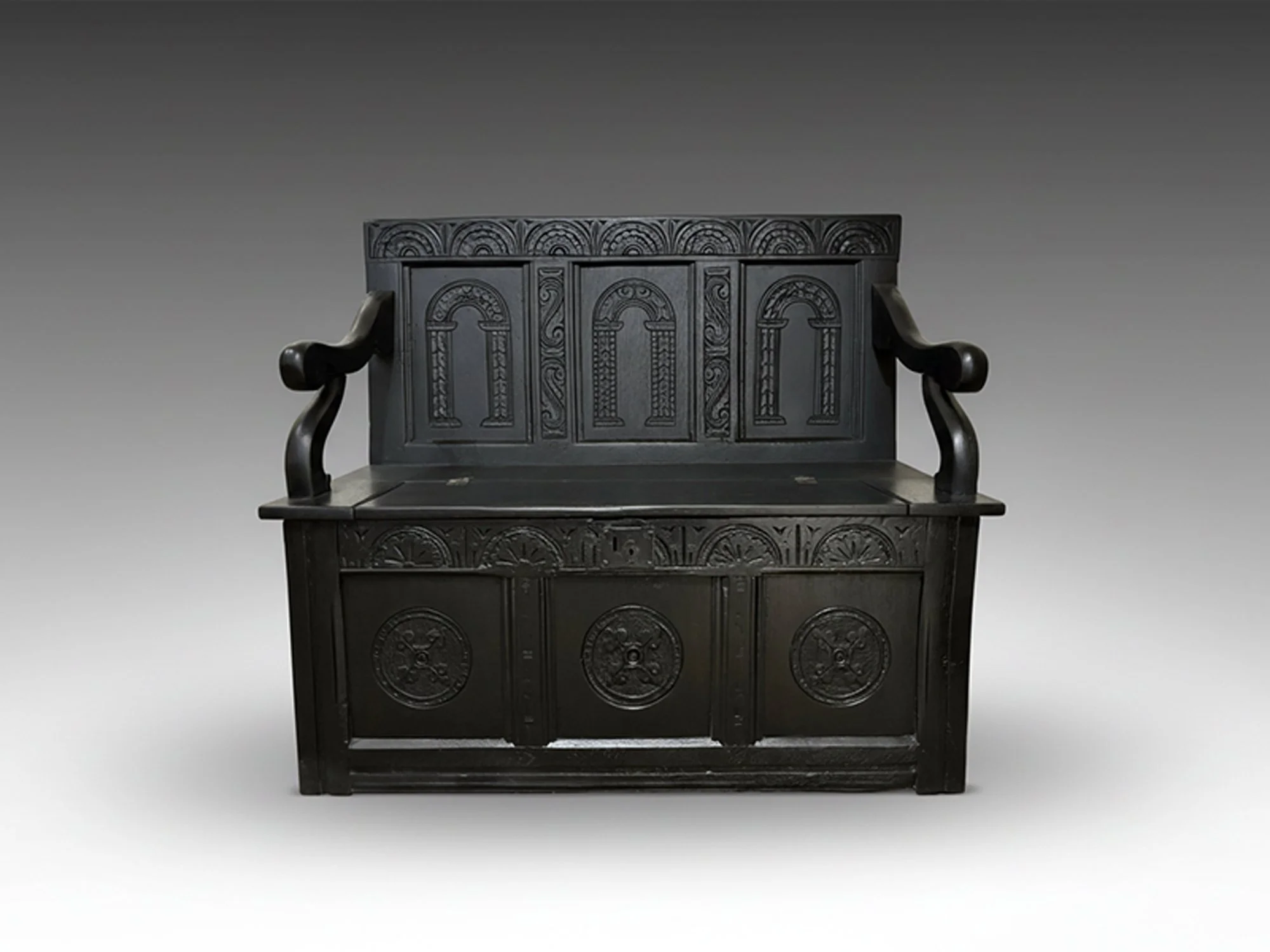
 Image 1 of 3
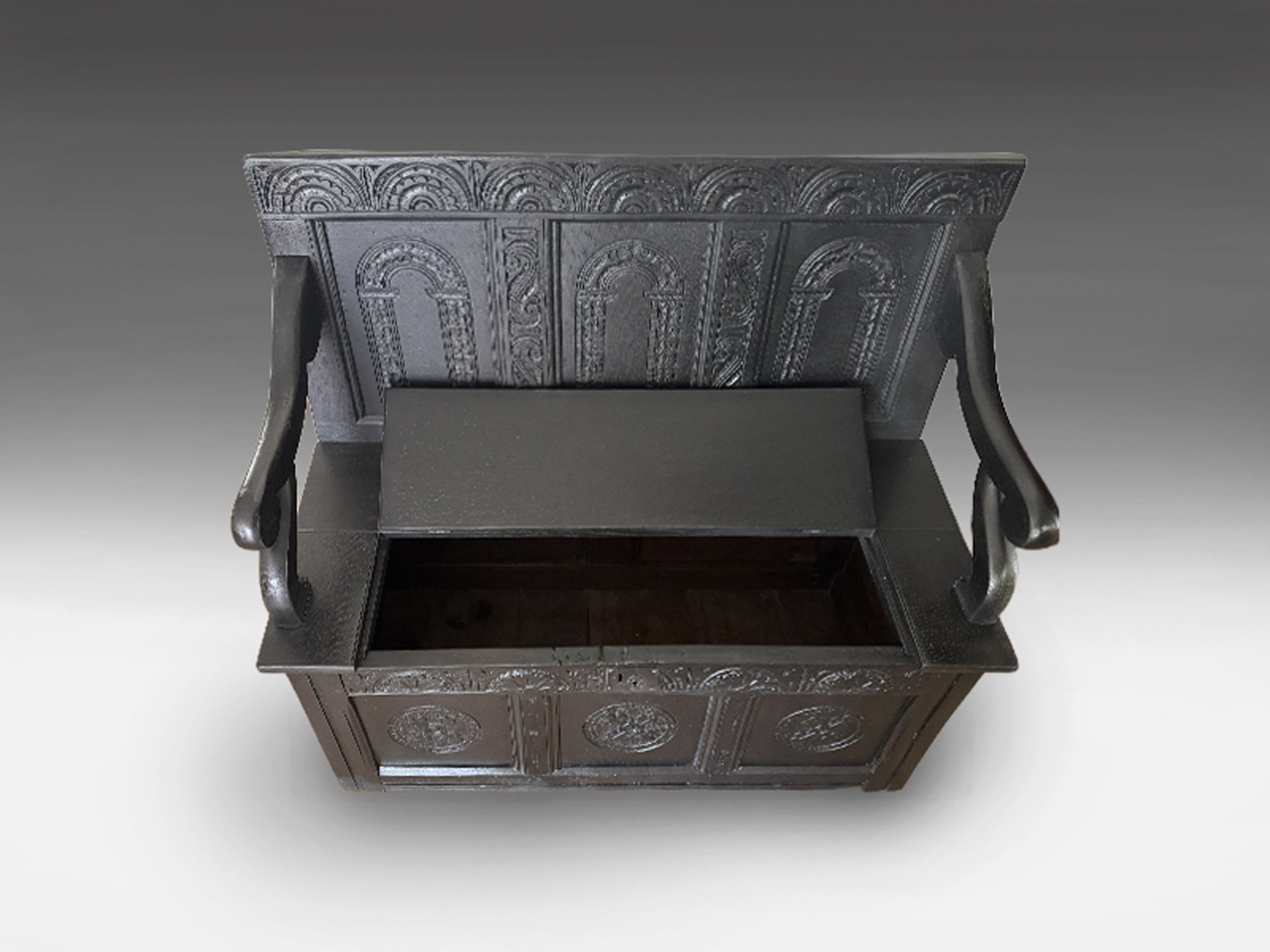 Image 2 of 3
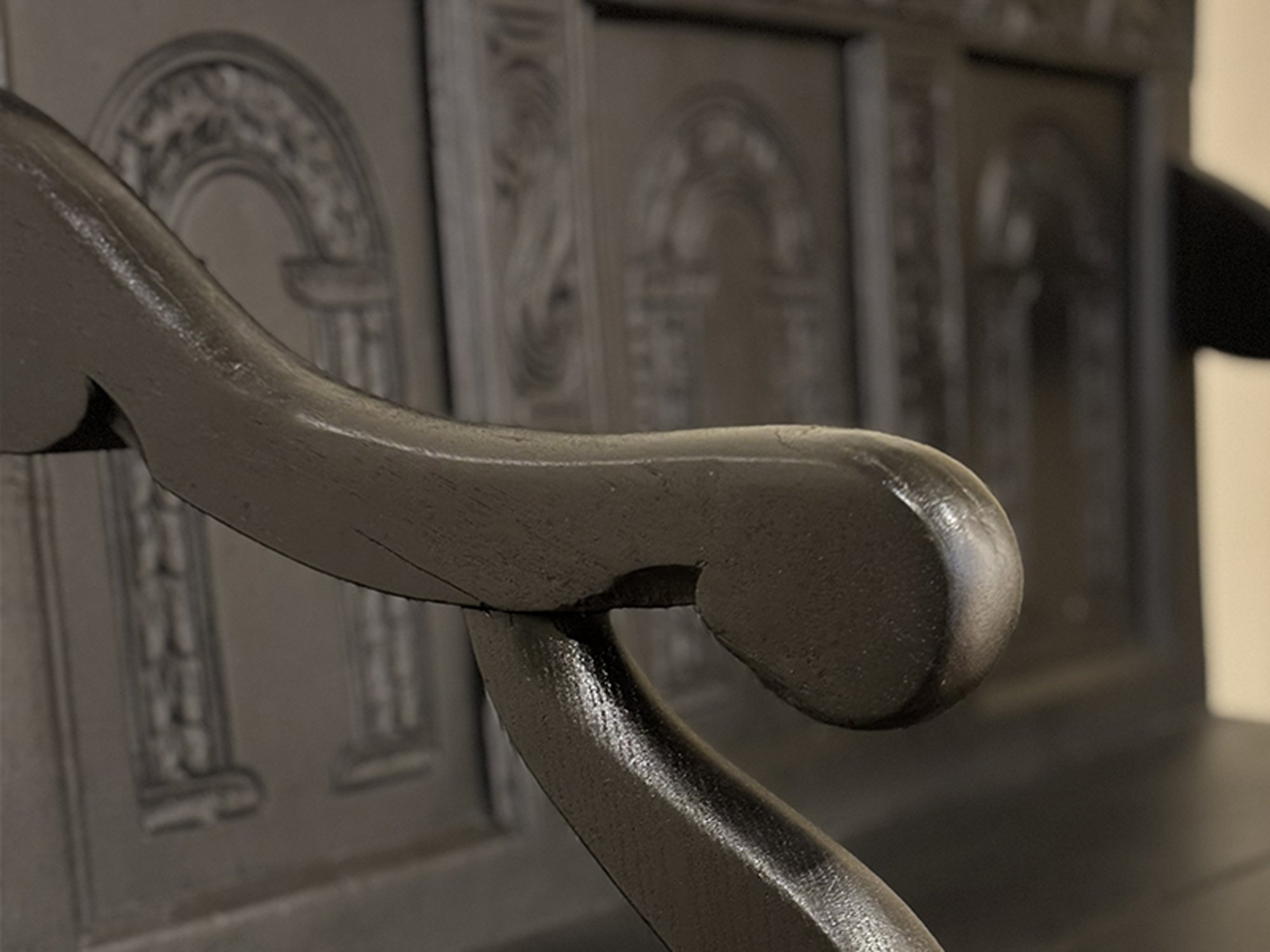 Image 3 of 3
Living With This Object
In a room, the settle reads as a dark, upright block: the triple-arcaded back rising to about eye level, the scrolled arms and paneled chest squared to the wall, the whole holding as a single ebonized silhouette rather than a set of separate parts.
The room view below is an AI visualization, offered to suggest scale and placement. It is a rendered image, not a photograph of the settle in this room.
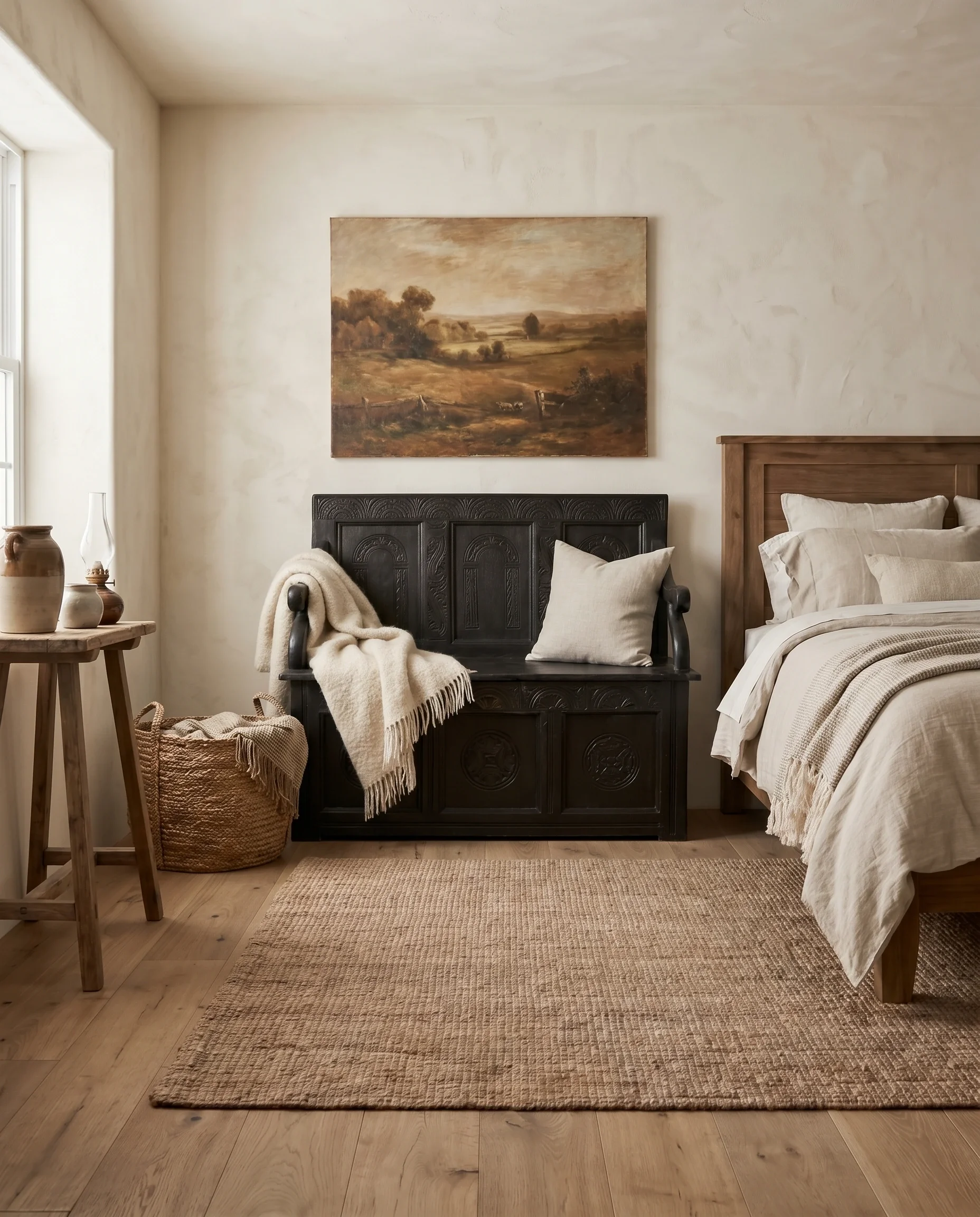
-
Whether it stands in an entry hall, anchors a study, or lines a corridor, the settle offers seating and storage in one mass, the high back rising over the concealed well. The interior chamber takes papers, linens, or keepsakes. Heavy and architectural, it anchors a wall or corner through its own mass rather than through visual delicacy, and it reads best against a plain ground that lets the carved back and the ebonized surface register.
-
Type: Box settle; a high-backed hall settle with a hinged seat over a storage chest, also read as a hall bench with storage or storage bench
Style: Jacobean / Jacobean Revival
Date: Circa 1890–1920 (inferred)
Origin: Not established
Provenance: Most recent documented acquisition from a private residence in Palos Verdes Estates
Material: Oak, quartersawn
Finish: Ebonized black, applied during a recent refinishing; not original
Construction: Joined and pegged oak; frame-and-panel; hand-carved
Maker & Origin: Unattributed; no mark located
Condition: Refinished; sound; historic top-rail loss and old, filled worm holes; general wear
Dimensions: 41½ W × 18 D × 36¼ H in. Seat height not recorded.
-
Original: The oak carcase, the frame-and-panel back and chest, the carved decoration, and the scrolled arms appear original to the piece as assembled.
Replaced: Nothing was replaced in the documented work. The iron hardware, the hinges and lock plate, appears original to the piece and shows no evidence of replacement, and was not altered in the recent restoration. The seat boards could not be separately verified during documentation.
Reconstructed: No elements were reconstructed. Whether the settle is wholly original as assembled or combines period and later elements is not established; this is a question of originality, not of object type.
Repaired: Historic loss with consolidation and filler at the top back rail. Minor surface repairs consistent with age.
Finish Work: Recent refinishing. The piece was stripped of its earlier dark surface to bare oak, then ebonized black. The black is an applied surface, not an original one, and the uniform tone reduces the contrast that would otherwise define some shallow carving.
Other: Old woodworm is evident at the back rail, with holes that read as old and were filled and concealed under the refinishing. No frass has appeared in the year since refinishing, including through a warm season, on a sealed surface where fresh emergence would show. The damage is treated as historic and inactive.
Remediation: The underside of the seat lid had a light surface mold bloom, which prompted the recent cleanup and refinishing. That section was sanded and treated, and the bloom is no longer present; the interior is clean and sound. As with any wood furniture, keep the piece in a dry, well-ventilated space, since mold can return wherever moisture does.
-
The settle reads from its back first. Three fielded panels each carry a round Romanesque arch raised on columnar supports, the arch ring scalloped and dotted, the columns dressed with pendant leaf carving. Narrow muntins of guilloche and scrollwork divide the panels, and a deep lunette frieze of overlapping fans crowns the whole. The same lunette band returns on the chest front above three lower panels, two of them centered on carved roundels with a cross-and-disc motif. Seen together, the effect is architectural and repetitive, a small arcade rendered in oak.
-
No maker's mark, label, or stamp has been found, and no provenance chain accompanies the piece, so it is left unattributed rather than assigned to a maker the evidence cannot name. The carved vocabulary belongs to the Jacobean carved-oak tradition of the English seventeenth century, widely revived in later Victorian and Edwardian workshops, and the wear and carving point to that revival window, circa 1890–1920. Each of these is an inference from form and condition, not a documented fact. The origin is left open: comparable pieces in this taste were made in Britain and on the Continent, and the settle carries no mark to assign a country.
-
The timber is quartersawn oak. The back frame shows pegged mortise-and-tenon joints, with a square peg standing slightly proud near the top rail. The seat is a two-board plank lid on iron hinges with slotted screws, lifting to a board-lined storage well. An iron lock plate is fitted to the chest front; its function was not tested and no key is present. The arms are cut from solid stock and scrolled. The carved panels are worked in solid oak rather than applied, and the carving is hand-worked throughout. The same oak carries through the carcase and hinged lid alike.
-
Settles of this kind were a hall and passage form: a bench, a back, and a chest joined into one, keeping seating and storage close to the door. In English interiors a settle like this stood where people waited or removed boots, with linen or candles kept in the well beneath the seat. Its carving looks back to early seventeenth century English joinery.
The known history of this example begins in Palos Verdes Estates, California. According to the previous owner, the settle remained in the same family home for many decades, where the storage well beneath the seat was used to keep family photographs and keepsakes, including items dating to the late nineteenth century. While this account is preserved as owner-reported provenance rather than independently documented history, it records the object's known domestic life before entering the Acanthus Home collection.
The maker is unattributed, the date undocumented, and whether this is a period survival, a revival production, or an assembly of older and later elements is unresolved. Earlier ownership before its time in Palos Verdes Estates is not known. The record ends where the evidence ends.
-
Is this an antique or a vintage settle? Antique, based on informed inference. The construction, wear, and carved detail read as late nineteenth to early twentieth century, circa 1890–1920, and every year in that range predates 1926, the date Acanthus Home uses to distinguish antique from vintage. Because the call rests on style rather than a mark or document, we state it as inferred, not documented.
Is the black finish original? No. The present black surface was applied in a recent refinishing and is a decorative, applied finish rather than a historic one. Before refinishing the settle carried a dark brown stained oak surface, which was stripped to bare oak. The uniform black reads slightly softer over some shallow carving.
What kind of bench is this? A carved oak hall settle with storage, technically a box settle: a high-backed bench with enclosed scrolled arms and a hinged seat over a chest, so it also serves as a hall bench or storage bench. The form is established and not in doubt; what stays open is whether it is period or later revival work.
Where was it made? The origin is not established. The settle carries no maker's mark or label, and its arcaded carved vocabulary follows the English seventeenth century joinery tradition. Comparable pieces in this taste were produced in Britain and on the Continent during the revival period, so we do not assign a country of manufacture.
Is the old woodworm still active? We treat it as historic and inactive. The holes at the top back rail read as old; they were filled and sealed under the refinishing, and no fresh frass has appeared in the year since, including through a warm season, on a sealed surface where new emergence would show plainly.