The Windward Collection: A Dialogue Between Craft and Coast
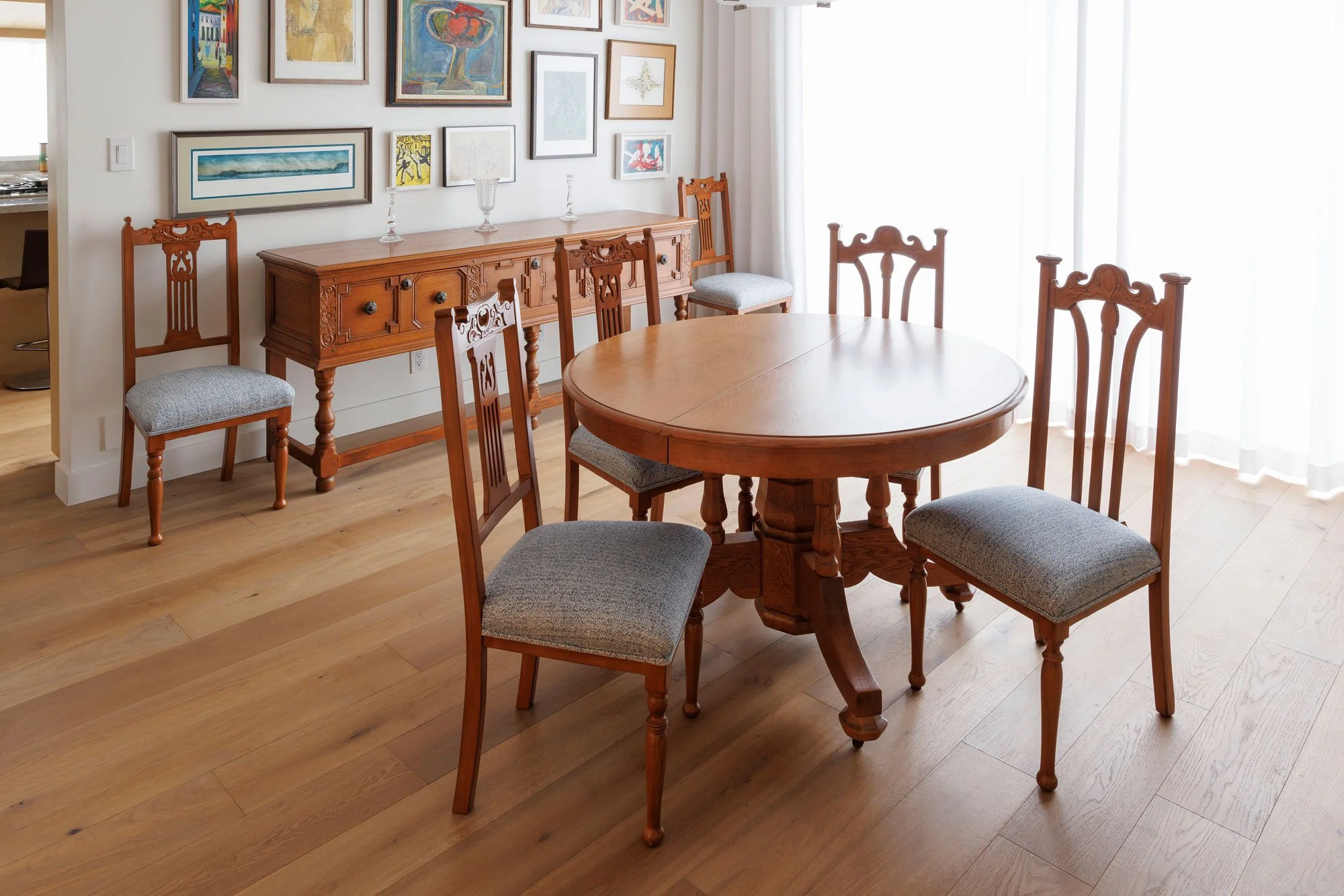
The Windward Collection in a dining room: the quarter-sawn oak table with its 47-inch round top and the six chairs, four lyre-backs and two splat-backs.
Antique dining chairs do not have to match to read as a set. The six chairs of the Windward Collection share one construction, one height, and one restrained vocabulary of ornament, and they hold together as a group even though four are lyre-backs and two are splat-backs.
Do antique dining chairs have to match?
They do not, and this set is the reason why. The Windward Dining Chairs are a set of six, dated to the early twentieth century on the evidence of their pierced splats, carved crest rails, and turned front legs, features commonly associated with Edwardian dining furniture. They came to Acanthus Home from a long-held estate on the Palos Verdes Peninsula, their history legible through use rather than record. Who made them is not recorded, and the country of manufacture is not established.
The variation is in the backs. Four are lyre-backs, the splat pierced as a lyre with elongated vertical cutwork beneath a shaped, carved crest rail; the other two are splat-backs, a single pierced splat of a related design at the same height and proportion. Whether the two designs left the workshop together or were paired later in the set's life is not documented. What holds the set together is proportion, not pattern. Seen together, the six establish continuity through proportion rather than identical carving.
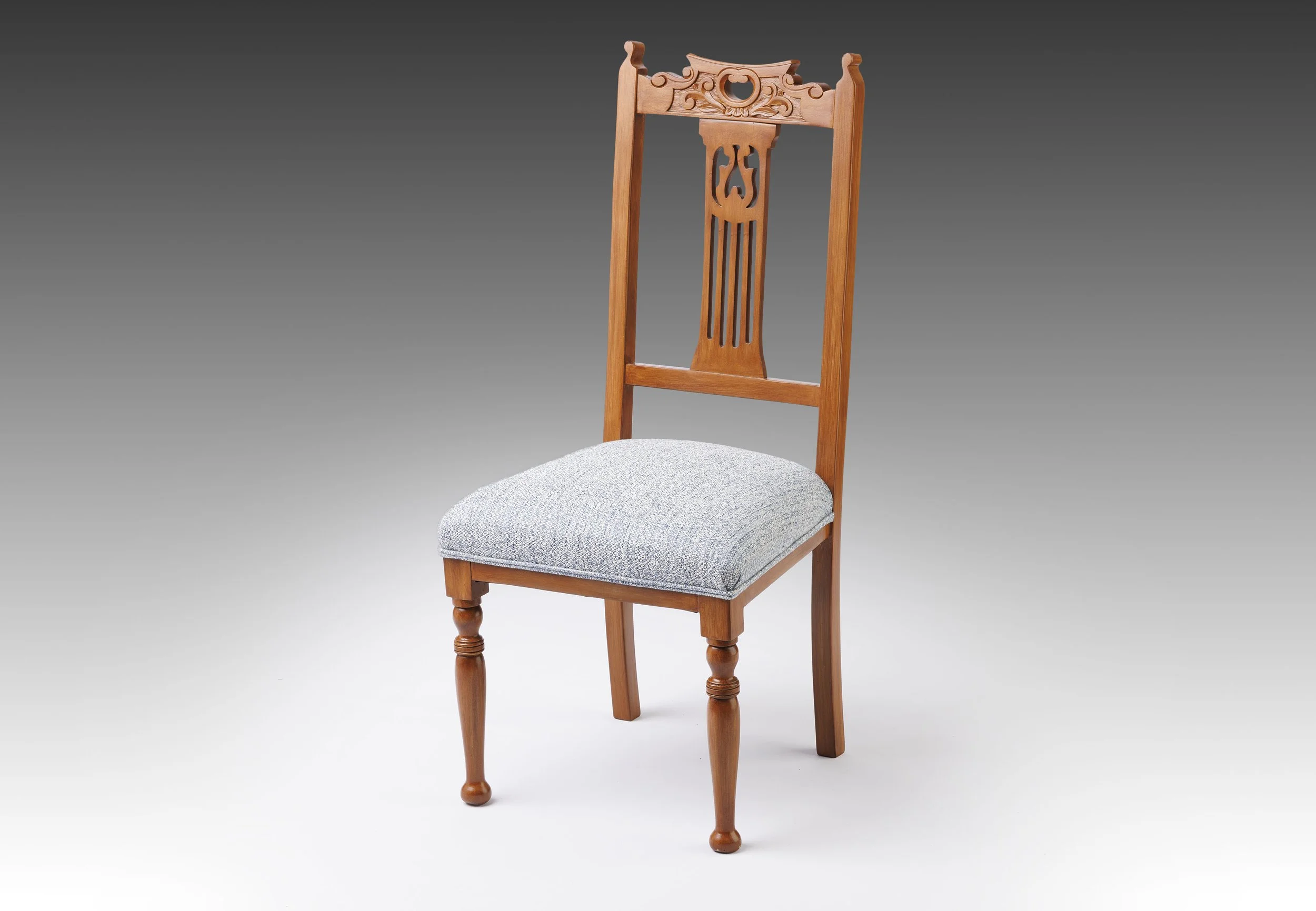
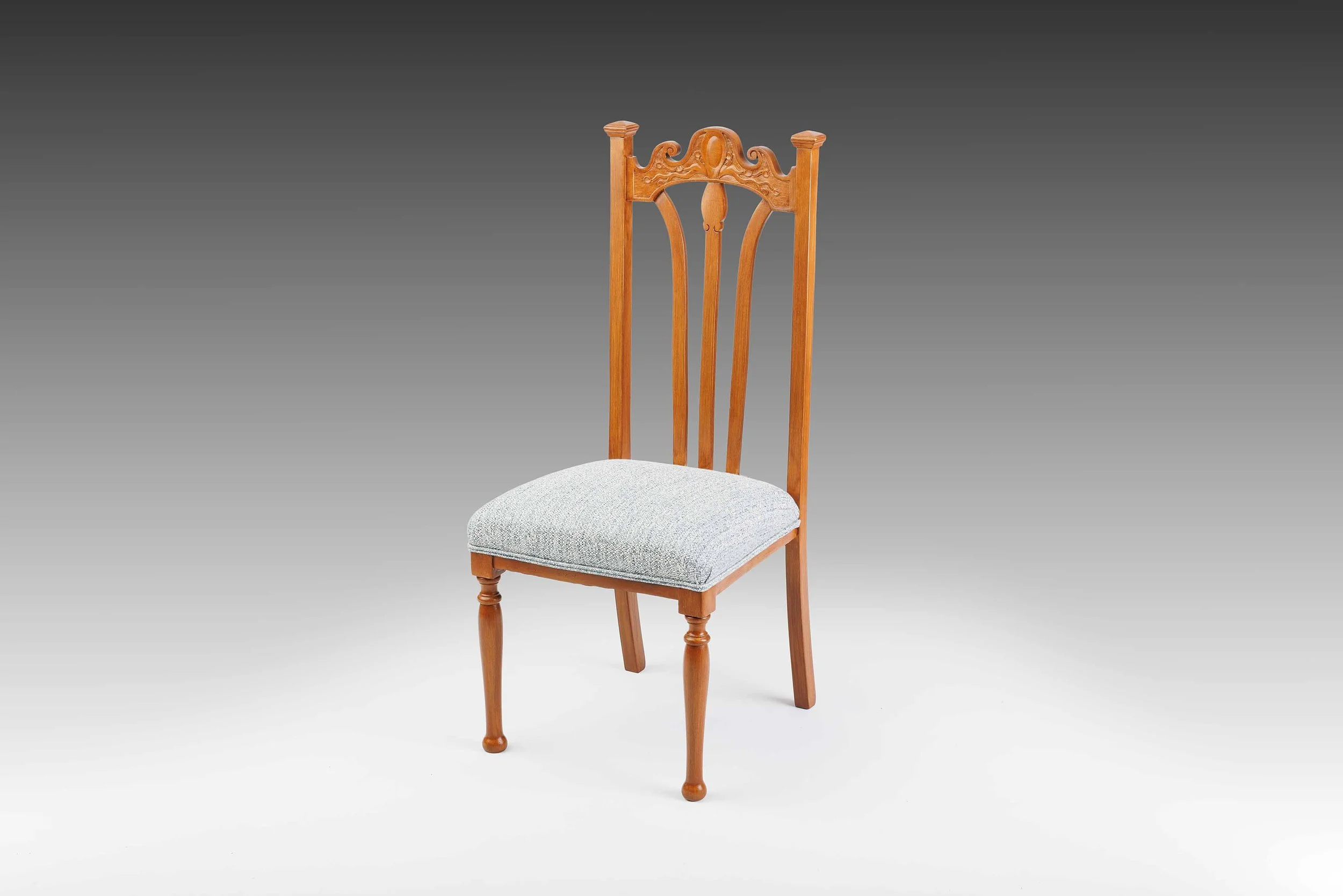
The frames are solid wood; the species is not identified, so it is not named here. Each back rises through two uprights to a crest rail carved with scrollwork around a pierced center. The front legs are turned and finish in compressed ball feet, while the rear legs are squared and raked, a pairing that gives each chair a stable, even stance. Acanthus Home refinished the frames to clarify tone while keeping their age and surface character. The present surface dates to the restoration, not to the period, and the original structure and proportions were left unchanged.
The seats were newly upholstered across the set in a textured cotton blend, its tonal blues running from pale mist to deep indigo. The blue was selected during restoration, its tonal range sitting comfortably within the coastal light of the Palos Verdes Peninsula. The work returned the set to use rather than display, which is the account we give in full in The Language of Threads.
The Windward Table anchors the collection through proportion rather than ornament. It is an antique extension dining table in quarter-sawn oak, dated to the early twentieth century. The round top, 47 inches across when closed, shows the broad ray fleck of the quarter-sawn cut, and a beveled edge eases the surface to its perimeter. The table is carried on a pedestal of turned columns around an octagonal post, over four downswept legs that end in squared feet on casters. Its surface was stripped and refinished to a lighter honey tone in restoration; the structure, joinery, and proportions remain original and unchanged. The underside carries the paper label of M. Friedman & Co. of San Francisco, the retailer that sold it in the 1910s or 1920s; the maker is not recorded. It is a well-established form of its period, a round quarter-sawn oak pedestal table of a kind made in quantity and sold, usually unmarked, across the country.
Extension tables developed as accommodations for changing household needs rather than as conveniences in the modern sense. The Windward Table takes three separate leaves, each added to lengthen the top. Closed, it reads as a fixed round. It accepts more.
Paired, the chairs and the table hold to the same measure. Restrained joinery and clear geometry let both pieces move between interiors without adaptation, an approach we describe further in Mixing Antique and Modern Furniture. The six backs differ, and the collection still reads as a single structure, its proportion carrying that variation without dissolving the set.

Point Vicente Light on the Palos Verdes Peninsula, the coast where the set was kept before it came to Acanthus Home.
Objects in this Journal
The Windward Dining Chairs. A set of six antique Edwardian dining chairs, early twentieth century, refinished and newly upholstered in a tonal blue weave. Acquire This Set
The Windward Table. An antique extension dining table in quarter-sawn oak, early twentieth century, with a 47-inch round top and three concealed leaves. Acquire This Piece
See more of the collection's restored antique seating.
See more of the collection's antique tables.
Related reading
What Remains: A Pair of Restored Antique Chairs
The Language of Threads: Couture in Antique Restoration
Thoughtfully Collected. Quietly Shared.
