 Image 1 of 2
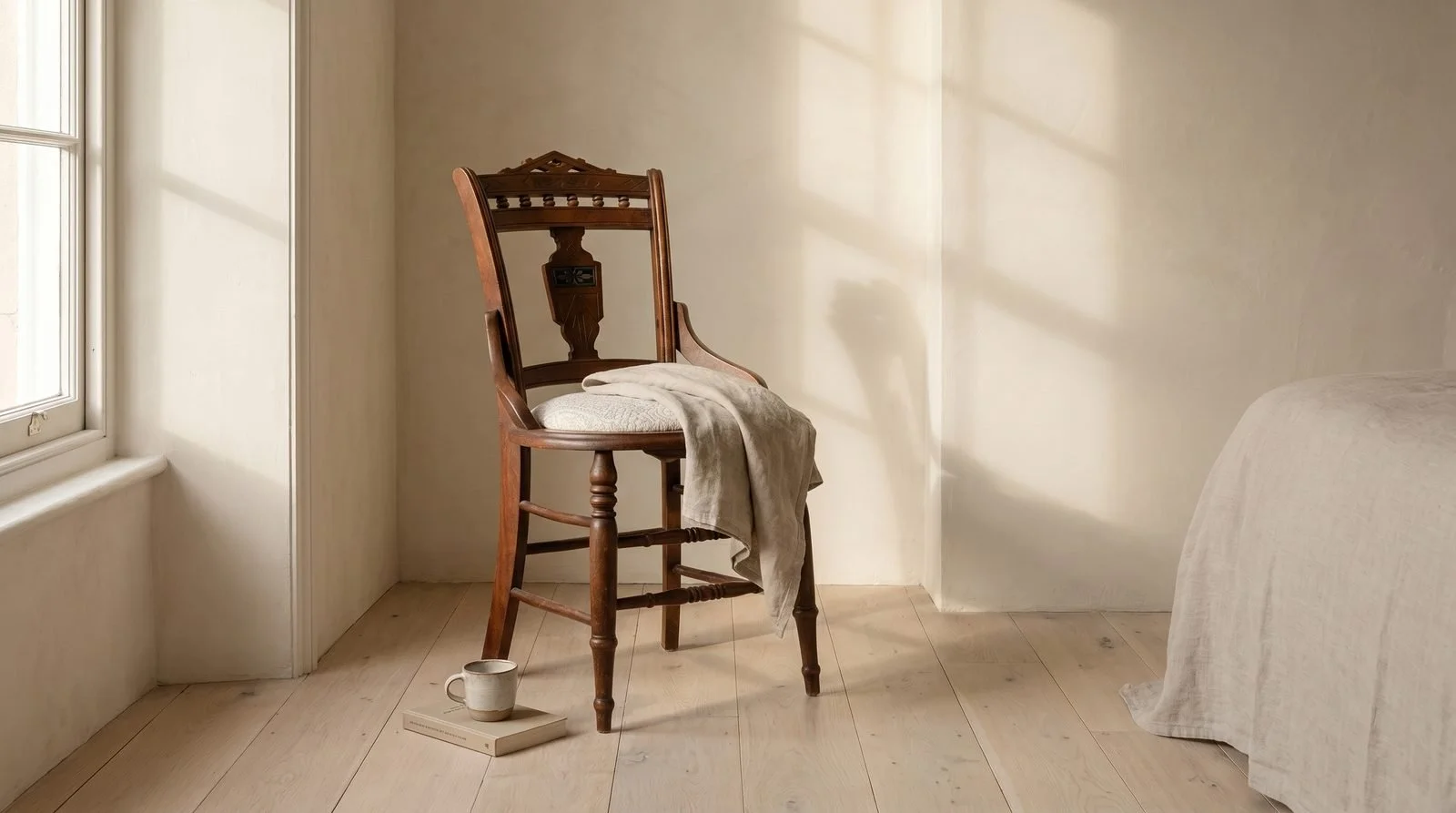 Image 2 of 2
Living With This Object
In a room the chair gathers its ornament where the eye falls: the pierced, peaked crest and the ebonized panels with their pale blooms rise above the turned spindle gallery, while the low scrolled arms and the round seat keep the frame compact and low. The dark panels carry the pale motif clearly across a room, and the quiet Glant weave keeps the emphasis on the carved and ebonized back.
The room view below is an AI visualization, offered to suggest scale and placement. It is a rendered image, not a photograph of the chair in this room.


-
The chair holds its place through proportion rather than scale, a single occasional form with a compact footprint. Whether it draws up to a writing desk, stands in an entry, settles into a bedroom or dressing room, or joins a larger seating arrangement, it is meant to be used alone rather than as one of a set. Its seat height of 19½ inches lets it serve at a desk or table as readily as against a wall.
-
Type: Accent chair with a round seat and low, open scrolled arms
Style: Eastlake (American Aesthetic Movement)
Date: Circa 1880–1895
Origin: United States (inferred)
Maker: Unattributed (no mark located)
Provenance: Acquired from an estate sale in Rancho Palos Verdes, California. According to a family member, the chair had remained in the same family for multiple generations before the sale.
Material: Hardwood frame
Finish: Existing surface, retained and revived
Construction: Mortise-and-tenon and dowel joinery with a turned frame and round seat ring
Condition: Restored; surface retained and revived; seat converted from cane and reupholstered; one repaired segment in the seat ring
Dimensions: 18 W × 15½ D × 34 H in.; seat height 19½ in
Upholstery: Glant 'Soft Shell', a rayon and cotton weave; reupholstered (see The Glant 'Soft Shell' Upholstery)
-
Original: The frame, back, legs, and stretchers appear original, with no evidence of replacement.
Replaced: The seat covering and pad are new. Originally caned, the seat had been converted to an upholstered pad earlier in its life; the pad is secured from beneath with modern screws and a fitted dust cover. The textile is detailed under The Glant 'Soft Shell' Upholstery.
Reconstructed: No elements were reconstructed.
Repaired: One segment of the round seat ring shows a repair.
Finish Work: The existing surface was retained and revived rather than stripped, its wear and tonal variation left intact.
-
The chair takes its name from this passage of ornament. Beneath the pierced, peaked crest rail runs a gallery of six turned spindles. The crest and the central splat each carry an ebonized rectangular panel, centered with a pale, stylized floral motif and framed by incised geometric lines: lozenges, chevrons, and triangles cut into the surface. The dark panels hold the pale blooms in sharp relief, so the ornament reads clearly at room distance while staying within the frame's own lines, in the reform manner the Eastlake style favored.
-
No maker's mark or label is present. The faint stamped numerals on the rear seat rails are assembly or inventory marks rather than a maker's mark. The chair is Eastlake, the American interpretation of the Aesthetic Movement reform style, and its manufacture in the United States is inferred from its form and construction rather than documented. The circa 1880–1895 date follows from that same evidence.
Provenance: Acquired from an estate sale in Rancho Palos Verdes, California. According to a family member, the chair had remained in the same family for multiple generations before the sale. Earlier ownership has not been documented. The same estate sale also yielded The Lost Spindle side chair, The Stratelle Spanish Colonial cabinet, and The Chamber Reliquary marble-top nightstand, all documented separately by Acanthus Home. Together, these acquisitions document that all four objects were present within the same Rancho Palos Verdes household when they were acquired by Acanthus Home. Whether they formed part of the same original furnishing or were assembled within the household over time is not documented.
-
The primary wood is consistent with walnut, based on its color and straight, mildly figured grain. The frame is joined with mortise-and-tenon and dowels. The front legs are turned, with slight irregularities consistent with hand shaping, while the rear legs rake back in a continuous line with the back stiles. Low, open scrolled arms rise from the seat sides, and turned stretchers tie the legs together. Underneath, the round seat ring is drilled with a double row of holes for an earlier hand-caned seat.
-
A woven textile with a matte surface and soft tonal variation, patterned in an understated abstract in cream and beige. The weave keeps the visual emphasis on the frame rather than the covering.
Manufacturer: Glant
Pattern: Soft Shell
Design Style: Abstract (as stated by the manufacturer)
Composition: 56 percent rayon, 44 percent cotton (as stated by the manufacturer)
Performance: Rated for heavy domestic use, Martindale 30,000 rubs
Flame resistance: Passes California Technical Bulletin 117-2013
Textile origin: United States
Reupholstered: Yes, over a new pad, in this restoration
-
Chairs of this kind were the affordable face of the Aesthetic Movement, the mass-produced American parlor and side seating of the 1870s and 1880s that carried incised, rectilinear ornament into ordinary middle-class rooms. This example wears its use plainly: the retained surface keeps its wear and tonal variation, and the seat's life had already moved once, from cane to an upholstered pad, before the present covering. Its restoration kept those chapters legible rather than resolving them into a single refinished surface.
By the time it reached Acanthus Home, the chair had remained with the same family for multiple generations before passing through an estate sale in Rancho Palos Verdes, California, according to a member of the family. That documented line of recent ownership becomes part of the object's biography, even as its maker, original purchaser, and earliest households remain unknown. The record ends where the evidence ends.
-
Is this an antique or a vintage chair? Antique. This antique Eastlake accent chair predates 1926, the cutoff Acanthus uses: its Eastlake form and its incised, ebonized ornament place it circa 1880–1895, which makes it roughly 131 to 146 years old. The date rests on style and construction rather than a dated mark, so it is offered as an informed estimate.
What wood is it? The primary wood is consistent with walnut, based on its color and straight, mildly figured grain. The species is an informed identification rather than a confirmed one. For that reason the listing describes the frame simply as hardwood where a single word is required.
Has it been restored or reupholstered? Yes. The wood surface was retained and revived rather than stripped. The seat, originally caned, was converted to an upholstered pad and newly covered in Glant's 'Soft Shell', a rayon and cotton weave rated for heavy domestic use, and one segment of the seat ring shows a repair. No other interventions are recorded.
What is the panel on the back? Each ebonized panel, one on the crest and one on the central splat, is centered with a pale, stylized floral motif framed by incised geometric lines. The dark ground makes the pale bloom read clearly across a room, and the new seat textile was chosen to stay quiet beneath that ornament.