 Image 1 of 7
 Image 2 of 7
 Image 3 of 7
 Image 4 of 7
 Image 5 of 7
 Image 6 of 7
 Image 7 of 7
Living With This Object
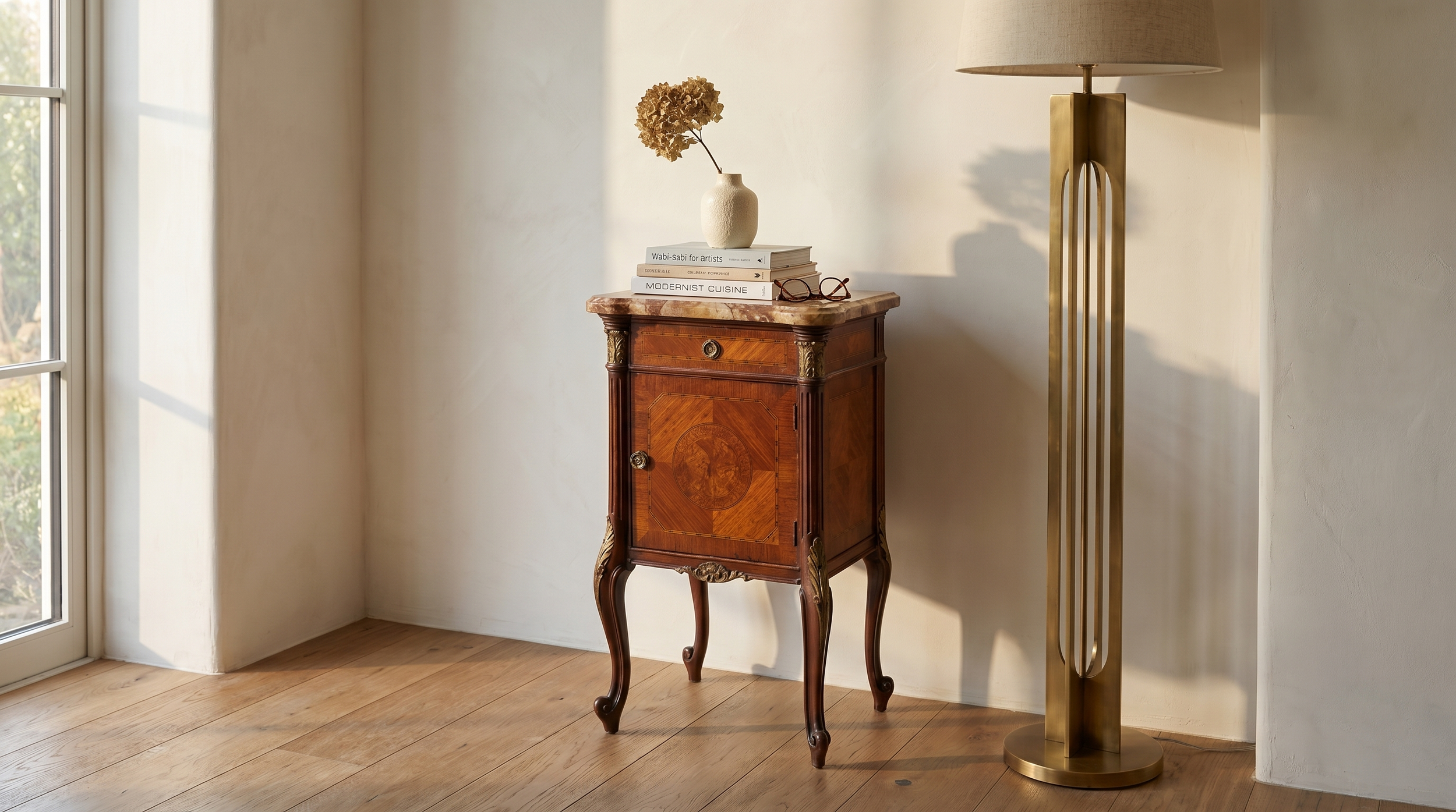
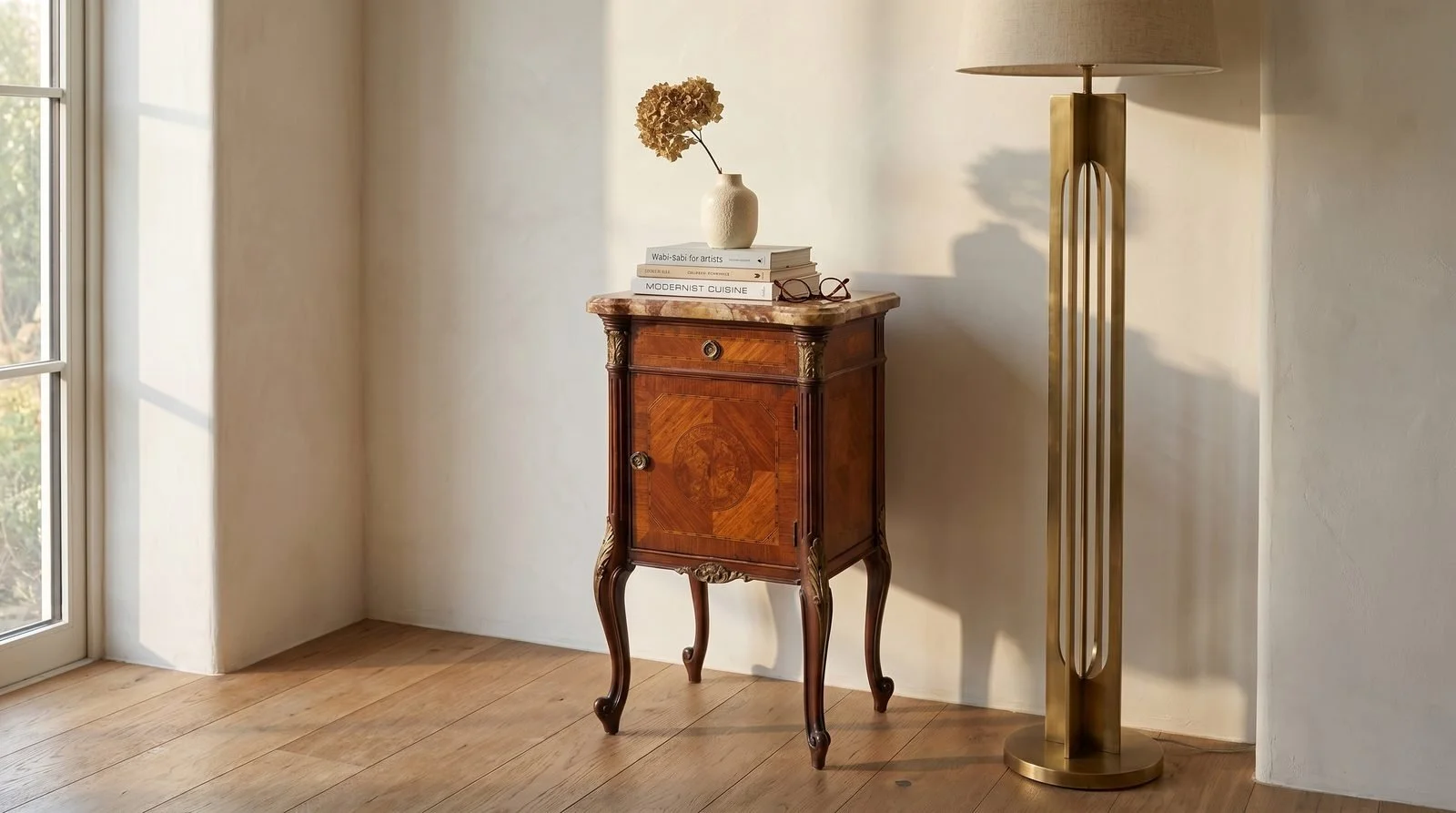
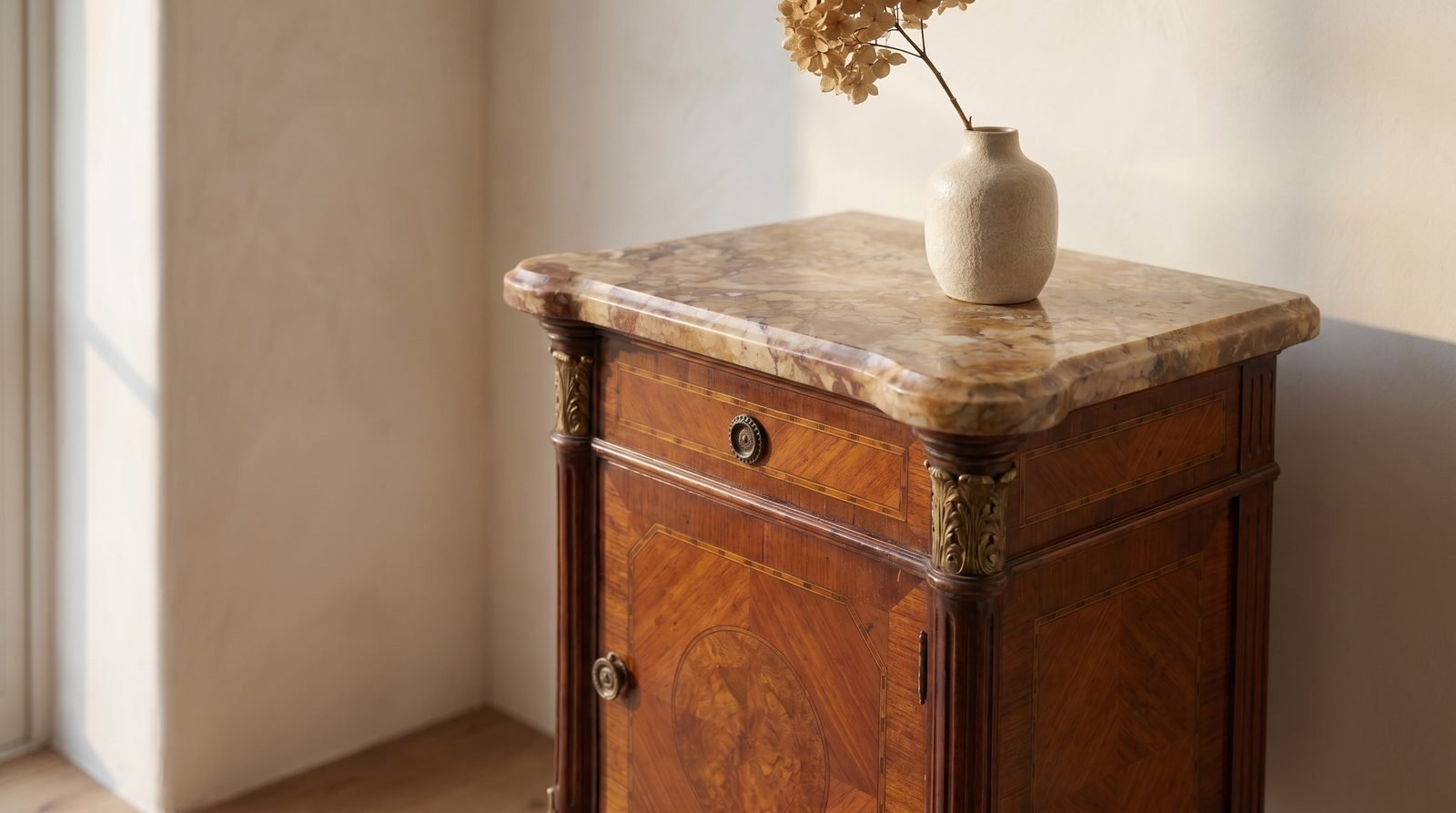
The following images are AI-generated visualizations intended to illustrate scale, proportion, and possible interior settings. They are conceptual, not photographs of the object in an existing room, and they preserve the documented proportions, finish, hardware, repairs, mirror, and construction of the piece.
-
Whether it stands beside a bed, at the arm of a reading chair, or serves as an occasional table in a layered interior, the cabinet keeps to a modest footprint and does the work it was built for. The drawer takes small items and the cupboard holds a little more, while the stone top comfortably supports a lamp, a carafe, or a stack of books.
-
Type: Bedside cabinet (table de nuit); sized to serve as a side table
Style: French, transitional Louis XV / Louis XVI taste
Date: Circa 1900–1920
Origin: Not established
Materials: Hardwood with figured veneers and marquetry; marble top; gilt-metal mounts
Finish: Original surface, retained and revived; hand-applied shellac
Construction: Veneered and inlaid case; single drawer over a cabinet door; cabriole legs on metal sabots
Maker: Unattributed; retailer's label present (Berman Furniture Co., New York)
Condition: Structurally sound; honest wear; natural fissuring and minor edge losses to the marble
Dimensions: 17 W × 13 D × 29 H in.
-
Original: The marble top, gilt-metal mounts, ring pulls, drawer, and cabinet door are present and appear original; no replacement evidence is documented.
Replaced: Nothing was replaced in the documented work.
Reconstructed: No elements were reconstructed.
Repaired: No structural rebuilding is documented. The case stands square and the legs are firm.
Finish Work: The original surface was cleaned and revived rather than stripped, with hand-applied shellac reviving tone and depth while preserving the marks of use. Veneers and marquetry keep their period surface variation and aging.
Other (marble): The brecciated top carries natural veining and fissures, with minor losses and old filled lines along the edges. These reflect the stone's structure and its history of use rather than damage.
-
The cabinet door is centered on an oval marquetry reserve: a flowering spray with foliage, worked in contrasting light woods and burl against a darker veneered ground. Fine line inlay and banded chequer stringing frame that reserve and repeat around the drawer front and the side panels, so the case reads as one composed surface with the flowering spray as its focal point. That bloom is the namesake of the piece, making the door, rather than the marble above it, the visual center of the cabinet.
-
No maker's mark, stamp, or documentation has been found, so the cabinet is offered without attribution. The form, a marble-topped bedside cabinet in transitional Louis XV and Louis XVI taste, was made widely in France and in neighboring countries from the late nineteenth century onward, and nothing on the piece settles which workshop or country produced it. The paper retailer's label for Berman Furniture Co. of New York records where the cabinet was once sold, not where or by whom it was made. It is provenance, not a record of manufacture. The dating rests on the styling and the machine-cut drawer construction, which together place manufacture circa 1900–1920. Its later appearance at a New Hampshire auction documents a later chapter in its provenance rather than its place of origin.
-
The carcase is a hardwood, veneered and inlaid across the front and sides with a plain back. Its primary veneer is a warm reddish-brown wood with close, straight figure laid in mirrored quarters; the species is not confirmed and is not named. The marquetry and stringing are worked in lighter contrasting woods and burl, and the single drawer is built with machine-cut dovetails. The side-hinged cabinet door carries a mortise lock plate and a ring pull, and opens to a single-compartment interior. Gilt-metal mounts dress the front capitals, the apron, and the leg fronts, and the cabriole legs end in metal sabots. The brecciated marble top, veined in warm tones, sits within the perimeter of the case.
-
Marble-topped bedside cabinets of this kind were familiar fixtures of the bedroom, arriving as private sleeping rooms took on their defined routines: the drawer, the cupboard, and the washable stone surface absorbed the nightly traffic of water, books, correspondence, and small personal things. This example carries quiet evidence of that service, its veneers softened by time and its marble top marked by handling.
The cabinet's documented history remains fragmentary. A paper retailer's label inside the drawer records that it once passed through Berman Furniture Co. of New York, preserving one documented chapter of its commercial life. More recently, the cabinet was acquired by Acanthus Home at an auction in New Hampshire before entering conservation and documentation. Its maker is not recorded, its date remains an evidence-based estimate, and the owners between that New York furniture showroom and the New Hampshire auction are unknown. The record ends where the evidence ends.
-
Is this antique or vintage? It is an antique French marble-top side table on the evidence: the transitional Louis XV and Louis XVI styling and the machine-cut drawer joinery point to manufacture circa 1900–1920, so even the latest plausible date is over a century old. Acanthus Home dates its objects from the available evidence rather than rounding to an earlier period.
What does the label inside the drawer mean? A paper retailer's label for Berman Furniture Co. of New York, with the line "Furniture of Refinement," remains inside the drawer. A retailer's label records where the cabinet was once sold, not who made it, so it is a chapter of provenance rather than a maker's mark.
Where was it made? The form is French, a marble-topped bedside cabinet in transitional Louis XV and Louis XVI taste, but the pattern was produced in France and in neighboring countries, and the cabinet carries no maker's mark. The country of manufacture is therefore not established, and the record leaves it open.
Has it been restored? Lightly, and honestly. The original surface was cleaned and revived with hand-applied shellac rather than stripped, so the wear of use stays legible. No structural rebuilding is recorded; the case stands square and the legs are firm. The marble top, mounts, ring pulls, and marquetry appear original and were retained.