 Image 1 of 2
 Image 2 of 2
Living With This Object
On its tall spoked wheels, the cart carries something of the character of a small carriage. Open the leaves and it becomes a generous serving surface; fold them down and it slips comfortably beside a wall or chair. The clear finish keeps the natural grain visible, making the wood itself part of the design.
The room view below is an AI visualization, offered to suggest scale and placement. It is a rendered image, not a photograph of the cart in this room.
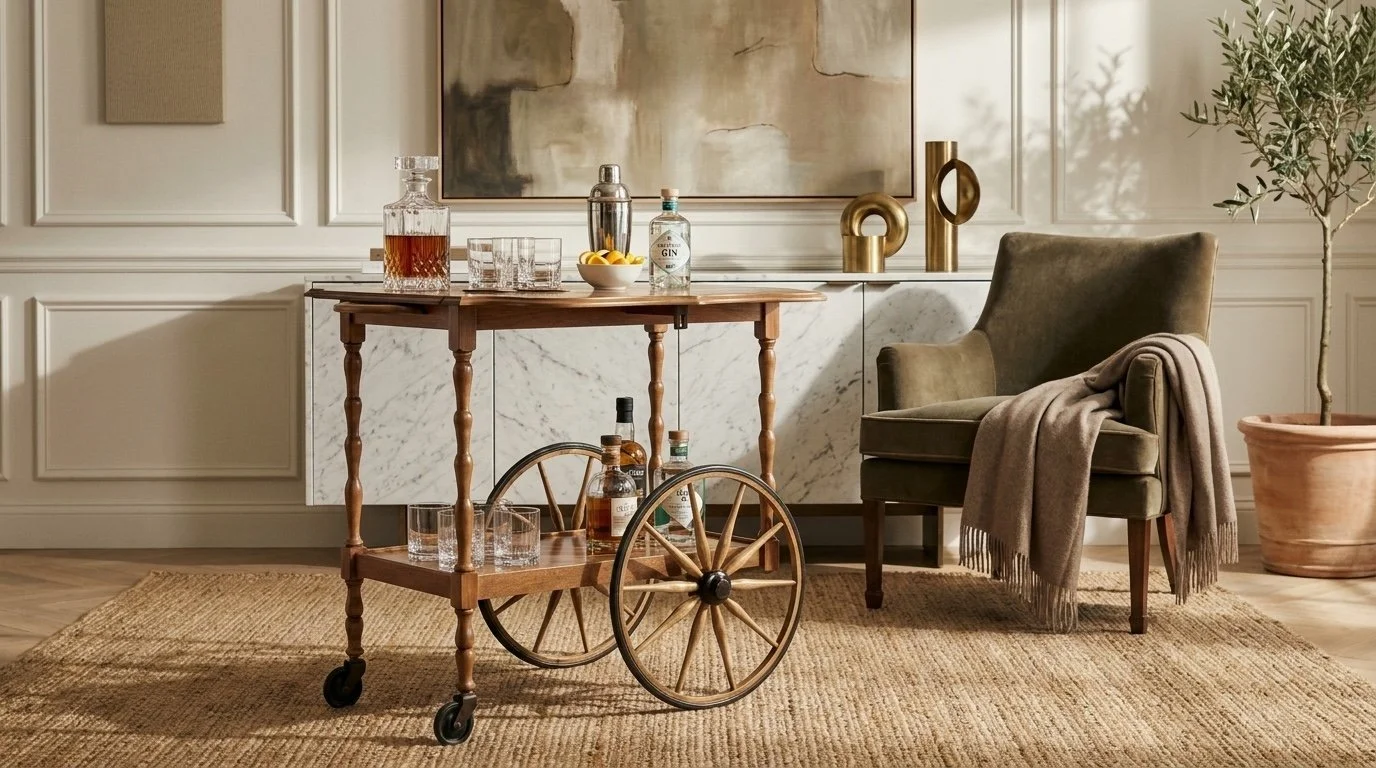
-
Today it serves equally well as a bar cart, a tea or coffee service, or a movable side table. Closed, the folding leaves let it rest against a wall; opened, they give more surface when service calls for it, and the wheeled base brings it easily from room to room. The gallery shelf below keeps bottles, serving pieces, or books close at hand without claiming more floor.
-
Type: Tea cart (drop-leaf serving cart); serves today as a bar cart
Style: Colonial Revival
Date: Circa 1930–1945
Origin: Not established (American Colonial Revival form)
Material: Hardwood
Finish: Clear finish, applied in restoration
Construction: Turned spindle legs; drop-leaf top on spring-assisted swing supports; spoked carriage wheels; swivel casters; lower gallery shelf
Maker & Origin: Unattributed; no maker's mark located
Condition: Refinished; structurally sound
Dimensions: 27¼ W × 18 D × 28½ H in. (closed); 36 in. W with leaves extended
-
Original: The spindle legs, gallery shelf, spoked wheels, swivel casters, and the drop-leaf supports and hinges show no evidence of replacement.
Replaced: Nothing was replaced in the documented work.
Reconstructed: No elements were reconstructed.
Repaired: No structural repairs are recorded; the documented work was confined to the finish.
Finish Work: The cart has been refinished. The earlier darker surface was removed and a clear finish applied over the bare wood, leaving a honey-brown tone with the grain and figure left visible.
-
The cart rides on one pair of large multi-spoke wheels with turned hubs and banded rims, set at one end, with a pair of small swivel casters under the spindle legs at the other. Together they make up the wheeled tea-wagon configuration that defines the form, and the large wheels were as much the decorative signature of the type as a practical means of moving it.
-
No maker's mark or label was located. The only marks on the piece are stamped assembly numbers, which speak to how it was put together rather than to who made it (detailed under Materials & Construction), so the cart is left unattributed rather than assigned by inference.
The form is an American Colonial Revival tea wagon, drawing on earlier drop-leaf and turned-leg traditions. The tea-wagon form was produced in more than one country, and with no mark the manufacture origin of this example is not established; an American origin is consistent with the style and form but is an inference, not a documented fact.
The circa 1930–1945 date likewise rests on the form and construction rather than a dated mark: the spring-assisted leaf supports, the swivel casters, and the banded, spoked wheels are consistent with this period.
Although its manufacture cannot be assigned with certainty, the cart's ownership history is better documented. Its most recent documented provenance places it in a family home in Palos Verdes Estates, where it remained with the same family for decades before its acquisition.
-
The wood reads as a medium hardwood with a warm, moderately figured grain; the species is unconfirmed and is not named here. For cataloguing purposes, the wood is identified simply as hardwood.
The two drop leaves are hinged to a fixed center panel and each is carried on a spring-assisted steel swing arm fixed to the underside. The fittings are present, though their action has not been tested. The legs are turned spindles joined to the lower shelf frame, and the base carries the spoked wheels and casters described under The Carriage Wheels.
On the underside, two adjacent boards beside a hinge each carry a stamped "18," the kind of matching number used to pair components during assembly. This is not a maker's mark and does not attribute a maker.
-
The tea cart, or tea wagon, was designed to carry tea, refreshments, and serving pieces from kitchen to parlor, keeping everything close at hand throughout a gathering. It belongs to a period when American hospitality was growing less formal and more mobile, when service moved with the company rather than staying fixed to a dining room or sideboard, and the form let a host bring refreshment into whatever room the afternoon had settled in.
This example carries the evidence of long domestic use: a darker original surface kept for decades, then removed in a recent refinishing that brought the wood back to a lighter honey tone (documented under Condition & Restoration). Its assembly match-marks remain, a small record of how it was put together.
The cart's most recent documented history places it in a family home in Palos Verdes Estates, where it remained with the same family for decades before entering the Acanthus Home collection. Earlier ownership, its maker, and its original place of sale are not documented. The record ends where the evidence ends.
-
Is this an antique drop-leaf bar cart? It is catalogued as vintage, not antique. Acanthus uses 1926 as the antique cutoff, and this cart's spring-assisted leaf supports, swivel casters, and banded spoked wheels point to circa 1930–1945. With no dated mark, the age rests on form and construction, so it is dated conservatively rather than rounded up to antique.
Has the cart been refinished? Yes. The earlier darker surface was removed and a clear finish applied over the bare wood, leaving the honey-brown tone you see now. The legs, shelf, wheels, casters, and leaf supports show no evidence of replacement, so the work was a refinish rather than a rebuild.
Why was it given a clear finish? The refinishing was a deliberate choice, not a repair. The darker finish the cart carried had muted the wood's figure and obscured some of its natural character. Removing it allowed the grain and figure of the solid hardwood, concealed beneath that finish for decades, to read plainly. That visible figure is much of what makes the piece individual.
What wood is it? The cart is a solid hardwood with a warm, moderately figured grain. The species itself is not named: under a clear finish it cannot be identified from inspection alone, so the listing records it simply as hardwood rather than name it on a guess.
Is there a maker's mark? What are the "18" stamps? No maker's mark or label was found, so the cart is offered unattributed. Two boards on the underside, beside a leaf hinge, each carry a stamped "18," the kind of matching number used to pair components during assembly. It records how the piece fits together, not who built it.