The Emerald Noir: Victorian Slipper Chair
A 19th-century Victorian slipper chair set on casters, a form of antique seating made to move within a room and remain near the body. It emerged as interiors shifted toward dressing and private use, where seating was placed in proximity rather than at a distance. Such forms belong to rooms shaped by routine rather than display, where objects were handled, adjusted, and returned to use without ceremony.
The structure remains intact, the back resolving into the seat without interruption. The curvature holds, and the joinery shows no separation. Each leg retains its original caster, aligned as intended. The proportions have not shifted.
The carved frame retains its original articulation, with floral and scroll motifs held in low relief along the crest and apron. Subtle variations remain visible beneath the darkened surface, where earlier handling has left minor compression and wear. The previous upholstery bore similar traces, with areas of fading and puncture across the back, marking prolonged use rather than failure.
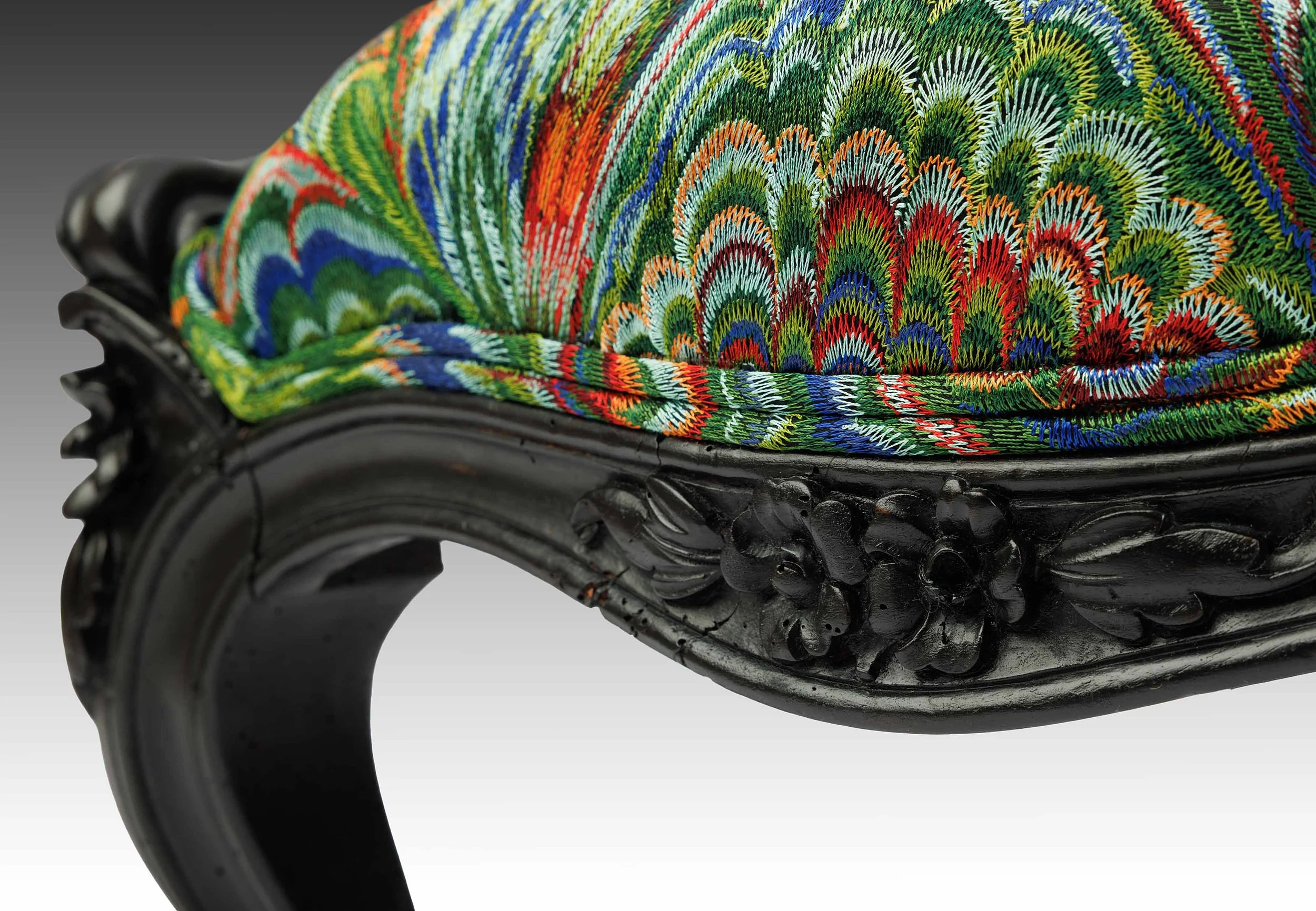
The structure did not require correction. The intervention remained at the level of the surface.
Objects fall out of recognition before they fall out of value. It is continuity that breaks, and this chair had entered that interval, its upholstery reduced to a uniform tone through extended use, the surface receding as the structure endured.
The surface was reupholstered in Bastian Sfumato, an embroidered textile from Pierre Frey, introducing a layer of designer upholstery to the original antique chair. Its pattern is built through thread, creating a softened diffusion of color that reads as a continuous field from a distance and resolves into embroidery at close range.
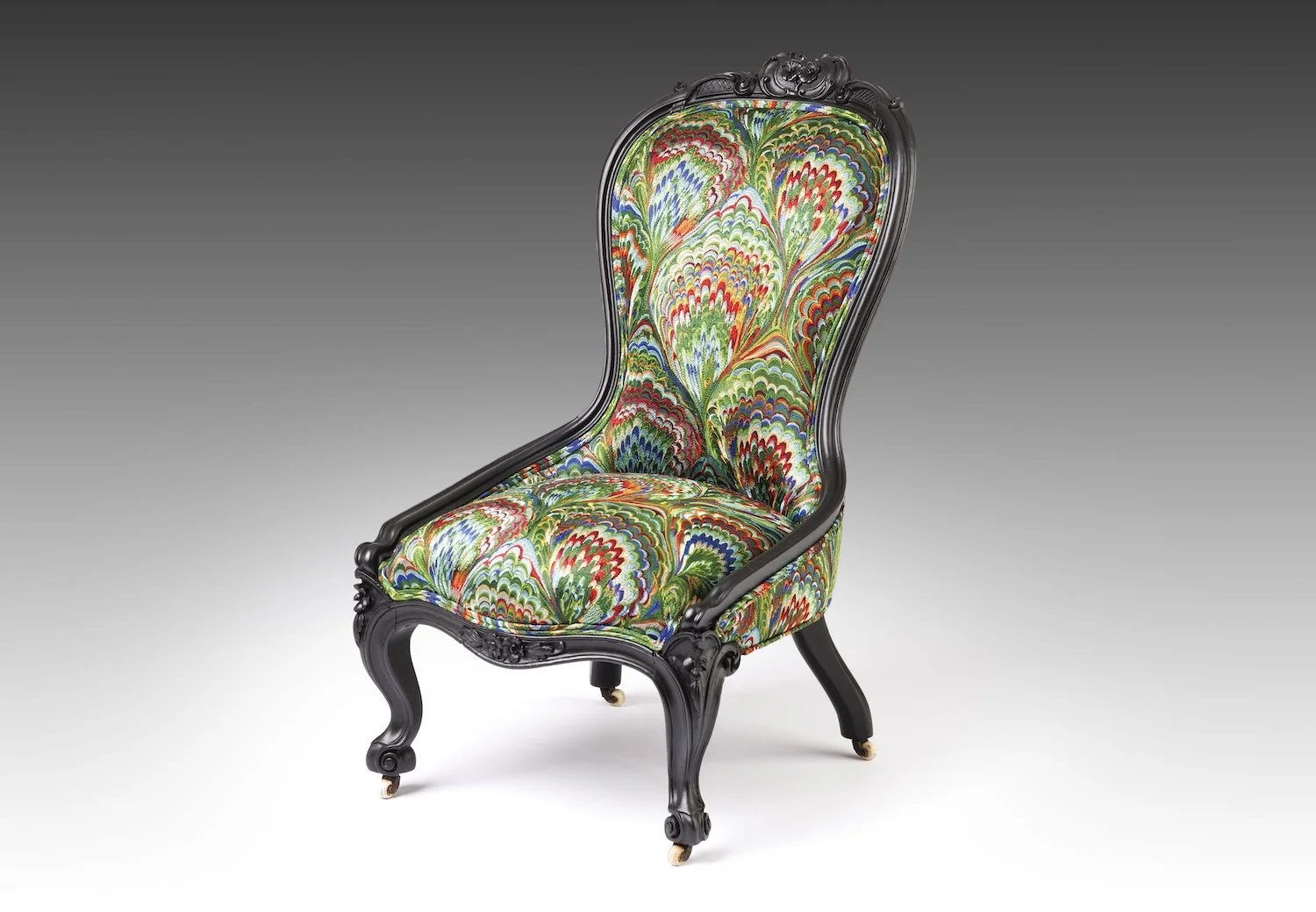
Drawn from 18th-century Venetian marbled paper, color gathers and disperses across the surface, depth built through repetition rather than contrast. The pattern does not settle into a fixed image, but continues across the chair as a carried surface rather than a contained one.
The frame has been darkened, compressing the outline into a defined boundary. The embroidery expands against it.
Nothing here has been transformed. The chair has been reintroduced into circulation following a period of disuse. The form is familiar; its condition and material treatment distinguish it as a restored antique slipper chair.
Curated and presented by Acanthus Home.
